Human Rights in Chechnya
|
Reports selected and
ordered by time of appearance
|
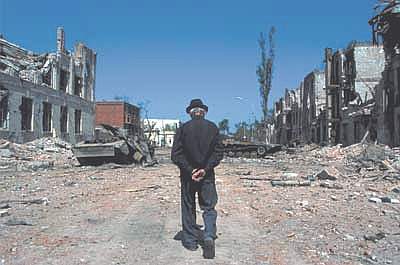
(Photo by Laurent Van der Stockt)
|
From the Conflict
Zone
Bulletins of human rights center “MEMORIAL” March 2006 April 2005 January 2005 December 2004 November 2004 October 2004 September 2004 August 2004 July 2004 June 2004 May 2004 April 2004 March 2004 February 2004 January 2004 December 2003 November 2003 October 2003 |
Other Reports
|
12 May 2006 |
Unofficial Places of Detention in the Chechen Republic |
International Helsinki Federation |
|
March 2006 |
The Chechen Republic: Consequences of “Chechenization” of the conflict |
Memorial |
|
21 December 2005 |
Human rights violations in the Chechen Republic: the Committee of Ministers’ responsibility vis-à-vis the Assembly’s concerns |
Parliamentary Assembly Council of Europe |
| 25 November 2005 | Chechnya Parliamentary Elections in a Climate of Fear | International Federation for Human Rights |
| September 2005 |
A Conveyer of Violence - Human rights violations during anti-terrorist operations in the Republic of Ingushetia |
Memorial |
|
1 July 2005 |
Russian Federation: Violations continue, no justice in sight. A briefing paper on human rights violations in the context of the armed conflict in the Chechen Republic |
Amnesty Interantional |
| May 19, 2005 |
Impunity: A Leading Force behind Continued Massive Violations in Chechnya |
International Helsinki Federation |
|
March 30, 2005 |
Chechnya: More of the Same Extrajudicial Killings, Enforced 'Disappearances', Illegal Arrests, Torture |
International Helsinki Federation |
March 2005 |
Worse Than a War “Disappearances” in Chechnya - a Crime Against Humanity |
Human Rights Watch |
March 17, 2005 |
Chechnya 2004: “New” Methods of Anti-Terror. Hostage taking and repressive actions against relatives of alleged combatants and terrorists |
Memorial |
September 17-20, 2004 |
Parliamentary Assembly Council of Europe |
|
| September 16, 2004 |
Chechnya's suicide Bombers: Desperate, Devout, or Deceived? |
American Committee for Peace in Chechnya |
August, 2004 |
The Trauma of ongoing War in Chechnya |
Doctors without Borders |
|
August 4, 2004
|
International
Helsinki Federation |
|
|
June 25, 2004
|
Amnesty Interantional
|
|
|
February 25, 2004
|
U.S. Department of State
|
|
|
October 2003
|
Amnesty Interantional
|
|
|
September 2003
|
Human Rights Watch
|
|
|
Updated on May 2003
|
Memorial
|
|
|
April 7, 2003
|
Human Rights Watch
|
|
|
March 13, 2003
|
Parliamentary Assembly
Council of Europe |
|
|
February 2003
|
United Nations High Commissioner for Refugees
|
|
|
January 2003
|
Human Rights Watch
|
|
|
January 2003
|
Caucasus Foundation
|
|
|
2003
|
Amnesty International
|
|
|
May 2002
|
Caucasus Foundation
|
|
|
April 2002
|
Human Rights Watch
|
|
|
March 2002
|
International Federation for Human Rights
|
|
|
March 18, 2002
|
Human Rights Watch
|
|
|
February 2002
|
Human Rights Watch
|
|
|
January 2002
|
Doctors without Borders
|
|
|
May 2001
|
Human Rights Watch
|
|
|
March 2001
|
Human Rights Watch
|
|
|
February 9, 2001
|
Human Rights Watch
|
|
|
January 23, 2001
|
Physicians for Human Rights
|
|
|
October 2000
|
Human Rights Watch
|
|
|
December 1999
|
Amnesty International
|
|
|
18 November
1999
|
Society for Threatened Peoples
|
|
|
1997
|
Memorial
|
|
|
1995
|
Memorial
|
|
Update of events
|
BBC, Human Rights Watch, press releases.
|
|
|
Past events
|
Various sources
|
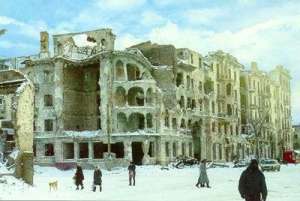
Unofficial Places of Detention in the Chechen Republic
Background Information Memorandum to Dick Marty,
rapporteur of the Committee on Legal Affairs and Human Rights of the
Parliamentary Assembly of the Council of Europe on alleged secret detention
centres in Council of Europe member states
International Helsinki Federation for Human Rights (IHF)
12 May 2006
Executive Summary
At the beginning of the second Chechen war, numerous unofficial places of
detention existed throughout Chechnya, many of them in the form of earth pits.
The biggest such facility was located on the territory of the headquarters of
the federal army in Khankala, close to Grozny. The existence of these unofficial
places of detention was denied at the time. Later, in February 2001, a large
mass grave was found close to Khankala, containing more than fifty dead bodies,
many bearing signs of execution. Most of the bodies that were identified
belonged to persons who were last seen in the custody of Russian troops or
police.
Now, in the seventh year of the armed conflict, many illegal places of detention
still exist in the Chechen Republic. Most of them are run by forces operating
under Chechen Prime Minister Ramzan Kadyrov (so-called "Kadyrovtsy"). One reason
for this parallel penitentiary system is to obtain "confessions" and "testimonies"
through cruel beatings and torture, which subsequently can lead to the official
detention and persecution of the respective persons. A high number of such
criminal cases are fabricated.
Continues....
The Chechen Republic: Consequences
of “Chechenization” of the conflict
A
report by the Human Rights Center Memorial
(September 2005)
Read
the complete report
Introduction
A detailed analysis of the situation
described in the report by the Human Rights Center “Memorial”, Center “Demos’,
International Federation for Human Rights (FIDH), Norwegian Helsinki Committee
«In a Climate of Fear. “Political Process” and Parliamentary Elections in
Chechnya»
According to the representatives of Russian authorities, the armed conflict in
the Chechen Republic is over, the process of political regulation of the
conflict is finished, and the republic has been returned into the legal space of
Russian Federation.
In reality, however, behind the façade of “regulation” the armed conflict
continues, although its forms have changed. Gross mass violations of human
rights continue; these violations are carried out by both sides of the conflict
– the armed groups of separatist fighters, and, primarily, by the forces under
control of the Russian Federation’s federal center. Over the past few years, the
conflict has been “chechenized” – new power structures have been formed, manned
by local residents, ethnic Chechens. These structures now have the considerable
authority to carry out illegal violence.
Any real political process is impossible under the conditions of continuing
state terror. The result is that the Chechen Republic has no political power
elected by the population, no power that would be considered legitimate at least
by a considerable portion of the population.
Due to the “chechenization” of the conflict, over the last three years the
methods and tactics of the power structures have also changed on the territory
of the Republic.
Over the years 2003-2005, new power structures made up of ethnic Chechens
continued to be formed. Apart from police forces, specialized groups are created
for the purpose of fighting the armed separatists. It is to these groups that
the “right” to carry out illegal violence is delegated.
The people that the members of these structures get their hands on “disappear”
for the rest of the world. They are kept in illegal prisons and are not
registered as detained or arrested; they are tortured and thus forced to sign
“confessions”, later used to manufacture criminal cases. About half of the
kidnapped individuals later disappear without a trace.
At the beginning of the year 2004 a new method is used to force the armed rebels
to surrender – their family members are taken hostage or threatened with death.
The number of “cleaning measures” (“zachistka”, when governmental forces raid an
area and eliminate or detain all those suspected of supporting the armed rebel
fighters) decreased abruptly at the beginning of 2003. However, in August of
2004 it increased again, although it never reached the old level. In 2004 the
brutality and mass character of all “cleanings” also decreased. However, the
brutality of some of the “cleanings” in 2005 can be compared to those of the
first years of the war, and the events in the village of Borozdinovskaya can
serve as an example of that.
The problem of “disappearances” of people in Chechnya is still very urgent and
serious. In most cases, the “disappeared” individuals have been kidnapped by the
members of Russian Federation’s armed forces. The human rights activists do note
a certain decrease in the number of registered kidnappings; however, this
decrease is not as significant as stated by the official representatives of the
government. This “decrease” can be connected in part to the reign of “latent
violence” in Chechnya; this violence is registered neither by human rights
organizations nor by law enforcement agencies.
Investigation of crimes against the peaceful civilian population in the conflict
zone is dominated by selective impunity.
The criminal cases against separatist fighters are investigated and heavy
sentences are passed regardless to the gravity of the crime. However, things are
very different in cases of crimes committed by representatives of federal or
pro-federal forces. The official statistics are falsified. In most cases where
the participation of representatives of these departments is suspected, the
investigation is stopped “as it is impossible to find the persons to be
persecuted”. Only an insignificant minority of cases is brought to court. The
overwhelming majority of defendants receive symbolic punishment for serious
crimes.
Often the separatist fighters purposely attack civilians or unarmed
representatives of state authorities. Some of the groups opposing the federal
power use obviously terrorist methods. After the murder of A. Maskhadov, the
influence of terrorists and Muslim fundamentalists has increased among the
forces opposing the Russian Federation’s power in Chechnya.
[Continues....]
Human rights violations in the Chechen
Republic:
the Committee of Ministers’ responsibility vis-à-vis the Assembly’s concerns
A report by the Parliamentary Assembly of the
Councli of Europe (PACE) (Doc.
10774)
Read
the complete report
Report Committee on Legal Affairs and Human
Rights Rapporteur: Mr Rudolf Bindig, Germany, Socialist Group
Summary
The Committee on Legal Affairs and Human Rights is deeply concerned that
a fair number of governments, member states and the Committee of Ministers have
failed to address the ongoing serious human rights violations in the Chechen
Republic in a regular, serious and intensive manner – despite the fact that such
violations still occur on a massive scale in a climate of impunity in the
Chechen Republic and, in some cases, in neighbouring regions.
The Committee urges the Committee of Ministers to confront its responsibilities
in the face of one of the most serious human rights issues in any of the Council
of Europe’s member states. It should relaunch its monitoring of the human rights
situation in the Chechen Republic – which has been at a standstill since spring
2004 – and discuss the consequences of Russia’s insufficient co-operation with
the Committee for the Prevention of Torture as well as take “specific action” on
the 1994 Declaration on compliance with commitments, as requested by the
Assembly in 2003. Otherwise, the committee warns, the lack of effective reaction
by the Council’s executive body could seriously threaten the credibility of the
whole Organisation.
[Continues....]
Chechnya Parliamentary
Elections in a Climate of Fear
A
report by the International Federation for
Human Rights (25 November 2005)
Read
the complete report
Introduction
The International Federation for Human Rights (FIDH), the Human Rights Center
‘Memorial’, The International Helsinki Federation for Human Rights (IHF), The
Norwegian Helsinki Committee and the Center "Demos" are today publishing the
report “In a Climate of Fear: the ‘Political Process’ and the Parliamentary
Elections in the Chechen Republic.”
The report refutes claims of the Russian government that the situation in the
Chechen Republic has stabilized and returned to peaceful life. There is no
authentic conflict resolution. Instead, the policy of the Russian government
only intensifies the “Chechen deadlock”. The process leading up to and including
parliamentary elections, which will take place in Chechnya on November 27, 2005,
represents a cynical and dangerous game, which has contributed to the
establishment of a climate of fear.
The first section of the report, “The Essence of the Political Process in
Chechnya”, gives an analysis of the dynamics of the “political process in the
Chechen Republic” from the Referendum of 2003 to the parliamentary elections of
2005, including the present situation of media and the campaign. The second
section, “In a Climate of Fear”, covers activities of the Chechen fighters, as
well as activities of federal and local pro-Moscow security agencies such as
hostage taking and vendetta through abuse of official power, torture, the
fabrication of criminal cases, and abductions.
A Conveyer of Violence -
Human rights violations during anti-terrorist operations in the Republic of
Ingushetia:
A Leading
Force behind Continued Massive Violations in Chechnya
A
report by the Human Rights Center Memorial
(September 2005)
Read
the complete report
Introduction
Abductions continued in the fall of 2005 in Ingushetia; relatives of the
abductees turned to human rights center Memorial in Nazran. The majority of the
abducted were found find by lawyers within a few days in provisional detention
facilities in North Osetia or Ingushetia. Those who had "disappeared" and were
subsequently “found" in temporary detention centers had, as a rule, already
managed to confess to committing terrorism-related crimes. One person died from
his injuries received in detainment. Two abductees disappeared without a trace.
In 2005, judicial decisions on indictments in terrorist activities were made for
several cases which Memorial had been tracking since 2004. Evidence of the guilt
of the accused comprised, on the whole, their own confessions regarding their
criminal acts, which were made during preliminary investigations. According to
the testimony of lawyers and the statements of relatives, these people had been
cruelly tortured. In addition, Memorial received six statements from the
detention locations--from the accused themselves--wherein it was described in
detail how the young people were subjected to torture and humiliation until they
signed "voluntary confessions".
"Who will I become? How will I live in this country if you sentence me, without
evidence of my guilt, to such a long prison term for crimes I did not commit?"
asked 27-year-old Magomed Khamkhoev in his closing statement in court. Khamkhoev
was sentenced to 10 years--in the opinion of his lawyer Umar Khayauri, chairman
of the 21st Century board of lawyers in the Republic of Ingushetia, Khamkhoev
was sentenced despite the complete absence of an evidentiary basis for his
having committed the crime.
The evidence collected in this report compels us to demand an examination of the
activities of law-enforcement agencies and the provisional detention facilities
in Ingushetia and Northern Osetia. It is clear that a conveyer of violence has
been installed in the North Caucasus which comprises law-enforcement agencies,
the special forces, the inoperative office of the public prosecutor, the courts
which are incapable of revealing falsification, and even some lawyers. Innocent
people are inevitably lost to the machine while the real criminals go unpunished.
Memorial warns that the existing system is incapable of effectively fighting
terrorism and will, on the contrary, beget the most monstrous forms of terror.
Memorial does not call into question the necessity of the fight against terror.
However, this fight must be conducted in accordance with the legislation of the
Russian Federation and the international obligations of the Russian Federation
to observe human rights.
[Continues...]
Russian Federation:
Violations continue, no justice in sight.
A briefing paper on human rights violations in the context of the armed
conflict in the Chechen Republic
A report by Amnesty
International (1 July 2005)
Read the complete report
Introduction
The second armed conflict in the Chechen Republic since the break-up of the
Soviet Union has continued for nearly six years. In spite of repeated claims
from Russian and Chechen officials that the situation is 'normalizing', there
seems to be no end in sight either to the conflict itself or to the accompanying
human rights abuses. Clashes between Russian and Chechen security forces and
armed opposition groups continue. Such clashes are most frequent in the southern
regions of the republic, but also periodically take place in other areas,
including the capital, Grozny. The regular aerial and artillery attacks by
federal forces which took place in earlier phases of the conflict are now mostly
confined to the southern regions of the republic. However, Russian and Chechen
security forces are conducting targeted raids in towns and villages across
Chechnya, during which serious human rights violations, in particular, "disappearances"
are common. Extrajudicial killings, and torture, including rape, and
ill-treatment are also reported to take place on a regular basis. Such
violations are in breach of the obligations of the Russian Federation under
international human rights and humanitarian law to protect the right to life,
dignity and security of the person and not to be subjected to torture or other
forms of ill-treatment.
[Continues....]
Impunity: A Leading
Force behind Continued Massive Violations in Chechnya
A
report by the International
Helsinki Federation (May 19, 2005)
Read
the complete report (in .doc format)
Introduction
The most effective preventive measure against severe human rights abuses is to
have all such cases effectively investigated and the perpetrators duly punished
in accordance with the law, regardless of their rank and position. For Chechnya,
such deterrence would be central as a precondition for both reconciliation and a
lasting political settlement.
The reality in the Chechen Republic is the opposite. A systematic look at the
situation reveals an overarching climate of impunity. It shows that Chechen and
Federal law enforcement authorities remain either unwilling or unable to hold
accountable for their actions the vast majority of perpetrators of serious human
rights violations, particularly when the perpetrators are members of Federal
forces (military servicemen, FSB personnel, Ministry of Interior staff) or of
the pro-Moscow Chechen authorities, or armed groups controlled by these
authorities. People in Chechnya describe the situation as "worse than a war",
referring to the atmosphere of arbitrariness, intimidation, and vulnerability to
the ongoing abuses that prevail in the republic. Even in the most
well-documented and transparent cases there is, as a rule, no progress in
holding responsible the perpetrators. The lack of accountability perpetuates the
conflict and contributes to further abuses.
[Continues - in .doc
format]
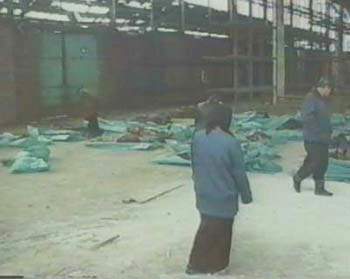
Exhumed bodies from mass graves in Chechenya
Chechnya: More of the Same Extrajudicial Killings, Enforced 'Disappearances', Illegal Arrests, Torture
A report by the International Helsinki Federation (March 30, 2005)
Read the complete report
Introduction
The second Chechen war began over 5 years ago. How does the republic mark this sad date? How do people live and survive in a strange situation of "no peace, no war", under the rule of no law? There are a few signs of peaceful life. Compensations for lost housing are slowly beginning to be paid (on rare occasions, even without kick-back to relevant officials), separate islands of reconstruction are appearing in Grozny, and many cars are visible on the streets. The central open-air market is ever so busy.
But some other things have not changed at all: Abductions and illegal detentions of civilians by unknown armed persons dressed in camouflage are still pervasive. The only difference is that these people now do not arrive exclusively in military vehicles, but in regular cars as well. As a result, murders, torture and beatings have remained unchanged. And the prosecutor's office is still either unwilling or unable to provide effective investigation into those endless cases.
People are afraid. The work of human rights defenders and journalists is further complicated by the civilians' reluctance to communicate with them: "You cannot change anything, you cannot defend us. And we still need to survive here." It is hard to argue with this logic.
It has become regular practice to illegally detain and abduct relatives of armed insurgents. Human rights defenders are trying to draw attention to this problem, but so far they have been unsuccessful. Authorities not only refuse to react to this lawlessness - they are actually trying to make it appear normal. On 29 October 2004, in his address to the Russian State Duma, Prosecutor General of the Russian Federation V.F. Ustinov officially suggested to legalize "counter-taking of hostages" as a method in the fight against terrorism.
Another trait of today's Chechnya is the increasing "Chechenization" of the conflict with various local armed formations being engaged in the "fight against terrorism" along with the multi-thousand Russian forces. These are not only "Kadyrovtsi"[1] and "Yamadaevtsi"[2] , but also "Baysarovtsi"[3] , "Kakievtsi"[4], etc. Often it is impossible to understand who exactly conducted an operation of detention or abduction. These groups are autonomous (or semi-autonomous), and many of them have their own illegal places of detention, to which the prosecutor's office, of course, has no access. People look for their missing relatives through arranged "black connections". Hence, a time of "legal bandit formations" has come in Chechnya.
What authorities do they work with, are they coordinated among themselves, does their existence promote security in the republic? During a trip to Chechnya in September 2004, an IHF team managed to meet several members of Baysarov's formation located around the 15th milk farm of the Grozny Rural district of Chechnya. Here are excerpts from that conversation:
- Yes. Ramzan visited Movladi after the death of Akhmad-Khadji Kadyrov and told him to dissolve this unit, to send everyone home. He said: 'After the death of the President you are not part of the presidential Security Service anymore. I don't need your bandits round here.' But Movladi refused to let us go. He said it was out of the question. He told Raman that we would not budge because we killed many Vakhabits and they will be after us. So, if we return to the villages we'll be killed, one by one. They argued for a long time. And then Ramzan came out to us and said: 'It's OK, boys. Movladi and I have sorted everything out. You just stay where you are and wait. There will be some changes in the enforcement structures and I'll make sure to find a good place for you.' But he has not done this so far. We don't have any official cover yet. And we need it.
- In this case, what power structure do you belong to now?
- We work in close cooperation with our FSB, but we are not officially employed anywhere. Only two persons from our group are listed among the employees of Chechnya's power structures. Length of experience does not matter here. If someone is wounded, he receives no social assistance. If our fighter is killed, his family gets nothing. And our boys die often… We had situations when a fighter went to his home village to see his family and was murdered there by the Vakhabits. Are people afraid of you? (smiling) - It is more like they use us to scare each other. Once I heard a young man tell another during an argument: "I am from the Baysarov group, we will show you!" I knew that he had no connection to the Baysarov group, and so I asked him why he says such things. And he answered: "Everyone says that you are terrible people."
- When your cars are stopped at check-points, what documents do you show? - No one has dared to stop us so far.
But it is certainly the "Kadyrovtsy," i.e. members of the so-called Security Service of the President of the Chechen Republic headed by the Chechen Vice-Premier Ramzan Kadyrov, son of the late President Akhmad Kadyrov, that are feared the most by Chechnya's civilian population. The recent missions of the IHF researchers to the region clearly demonstrated that as far as Chechen civilians are concerned, today "Kadyrovtsi" are more dangerous to them than federal servicemen. It is worth noting that while some victims and their relatives are willing to elaborated on the violation of their rights by federal servicemen, they are far more reluctant to talk about the crimes of "Kadyrovtsi," lowering their voice to a whisper and trying to avoid any concrete facts. In fact, when the Human Rights Center "Memorial" reports that the number of disappearances decreased by 17% in 2004 if compared to the previous year, the IHF researchers are convinced that one of the possible explanations behind this is that now a great portion of human abductions is perpetrated by "Kadyrovtsy" and in those cases relatives of the victims are afraid to complain due to possible repercussions against themselves or other members of their families.
As far back as on 27 August 2004, the Acting Minister of Internal Affairs, Ruslan Alkhanov, issued an order forbidding representatives of security power structures to carry out special operations on the territory of Chechnya while masked. Speaking on local television, Ruslan Alkhanov said: "From now on, representatives of any power structures who wear masks on the territory of Chechnya will be regarded as criminal elements, and will be subjected to lethal fire. This order has been made clear to all sub-divisions of MIA and other power structures of the republic." [4]
But, as seen in examples below, people in masks are continuing to "watch the order" in the republic, without any fear of punishment. These cases were documented in the course of field missions during the period of November 2004 to January 2005. They are only a part of a bigger and most disturbing picture, a vivid illustration to the pattern of never-ending violation of human rights and humanitarian law in the Chechen Republic, to which the international community fails to provide an adequate response.
--------------------------------------------------------------
[1] Members of the Security Service of the President of the Chechen Republic, headed by Ramzan Kadyrov.
[2] Members of the armed battalion "Vostok", headed by Sulim Yamadaev.
[3] Members of the armed formation, headed by Movladi Baisarov, formerly part of the Security Service of the President of the Chechen Republic.
[4] Members of the armed battalion "Zapad", headed by Said-Magomed Kakiev.
[5] See under http://kavkaz.strana.ru/news/224670.html
Worse Than a War “Disappearances” in Chechnya - a Crime Against Humanity
A Human Rights Watch Briefing Paper
A report by Human Rights Watch (March 2005)
Read the complete report
Executive Summary
Enforced disappearances in Chechnya are so widespread and systematic that they constitute crimes against humanity. Human Rights Watch urges the United Nations Commission on Human Rights to take urgent measures commensurate with the extreme gravity of the phenomenon. It should adopt a resolution condemning enforced disappearances in Chechnya, urging the Russian government to immediately adopt measures to stop the practice and requiring the government to issue an urgent invitation to the Working Group on Enforced and Involuntary Disappearances.
The conflict in Chechnya, now in its sixth year, is a dire human rights crisis. The Russian government has gone to great lengths to persuade the international community that the situation is steadily “normalizing,” even as in the past year the conflict has shown no sign of abating. Rather, it has increasingly spread to other areas of the Northern Caucasus. Russia contends that its operations in Chechnya are its contribution to the global campaign against terrorism. But the human rights violations Russian forces have committed there, reinforced by the climate of impunity the government has created, have not only brought untold suffering to hundreds of thousands of civilians but also undermined the goal of fighting terrorism.
Chechen fighters have committed unspeakable acts of terrorism in Chechnya and other parts of Russia. Russia’s federal forces, together with pro-Moscow Chechen forces, have also committed numerous crimes against civilians, including extrajudicial executions, torture, arbitrary detention and looting.
But it is their involvement in enforced disappearances that is an enduring feature of the six-year conflict. With between 3,000 and 5,000 “disappeared” since 1999, Russia has the inglorious distinction of being a world leader in enforced disappearances.1 This briefing paper argues that the pattern of enforced disappearances in Chechnya has reached the level of a crime against humanity. It shows that, as part of Russia’s policy of “Chechenization” of the conflict, pro-Moscow Chechen forces have begun to play an increasingly active role in the conflict, gradually replacing federal troops as the main perpetrators of “disappearances” and other human rights violations.2 It reflects forty-three cases of enforced disappearances that occurred in 2004, which Human Rights Watch documented during a two-week research trip to Chechnya in January-February 2005.3 Human Rights Watch has submitted thirty-six of these cases to the Russian government, requesting that it disclose information on the
whereabouts or fate of the “disappeared” individuals and hold the perpetrators responsible.4 We have also submitted the cases to the U.N. Working Group on Enforced and Involuntary Disappearances, asking that they raise these cases with the Russian government. These cases are appended to this briefing paper.
--------------------------------------------------------------------------------
[1] Estimate by the Memorial human rights center, “Chechnya, 2004: Abductions and ‘Disappearances’ of People,” February 7, 2005 [online], http://www.memo.ru/hr/hotpoints/caucas1/index.htm (retrieved February 25, 2005).
[2] Most of these forces are led by Vice Prime Minister of Chechnya Ramzan Kadyrov, who is responsible for the republic’s law enforcement structures.
[3] In the course of its research, Human Rights Watch conducted more than sixty interviews with witnesses and victims of abuses in Grozny, Gudermes, Urus-Martan, Argun, Samashki, Sernovodsk, Starye Atagi and many other towns and villages in Chechnya
[4] In the remaining cases, witnesses asked Human Rights Watch not to release any information, since the families are still trying to find their “disappeared” relatives though private channels. In addition to the forty-three cases that occurred in Chechnya in 2004, Human Rights Watch documented one “disappearance” that occurred in December 2003, and two 2004 “disappearances” that took place in Ingushetia. These are not included in the appendix.
Chechnya 2004: “New” Methods of Anti-Terror. Hostage taking and repressive actions against relatives of alleged combatants and terroristshe human rights situation in the Chechen Republic
A report by the Memorial
Read the complete report
FROM THE CONFLICT ZONE
BULLETIN OF HUMAN RIGHTS CENTER “MEMORIAL”
For the Chechen Republic the year 2004 was of special significance for a number of reasons. Firstly, the war spilled over its borders and spread to the neighboring republics, primarily to Ingushetia, Dagestan, North Ossetia and Kabardino-Balkariya. Secondly, it was a year of qualitative change in the methods of the anti-terrorist operation. On the one hand, the process of "Chechenization" has come to its logical completion. On the other hand, in conjunction, with support and under the auspices of the Federal Center, previously individual cases of hostage-taking, destruction of property and other forms of repressive actions against family members of alleged combatants have become systematic.
If previously repressive actions against family members of alleged combatants were either instances of revenge, or attempts to extort information about the fighters from their relatives, now these methods have become a tactic used to exert pressure upon combatants in order to force them to surrender. Thus, the methods of the state, which for over five years now has justified its actions in the Chechen Republic by the necessity to combat terrorism, have finally concurred with the methods of terrorists.
The ensuing thematic bulletin of HRC “Memorial” aims to systematize and analyze available data on these forms of human rights abuse. [Continues...]
The human rights situation in the Chechen Republic
A report by the Parliamentary Assembly of the Councli of Europe (PACE) (Doc. 10283, 20 September 2004)
Read the complete report
Report Committee on Legal Affairs and Human Rights
Rapporteur: Mr Rudolf Bindig, Germany, Socialist Group
Summary
The human rights situation in the ChechenRepublic remains catastrophic. The report strongly condemns human rights violations committed by all sides of the conflict, including the recent spate of despicable terrorist attacks against civilian targets, other killings committed by illegal armed formations and the numerous violations of human rights in the form of murder, forced disappearances, torture, hostage-taking, rape and arbitrary detention committed by members of different Federal and regional security forces during their “special” or “targeted” operations in the Chechen Republic and, increasingly, in neighbouring regions. The report concludes that a climate of impunity is still prevailing in the ChechenRepublic due to the fact that the Chechen and Federal law enforcement authorities remain either unwilling or unable to hold accountable for their actions the vast majority of perpetrators of serious human rights violations. The draft resolution and recommendation make concrete
proposals to help solve the human rights crisis and urge in particular
* the Government of the Russian Federation to end the climate of impunity in the ChechenRepublic;
* the Russian State Duma to set up a Committee of enquiry to investigate the alleged abuses by different branches of the executive, in particular the different law enforcement bodies in the ChechenRepublic and in neighbouring regions;
* the Council of Europe’s member states to use every opportunity, in their bilateral and multilateral relations with the Russian Federation, to recall the need to respect human rights also in the fight against terrorism and separatism;
* the Committee of Ministers to ensure that the discussion and debate of the human rights crisis in the North Caucasus region of the Russian Federation remains a regular item on the agenda of the Committee of Ministers and Ministers’ Deputies, to ensure that such discussions cover reports and the follow-up of the implementation of recommendations made to the authorities by all bodies and mechanisms of the Council of Europe and to urge the Government of the Russian Federation to put an end to reprisals taken against any person in relation to the filing of an application to the European Court of Human Rights.
The humanitarian situation of the Chechen displaced population
A report by the Parliamentary Assembly of the Councli of Europe (PACE) (Doc. 10282, 20 September 2004)
Read the complete report
Report Committee on Migration, Refugees and Population
Rapporteur: Mr Tadeusz Iwinski, Poland, Socialist Group
Summary
The aim of this report, based on the findings of the visit to the North Caucasus as well as on the information provided by the international and local organisations involved in the humanitarian action in the region, is to examine the situation of Chechen internally displaced persons (IDPs) and refugees in Chechnya, in other parts of the Russian Federation and in other countries.
According to the Rapporteur, the security and humanitarian situation in the ChechenRepublic remains unsatisfactory. On the other hand, the situation of the Chechen displaced persons in Ingushetia has slightly improved. The Rapporteur welcomes the efforts of the Ingush authorities aimed at the normalisation of living conditions of the displaced population.
The Rapporteur raises the question of insufficient legislative mechanisms and related assistance which would facilitate the settlement of Chechen IDPs in other parts of the Russian Federation. Moreover, the vestiges of propiska (residence permit) seriously hamper the principles of freedom of movement and liberty to choose one’s place of residence within the country.
The political situation in the Chechen Republic: measures to increase democratic stability in accordance with Council of Europe standards
A report by the Parliamentary Assembly of the Councli of Europe (PACE) (Doc. 10276 17 September 2004)
Read the complete report
Report Political Affairs Committee Rapporteur: Mr Andreas Gross, Switzerland, Social Group
Summary
The situation in the Chechen Republic is of great concern to the common values which all member states of the Council of Europe have committed themselves to and thus requires close attention by the authorities of the Russian Federation as well as assistance by the relevant Council of Europe bodies. The absence of the rule of law in Chechnya prevents the development of a humane and democratic society. Democratic institutions will remain hollow and fragile where people live in fear and poverty, organised crime and warlords fighting for quick profits and daily terror costing the lives of many. The Parliamentary Assembly strongly condemns the gross violence which persists in Chechnya and has sadly become the most significant formative factor for a whole generation of people in Chechnya, as well as the spill over of terrorist action towards other federal entities of the Russian Federation neighbouring the Chechen Republic, in particular the most recent tragic hostage-taking at the school
in Beslan (North Ossetia). The Assembly is concerned that the recent wave of terrorist attacks will lead to a further escalation of violence and a deterioration of the human rights situation in the North Caucasus region. There is no alternative to dialogue and negotiation for those who really want to reach peace and reconciliation. This must be possible with those who are ready to renounce the use of violence and weapons.
Chechnya's Suicide Bombers: Desperate, Devout, or Deceived?
A reprot by the American Committee for Peace in Chechnya (September 16, 2004)
Read the complete report
Executive Summary
Now in its fifth year, the second Russo-Chechen War has deteriorated into a protracted stalemate where death and despair are the only clear victors. In Chechnya, the conflict has created a cultural and demographic crisis rivaling the tragedies witnessed in Bosnia and Kosovo. Years of war and social upheaval have left the people of Chechnya with nothing but misery. Throughout the second Chechen war, Russian Forces have radicalized the resistance and humiliated the populace by committing widespread human rights abuses against civilians. These actions, combined with the Kremlin’s unwillingness to negotiate with moderate members of the resistance, have continued the Chechen conflict and correspondingly engendered extremist tactics such as suicide terrorism.
Chechen suicide terrorism is an important topic of inquiry for several reasons:
Chechen suicide terrorism is a strategic tactic. Engaged in an increasingly asymmetrical struggle with the Russians, radical factions within Chechnya are seeking any means available to achieve their goals. As this report indicates, these elements have used suicide terrorism as a way to attract support while attempting to coerce Russia into leaving the Chechnya. As such, the implementers of Chechen suicide terrorism are analytically distinguishable from the vast majority of those who actually carry out suicide attacks.
An examination of the psychology, motives, and demographics of individual suicide bombers provides helpful insights into Chechnya’s war-torn society. In particular, the war in Chechnya has profoundly changed the role of women in Chechnya, and due in large part to this fact, females comprise a shocking majority of Chechen suicide bombers.
Understanding the motives and circumstances of Chechen suicide terrorism naturally leads to certain conclusions about Russia’s presence in the region. For example, Russia’s brutal prosecution of the war in Chechnya, combined with its unwillingness to negotiate with moderate forces in the Chechen resistance, has spawned and exacerbated suicide terrorism in Chechnya.
Suicide terrorism is one of the least understood aspects of the second Russo-Chechen war. The most common explanations of Chechen suicide terrorism are either too restricted in their scope or too removed in their perspective. In an effort to provide reliable information, dispel certain myths, and offer much-needed context, the American Committee for Peace in Chechnya (ACPC) has prepared this study. A number of studies have examined the worldwide proliferation of suicide terrorism on the macro level, but there have been no comprehensive attempts to investigate the specific phenomenon of Chechen suicide bombings. Taking into account individual case profiles, scholarly studies, and empirical analysis, this report seeks to fill that gap.
There are two main competing theories that attempt to explain why Chechen suicide bombings occur. Focusing upon selected suicide attacks, some observers claim that all Chechen suicide bombings are orchestrated by deranged religious extremists, who blackmail, drug, and coerce young women into committing heinous acts. While still others make the blanket claim that all Chechen suicide bombers carry out attacks autonomously, and are self-actuated by despair alone. This report seeks to dispel both of these myths by showing that there is no axiomatic explanation for Chechen suicide terrorism. The situation is more complex. Since 2000, there have been 23 Chechen related suicide attacks in the Russian Federation, and the profiles of the suicide bombers have varied just as much as the circumstances surrounding the bombings.
However, all this is not to say that certain instructive patterns are not apparent in the phenomenon of Chechen suicide terrorism. The lowest common denominator shared by all Chechen suicide bombers is the despair and hopelessness spawned by the horrific conditions of the Russo-Chechen war. Most Chechen suicide bombers have lost loved ones in Russian ‘counter-terrorist’ operations or in fighting against Russian forces. Some cases documented in this report indicate that a few of Chechnya’s suicide bombers were recruited by manipulative orchestrators using radical Islamist rhetoric, but even in those instances, unbearable grief and hopeless despair have made the potential bombers (especially women) vulnerable to the advances of suicide terrorism recruiters.
Thus, while there can be no excuse for the abhorrent terrorist tactic of suicide bombing, Russia ultimately bears responsible for creating the underlying conditions that fuel suicide terrorism in Chechnya. Suicide bombings did not begin until the Second-Russo Chechen war, when Russian forces began systematically targeting Chechen civilians in so-called cleansing operations. If Moscow wants eschew another wave of suicide terrorism, then it must take a close look at the human catastrophe it has wrought in Chechnya. Ultimately, the Kremlin must come to understand that ‘counter-terrorism’ strategies, which employ abduction, torture, and lawless killing, only serve to radicalize the resistance and humiliate the population, thereby creating a fertile breeding ground for more terrorists. By marginalizing moderate voices in the Chechen resistance and denying hope to thousands of Chechen civilians, Russia has needlessly prolonged the war, prompting some to resort to radical measures, including suicide terrorism. In the final analysis, the road to peace in Chechnya and the prescription for stopping suicide terrorism are the same: peaceful reconciliation with moderate representatives of the Chechen leadership and an end to senseless violence against civilians.
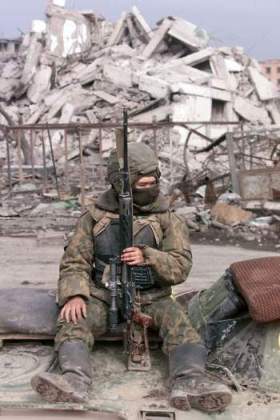
Quantitative assessment of living conditions, and psychosocial and general health status among war displaced in Chechnya and Ingushetia
A report by the Doctors Without Borders (August, 2004)
Read the complete report
This report presents the findings of two quantitative surveys conducted by MSF among the displaced populations in Ingushetia and Chechnya to gain information on living conditions and health status.[...] People interviewed had been displaced for at least five years. We found a population living in unacceptable conditions, traumatized by conflict, and in fear of their safety.
Physical and mental health needs were significant, but access to appropriate services is at best problematic.
The authorities are currently undertaking a policy of moving people, against their will, from Ingushet ia to Chechnya, but conditions in both locations are unacceptable and this will do nothing to improve the plight of this vulnerable population.
The authorities must ensure protection and appropriate living circumstances for this displaced population. This will require greater attention from the international community to this conflict that has been largely ignored for the last decade.
A report by the International Helsinki Federation (August 4, 2004)
Vienna, 4 August 2004.
Today the International Helsinki Federation for Human Rights (IHF) issued three reports about the human rights and humanitarian law situation in Chechnya and Ingushetia, documenting severe human rights violations by Russian and Chechen security forces, which are increasingly spreading across the borders of Chechnya to neighboring Ingushetia.
"Chechnya: Enforced 'Disappearances', Extrajudicial Killings and Unlawful Detentions - An Update" describes seven cases of enforced "disappearances", two cases of torture and extrajudicial killings, one case of extrajudicial killing, one case of killing by torture and six cases of unlawful detentions. In none of the cases were the perpetrators brought to justice so far.
"Ingushetia: Enforced 'Disappearances', Extrajudicial Killings and Unlawful Detentions. December 2003 - June 2004" describes six cases of enforced "disappearances" of Ingush citizens on the territory of Ingushetia, including the 'disappearance' on 11 March 2004 of Rashid Ozdoev, an Ingush Deputy Prosecutor, who was responsible for investigating unlawful activities of security force structures, and who repeatedly made written and oral protests requiring FSB officials in the Ingush Republic to stop violating the law.
"The Situation of IDPs in Ingushetia after the Armed Incursion of 21/22 June 2004" deals with the series of so-called special operations by police and military agencies throughout Ingushetia, following the armed incursion in Ingushetia on 21/22 June 2004, and their effects on the situation of Chechen IDPs in Ingushetia. These operations included ID controls, interrogations, fingerprinting, as well as searches of individual houses. Particularly many of the temporary settlements for Chechen IDPs were targeted. While most of the operations were conducted in a more or less correct manner, some were marred by irregularities, obviously intended to intimidate IDPs in order to pressure them to return to Chechnya. One operation, in Altievo on 23 June 2004 was conducted as a mop-up operation ('zachistka'), involving numerous severe human rights violations. Approximately 2.500 of the 50.000 IDPs who were still present in Ingushetia, left for Chechnya in the three weeks after the armed raid.
For more information: International Helsinki Federation for Human Rights, Henriette Schroeder, Press Officer, Tel. +43-676-725 4829 Moscow Helsinki Group, Tanya Lokshina, Programs Director, Tel. +7-916-624 1906
The reports are available on the IHF website under www.ihf-hr.org (at the moment only in English).
A report by the Amnesty
International (June 23, 2004)
Read the complete report
AI INDEX: EUR 46/027/2004 Russian Federation: Chechen Republic
IntroductionThe second armed conflict in the Chechen Republic since the break-up of the Soviet Union has continued for nearly five years. In spite of repeated claims from Russian and pro-Moscow Chechen officials that the situation is 'normalizing', there seems to be no end in sight either to the conflict itself or to the accompanying human rights abuses. Although the regular aerial and artillery attacks which took place in earlier phases of the conflict are now intermittent, and raids on villages which where large in scale in previous years are now targeted and take place at night, Russian and Chechen security forces continue to carry out human rights violations with impunity. These include extrajudicial killings, "disappearances" and torture, including rape, and ill-treatment; such violations are in breach of the obligations of the Russian Federation under international human rights and humanitarian law to protect the right to life, dignity and security of the person and not to be subjected to
torture or other forms of ill-treatment. In addition, Chechen armed opposition groups target civilian members of the Chechen administration and are suspected of being responsible for a number of bombings, which have caused indiscriminate harm to civilians. Such violations and abuses, many of which constitute war crimes, are overwhelmingly committed with impunity, as very few perpetrators are ever identified and brought to justice. The "normalization" is characterized by the lack of respect for the rule of law and security of the individual.
Human rights abuses which previously occurred almost exclusively in Chechnya are increasingly spreading across the border to neighbouring Ingushetia. While Ingushetia enjoyed the reputation as a safe haven for displaced Chechens during the first years of the war, this is no longer the case. During the first few months of 2004, there appeared to be an increase in the number of "disappearances" and killings in Ingushetia, and affecting Chechen as well as Ingush people.
At the time of writing the last remaining tent camp in Ingushetia for internally displaced persons (IDPs) from the Chechen Republic, Satsita, was about to be closed down in early June. Four others were shut down in the previous six months. IDPs from these camps have been subjected to unacceptable levels of pressure from federal as well as local authorities to return to the Chechen Republic. Many have refused to go back, citing the security situation as their main concern. Others have felt that there was no alternative and have returned to an uncertain future. Now, after the closure of the tent camps, the question is whether the authorities will apply more pressure on the tens of thousands of Chechens who remain in spontaneous settlements or private accommodation in Ingushetia, to go back to Chechnya.
Photo caption: Two boys play in the ruins of the former tent camp for IDPs, Sputnik. © AI
This report is based on the findings of an Amnesty International delegation which travelled to Ingushetia in March/April 2004 as well as ongoing research conducted from Amnesty International's International Secretariat in London. During the field research, Amnesty International delegates interviewed a substantial number of victims of human rights abuses as well as their relatives and also met with lawyers and representatives of local and international organizations working in the region, including the Memorial Human Rights Centre, the Society of Russian-Chechen Friendship, the Danish Refugee Council, the Chechnya Justice Initiative and Niizo. The aim was to gather information about the human rights situation inside the Chechen Republic as well as in Ingushetia.
The delegates visited Ingushetia at a time when the situation in the republic is becoming increasingly tense. While the security situation in the Chechen Republic remains more precarious than in Ingushetia, the rising number of human rights abuses in a republic which, until two years ago, was considered relatively stable, warrants an inclusion of Ingushetia in this report. It is not only a place where Chechen IDPs have sought refuge, it is a republic where the cycle of violence and abuse which exists in Chechnya is now being repeated.
Amnesty International also continuous to be greatly concerned about the ongoing cycle of human rights abuses – committed with impunity – in the Chechen Republic, as well as the lack of investigations into past violations.