A Critical Analysis of
Western Realpolitik
The Case of Russia and Chechnya
|
"We understand, America doesn't want to ruin relations
with Russia over little Chechnya.
But even the slightest comment [from Washington] in favor of Chechnya
is a gift."
(35-year-old
Chechen rebel)
|
Please note: Please consider, having no
longer time for keeping it up to date, this document is hopelessly
outdated. It
does no longer cover the events after the first months of 2004 and
therefore there is no mention of many important more recent events (as
the Beslan hostage taking, etc.). Moreover as you will certainly
notice, English is not the native language of the author. We apologize
for all the
possible mistakes and the low quality of the text. In order to reduce,
as far as possible this difficulty, the text has been frequently copied
and pasted from original articles. Anyway, we hope that this source of
information might be helpful to begin a first analysis of the
Russian-Chechen conflict especially in outlining how the Russian
authoritarian involution was well evident under the eyes of the
whole international community much earlier than it wanted to admit,
as it is forced to do now.
Introduction
Background
to the Chechen Conflict
On
the political and social roots of the Russian-Chechen conflict
Some
facts to be known
The Western Realpolitik on Chechnya
The authoritarian involution of Russia
The
first signs of Western awakening
What
can be done?
Conclusion
Introduction
150.000 (or
more?) casualties during the two Chechen wars, 150,000 refugees,
120,000 homeless in Chechnya, 3-4,000 "disappearances", 10-20,000
detainees in concentration camps, dozens of mass graves, the regular
practice of torture, rape and massive killing of civilians, the death
squads, the ethnic cleansing in Chechnya, the rise of racism and the
lack of press freedom throughout the whole Russian Federation, still
are not sufficient to awake and alarm the Western public conscience and
opinion. Observers, analysts, politicians and Western state heads,
those who once saw in Slobodan Milosevic a guarantee against the
dissolution of the former Yugoslavia and were fascinated by Boris
Yeltsin's figure, are now again firmly convinced that despite his
Stalinist-scale regime, President Vladimir Putin is a guarantor against
the return of a communist or fascist dictatorship in Russia. The
Western mass media and a public opinion, obsessed almost exclusively by
the middle east crises, remain indifferent and blind to the complicity
of its own governments in the Chechen bloodshed, while its prime
ministers and presidents declare themselves as great friends of Putin,
his "war on terrorism" and his "democracy", allying more or less
consciously with his attempts to reestablish a police state and in
abolishing elementary freedoms and rights in Russia. A profound
unawareness, a sleep of consciousness mixed with blind cynical narrow and selfish
bureaucratic motives prevails. The Western sophisticated faithfulness
to its double standards and its willingness to compromise human rights
in order to preserve national interests remains the leading leitmotiv.
A shortsighted vision incapable to reconcile utilitarian motives and
national interests with humanitarian issues still dominates the
"realistic" and "pragmatic" vision.
From
Egypt to Pakistan to Indonesia and from China to Vietnam, governments
are heightening their repression on ethnic minorities, political
dissidents and human rights activists, selling it to the world as part
of the war on terrorism. President Vladimir Putin links the war in
Chechnya with that against international terrorism and wants that its
daily abuses against civilians are acknowledged not in the context of
human rights abuses but in the context of the war against terrorists.
Mass terror is carried out by the very people who are supposed to be
conducting a counter-terrorism operation. Religious fundamentalism and
Chechen terrorism finds a fertile soil among a population brutalized by
these "counter-terrorism operations".
But a Chechen leadership
that refuses terrorism, that is ready for
political talks without preconditions and that envisages a democratic
Chechnya, exists[*]. However, the Western
side deliberately ignores these forces because of its interests in
maintaining a good relationship with a Russian government which is
still
convinced of a "terror for terror" military solution. Western's lack of
support to these moderate forces in Chechnya has indirectly strengthen
the Chechen radical Islamists. Western's tendency to play down Russian
war crimes has provided a kind of protection for Russian's
international standing. Especially after September 11th, the
"democratic" and "free" nations adopted a strategy according to which
state terrorism, which is the primary source of extremism in Chechnya,
must be accepted and passed over silence in the name of the global
campaign against Islamic terrorism.
In order to
profit of short term commercial, political and strategic advantages the
West, instead of trying to break this vicious circle, turned blind eye,
ignored the appeals launched by the Chechen moderate forces which try
to oppose the extremistic drifts and did only very ambiguously condemn
Russia's state terrorism and war crimes perpetrated in the little
Caucasian breakaway Republic. Western leaders distinguished by their
loyalty to the Russian leadership, continue to declare themselves as
friends of Putin competing with each other
for his favor, while it doesn't seem to be aware of the warning signs
that indicate how Russia is spiraling back towards a dictatorship that
might threaten the Western world in the near future again. A
Realpolitik unaware of its indirect support to Chechen extremism and
that is precipitating the state of affairs through a re-edition of
Chamberlain's cynical pre-nazi Europe policy of 1938. An international
community which is deliberately encouraging the birth of a criminal
regime. A regime it might sooner or later be forced to confront with. Meanwhile
the so called "pacifists" are noteworthy absent and most journalists
usually repeat the Russian sources or even take them at their face
value.
|

(Photo by Larry Downing/Reute
|
Western
governments had already shown themselves willing to forgive Moscow's
brutal means. The undeclared strategy is to absolve the
Kremlin and forget Chechen's blood in exchange of Russian's oil,
gas and strategic alliance. When commercial, political and strategic
interests come into the play, the principles of freedom, democracy and
the respect for human rights, the Western nations apply at home, are
set aside abroad and state reason returns to have precedence over
everything else making them silent accomplices and sometimes even
adherents of the bloodshed. Moscow tries to convince the world that
Chechen terrorism is the cause and not the effect of the war in
Chechnya. This falsehood is known all too well, but the prevailing
belief is that there is no other way than being "pragmatic" and
"realistic". There should be no place for what a Realpolitik dismisses
altogether as mere "emotional idealism" or "idealistic appeals to
values". The conviction that "the enemy of my enemy is my friend", a
logic which already led to disastrous results, is still hardly engraved.
But
the sacrifice of global interests to domestic politics and bureaucratic
self-interest is producing instability and danger, not security,
especially for future generations. Evaluating today the Western policy
of the past decades just with the "realist" standards, i.e. not for its
motives or its idealistic intentions, but looking at its results, one
might rise some doubts about how "pragmatic" the realpolitical
strategies were that backed the worst dictatorships and which, just to
make some of the most cited examples, financed and armed Bin Laden in
the Russian-Afghan war, and how "realistic" the backing of Saddam
Hussein in the Iran-Iraq war turned out to be for Western interests. Of course, this time the
international scenario is very different, but the background strategy
is the same: the West stands on the side of state terrorism in the name
of the war against Islamic terrorism. To put it in Robin Cook's words[1], the British Foreign Minister, who seeks
to tone down Western criticism of Russia's conduct in Chechnya during a
Moscow visit: "Any tougher remarks [by Western leaders] are unlikely to
be required [because] it is no less important for us to maintain good
relations with Russia." One can only welcome such sincerity and frank
words (by the way, with an extraordinary lack of tact just at the 56th
anniversary of the deportation of Chechens to Central Asia by Stalin in
February 23, 2000), but we see again how just those nations boasting
about the principles of "democracy", "freedom" and "human rights"
practice a constant Realpolitik allying with genocidal policies.
Meanwhile,
as the hostage taking in Moscow's theater and the kamikaze suicide
bombings have clearly shown, Chechen terrorism and Islamic extremism is
gaining more and more ground in a brutalized society which has however
never been prone to any form of religious fundamentalism before.
Does the West
really have no other choice than continuing this policy? Is it
"realistic" and "pragmatic" to pursue a strategy which gradually brings
to a total abstraction the humanitarian values of the democratic world
and to set aside just those principles which are the true
foundation and the real source of stability and power of Western
nations? Will the West really protect its own civilians from terrorist
attacks allying with governments that commit systematically war crimes
against other innocent civilians? Are war crimes, crimes against
humanity, injustice, racism, the oppression and exploitation of
millions, even the extermination of thousands of innocent civilians not
a form of terrorism too? Should the West shield rights-abusing
countries that are its allies in the global struggle against terrorism?
Will the belief that the military solution alone will succeed, not
reveal itself a fatal illusion? Is that in the long run an advantageous
or a narrowly political strategy? Is the West credible when it presents
itself as a moral authority with democratic principle based on the rule
of law? And is it an advantage for Russia and the whole world to give
free hand to those appealing to the worst instinct in their country?
Zbigniew
Brzezinski, the former security advisor of Carter's presidency, asks "why
should one care?" and reflects:
"The Chechnya issue has some analogies--I emphasize the word
"some" because analogies don't mean identity. It has some analogies,
some similarities--some--to the Algeria issue that once stood in the
way of the modernization, democratization, and Europeanization of
France. And just ask yourselves, Where would France be today if the
Algeria issue had not been resolved, if it was still being repressed,
if the French were still claiming that Algeria is France and that
ultimately Algerians are Frenchmen?
It took a great man to resolve that issue, to cut the Gordian knot, to
break with the past and to draw the conclusions that permitted France
to be what it is. De Gaulle was a great man, figuratively and
literally. Putin is not. He's a small man who's appealing to the worst
instincts.
He's a small man who's appealing to the worst instincts in his country,
not to the best instincts in his country. And there are good instincts
in Russia. There are courageous Russians who have stood for principle
in a manner that few of us probably would have the daring to emulate,
and we owe them a great debt. And they represent the future of Russia.
And you know their names-- "[1d]
Goal of this
analysis is to deliver some basic information about the Western
attitude towards the Caucasian conflict in order to answer these
questions. However first a short introductory chapter is necessary to
evaluate and understand facts.
Background
to the Chechen Conflict
On the political and
social roots of the Russian-Chechen conflict
Apparently,
between the two wars, Chechens had the chance to build an own
independent and democratic republic. Russia recognized the republic of
Ichkeria and was apparently willing to accept it as a sovereign state
(Chechnya had even an "embassy" in Moscow!). The Chechen political
establishment showed however not to be particularly mature and ready to
recognize this historical occasion and did not profit from it loosing
itself in a corrupt and violent regime which finally forced Russia to
intervene again. This is at least the official Russian version and that
many Western observers acritically accept.
It
reflects however only a very partial truth which must be seen in a
broader contex. Russia's attempts to conceal its violations of human
rights against its neighbor are not new. The invasions of Hungary,
Czechoslovakia and Afghanistan were called "international help" (as
during the Soviet propaganda the slaughter in Chechnya is now portrayed
as an "action of brotherhood"); later the first Chechen war (CW1:
December 1994 - July 1996) was presented as the "restoration of the
constitutional order", and the second war (CW2: August 1999- April
2001) as a "fight against international terrorism".
But
the war in Chechnya has scarcely something to do with international
terrorism: its about separatism demanding national self-determination. The chronological order
of events and the following bloodshed shows how Chechen terrorism alone
can't be the cause of the conflict but that it flourished afterwards as
its direct effect. There are indeed terrorists in Chechnya, but the
world needs to be reminded that most of them wear Russian army uniforms.
Oil
or imperialism are frequently considered an explanation for the causes
of the Russian-Chechen conflict. Despite the fact that these elements
undoubtedly play an important role, it would be nevertheless an
oversimplification to say that these are the true underlying causes
that explain everything. On the other side it would be impossible to
understand the real reasons that stand behind the conflict if someone
continues to hold the idea that Russia is a democracy. Russia has not
found its freedom and is even not going towards it, as many Western
observers believe. The democratic reforms the West talks about
definitely failed, whereas the Stalinist tradition has survived intact.
Russia remains crippled by the lack of legal norms and the disregard
for human life. The situation is only worsening in this sense and no
signs of recovery are visible. Russia has almost never known a real
history of democratic reforms. It is not accustomed with the workings
of a collective participative free political system. Never, with the
exception of few years in the 90's and perhaps few months during the
Bolshevik revolution, could the Russian society enjoy true liberty,
freedom and the respect for human rights. Like the Weimar republic of
the pre-nazi Germany, these short periods of freedom were only a
superficial artifact imposed by a disastrous collapse of the former
social and political system. They were not the result of a true and
genuine collective understanding and the natural unfolding of a
historic and cultural development. And it is in this context that
the true nature of the Chechen disaster must be identified. And as
every regime that dislikes tolerance, human rights, freedom and
democracy the emergency of a war and the fictitious creation of
external enemies becomes its best allies.
|
Moreover
one must also keep in mind that a large part of the population lives in
a desperate state of material misery. In the post-Soviet era no
economic security is guaranteed and there is still no real historic and
cultural background capable to reform an economy and its institutions
in order to recreate a competitive and free but just commercial and
financial system. True is that Russia has for several years now
experienced an economic growth, inflation is under control, and the
ruble is strong. But most of this new wealth is under the control of a
tiny minority of oligarchs and concentrates prevalently in the great
urban areas. Therefore frustration is mounting nevertheless, and the
desire to find internal and external enemies to this state of affairs
is easy. Terrorism does the rest. Al Qaeda, the Muslim and the
Caucasian minorities are mixed together and are now blamed for
everything.
It
is in this atmosphere where a set of power hungry political and
military (frequently conflicting) leaderships promote themselves by
keeping alive a permanent military state of alert, justifying their
greed for an escalation in the political, military and economic power
structures through warfare and the use of other violent authoritarian
means. This political, military and gigantic secret service system that
has never experienced in its history a real democratic process of
reforms and that is far from being accustomed to solve problems through
a peaceful dialogue and the adoption of libertarian principles, has now
to come up with a disastrous economic, social and political situation,
but falls instead much to easily into corruption and violence. A
structure made up of a constellation of powers and forces, like the
special services, the army, the oligarchs, the bureaucrats, the
governors and a flourishing military industry (all more or less tied to
criminal organizations), eagerly waiting to profit for personal and
egoistic short term motives and that speculates and needs this war for
its bloody business. Or as Michaela Pohl nicely summarizes: "every
single document check, every arrest, every house search, every
disappearance, every death is profitable to someone, and the war as a
whole is profitable to Putin, to the Kremlin and the generals".[1c] Russia is not a single and homogenous
entity, but on the contrary its dominated by an internal struggle for
power among ferociously conflicting forces which try to preserve and
amplify only their own interests, and totally ignore the collective
Russian needs. All this behind the mask of "patriotism".
Russia
has lost the cold war, the war in Afghanistan and the first Chechen
conflict. Instead of looking further to its future it looks back to its
past and to its lost (forced) centralizing unity and its military
superpower, and can't accept and understand how and why a tiny republic
of only one million souls could lead it into a humiliating defeat in
the first war and break away from its federation, which after almost
ten years continues to escape to its control.
|
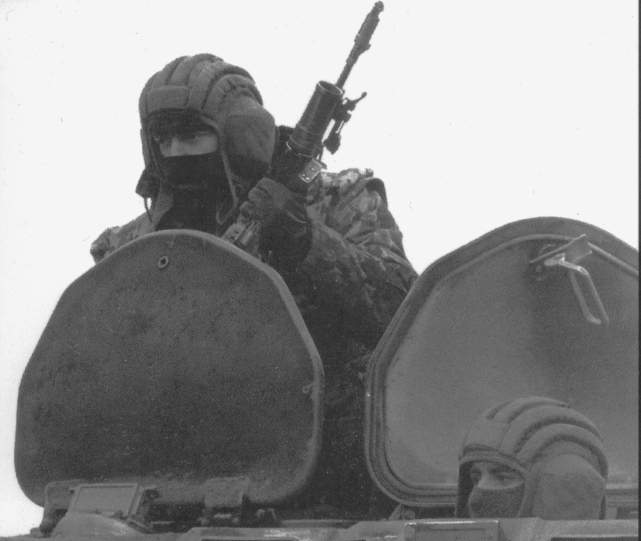 Special forces of the
Russian Ministry of Internal Affairs in Chechnya (Assoreporters) Special forces of the
Russian Ministry of Internal Affairs in Chechnya (Assoreporters) |
Of
course Russia is fortunately not only this, but unfortunately at
present it is also this. The true genuine side, the intelligentsia, the
great cultural figures, its real inner Spirit, has been temporarily set
aside in order to look back to the past with Putin's Russia which is
preparing again an aggressive and nationalistic police state. And, as
in the good old Soviet style (and as in every authoritarian state),
everyone who does not agree with this suicide policy is banned as a
"traitor of its motherland".
But
the conflict has moreover its origin also in some erratic leading
Chechen personalities who repeatedly showed to be unwilling in any form
of compromise and who made strategic errors that other republics asking
for independence carefully avoided, in mistakes and shortcomings of the
Chechen leadership headed by Aslan Maskhadov, and more recently in the
resort to terrorism by part of the Chechen resistance which alienated
the sympathies for the Chechen cause for sovereignty and
self-determination of part of the outside world. This could only
exacerbated divisions and tension, leading finally to forms of
extremism on both sides.
More
generally, the war in Chechnya can be seen as a symbol. The symbol of
the frustration of a society which still did not entirely accept that
it has lost the cold war. The symbol of a collective aggregate that has
lost the ideals dominating the October revolution and that actually
finds itself surrounded not only by a material but also and especially
by a psychological and spiritual emptiness. The slaughter in Chechnya
is the expression of a generalized social desperation which doesn't
know where to look forward and how to proceed further after the fall of
Berlin's wall. A dissatisfaction leading to anger and desire of revenge
which, especially after the chaotic Eltsin period, could only reinforce
a nostalgic return to the good old ideal of the "strong man" who is
supposed to bring law and order, an ideal which Putin's figure fits
well, and that could lead towards a "great Russia" reestablishing
justice for the humiliation it believes it has suffered in the past
years. Naturally, loosing another piece of the former Soviet landscape
and admitting the defeat of a country of almost 150 millions against a
scarcely one million strong tiny republic goes exactly in the opposite
direction and is inadmissible for a political and military power
structure which instead can only exist if it keeps, through media
control, censorship and the elimination of a dissenting opposition,
precisely this ideal alive.
It is in this general frame one has to understand that the set of this
material, political, social and psychological aspects combined itself
to become an explosive mixture which led to the war and the
humanitarian disaster we observe today. And in this light we believe
the single facts, some of which we are now going to analyze shortly,
must be seen.
Some
facts to be known
Russia, eager for
revenge for its withdrawal in 1996, decided to launch a full-scale
invasion of Chechnya three years in advance already and, on the
admission of its former interior Minster Sergei Stepashin,[1a] certainly since March 1999 where Putin
was head of the FSB ("Federal'naia Sluzhba Bezopasnosti", Federal
Security Agency, part of the former KGB). Russian public opinion is
told that the war in Chechnya is on Islamic extremists. Entire
electoral campaigns have been based on this. Putin, a nearly unknown
FSB colonel, showed to be a master in seizing the opportunity to
promote his personal political prestige by escalating the war
reinforcing in the public opinion the hatred against Chechen
minorities. When dealing with the Chechen conflict his jargon alone
comments itself: "we will wipe them out in the toilet", "whoever
offends us won't live 3 days", "a control shot in the head", etc. This
kind of appeal to people's baser sentiments was apparently highly
effective in ensuring him election and Putin became President on the
crest of the war in Chechnya. However this same public opinion had not
been informed that meanwhile the secret services, of which Putin was
the highest head, financed and armed criminal bands, Islamic terrorists
and mafia groups throughout Chechnya with the precise goal to
destabilize and overthrow by force the legitimate and democratically
elected government of Maskhadov. President Aslan Maskhadov, commander
of the Chechen armed forces during the first war and author, with
Russian general Aleksandr Lebed, of the peace agreements in the
Khasaviurt Accords in August 1996, came to power with an overwhelming
majority (59.3%) as the head of a regularly and democratically elected
government in 1997 (the regularity of this election was monitored and
confirmed by different international independent organization, among
others the Organization for Security and Cooperation in Europe, OSCE).
Also the Russian government recognized Maskhadov as the legitimate
President of Chechnya. But like in Afghanistan, where the Soviet Union
had used the principles of "divide and rule", provocateurs, and "false
flag" tactics, to break the internal relations of the Afghans, for
example by supporting and training Islamist terrorist groups also in
Chechnya, Russia only welcomed the activities of Islamist groups and
gangsters (since the dissolution of the USSR, most Chechen gangs have
been parts of a network based in Moscow and dominated by Russians).
This
policy is summarized through some examples by Anssi Kullberg[1b]:
"The most
important radical Islamist - and the only one who might have had
connections to international terrorism through his mysterious Arab ally
Khattab - is Shamil Basayev, a former officer of the Russian OMON
troops. As a young hothead, he went to Abkhazia to fight along with the
Russian military intelligence (GRU) against Georgia, the only truly
friendly state towards Chechnya. Another of the most notorious thug of
Chechnya was Arbi Barayev, who led the kidnapping business. He was
hated by Chechens, and Maskhadov's government issued a murder case
against him in 1988, and ordered him to be imprisoned. When Russia
started CW2, it did not issue warranty against Barayev, although he was
the main suspect for most cruel crimes, including the kidnapping and
murder of several Westerners. Barayev rose into rebellion against
Maskhadov, and the Russian secret services backed him to raise his own
paramilitary forces into rebellion against the Maskhadov government in
summer 2000. When the local police arrested him in November 2000, the
pro-Moscow puppet government ordered him to be released. Barayev was
reportedly killed in uncertain circumstances in autumn 2001."
Also
according to Vyacheslav Izmailov, a former army officer who fought in
Chechnya and certainly doesn't have sympathies for the Chechen cause,
admits that Arbi Barayev was known to have the protection of Chechen
FSB agents and that his protectors remain close to the present Russian
backed Chechen administration even now.[2]
Indeed,
the present Russian puppet administration in Chechnya is led by quite
dusky persons. Akhmed Kadyrov, appointed today by the Kremlin as the
nominal head of the administration, is a former chief mufti of Chechnya
and Islamist who, during CW1, for the great harm of pro-independence
Chechen leaders who were trying to find a peaceful way out in the frame
of a secular reorganization of the republic, declared almost
fanatically the jihad against Russia advocating the introduction of
Sharia'h. Actually Kadyrov commands several thousands armed men,
(officially 250 men but is said to be closer to 5,000 and the number is
expected to grow) who might become a considerable threat to Russia's
forces stationed in Chechnya itself once they turn their backs to the
Kremlin. Besides relatives and friends, this "security force" comprises
mostly former members of paramilitary criminal groups, who were
involved in robberies and murders. According to human rights
organizations Kadyrov’s security forces are responsible of several
crimes against humanity (e.g. of kidnapping Chechen citizens in order
to “sell” them back to their relatives). The present Chechen
authorities, which are under the strict supervision of Russian
authorities, deliberately stake on criminal groups.[2b]
Moreover the notorious Grozny (Djohar) mayor Beslan Gantamirov, who was
serving a 6-year sentence for embezzlement in a Russian prison (he
stole parts of the funds necessary to rebuilt the city after CW1), has
been released by Vladimir Putin's administration to lead a rebellion
against Maskhadov.
These
are only few examples of what the Russian government considers the
"warrants of stability" in Chechnya.
Maskhadov
is a quite different figure than Dzhokhar Dudaev, the former Chechen
president. CW1 broke out not only because of Boris Yeltsin's corrupt,
violent and power-hungry attitude and that of the collaborators
surrounding him (mostly hawks and few inactive or servile liberals),
but also because Dudaev was indeed an illegitimate, undemocratic and
intransigent extremist. The situation was dominated by the prickly
egotism of both sides. Maskhadov instead always distanced himself from
any terrorist or criminal formation as any form of religious extremism
and envisages a democratic Chechnya based on libertarian values.
However
he might be blamed either for his political indecisiveness, constantly
seeking consensus with all the armed groups and for his inability to
resist FSB's provocation, i.e. the pressure of his terrorist opponents
that led him to adopt quite doubtful measures (e.g. to adopt Islamic
Shariah law reducing his own power, despite his secularist convictions)
and bears some responsibility, like his forerunner Dudaev, for his
failure to keep firmly under control on its own territory an epidemic
criminal activity which spread out all over the republic. Arms trade,
narcotics business, hijackings and kidnappings became a quite usual
mean for political and financial aims. The decisive moment came in the
summer of 1998, when a group of Islamists rose in open rebellion
against Maskhadov's government. Loyalists fought a pitched battle with
them outside the town of Gudermes, and dozens of Chechens were killed.
Maskhadov decided not to arrest the Islamists but instead let them go
free. At the same time, he abandoned Dudayev's secular constitution and
introduced nominal Shariah law. There is no evidence that Maskhadov was
profiting from the kidnapping business, but some associates of him
certainly did. After all it might suffice to recall as for instance
Shamil Basayev, who organized in 1995 the hostage taking in Budennovsk,
and despite having been defeated in the 1997 elections won by
Maskhadov, became nevertheless the first deputy prime minister and
shared responsibilities for oil production. Perhaps for sheer
opportunism or simply because he thought that engineering an alliance
with these radical figures might keep them under control, Maskhadov
didn't or couldn't avoid such uneasy presence, his primary political
adversaries.
But
these very common universal political maneuvers, based on alliances
with criminal elements, reveal itself on the long run counterproductive
over and over again. Maskahdov soon broke up relations with Basayev
but, because of the tremendous brutality of the Russian repression
during CW2, he had no other choice than joining Basayev in a military
alliance five years later. After the October 2002 theater siege this
strategy showed all its weaknesses and he distanced himself from this
fanatical nationalist again. Maskhadov not only fired Basaev from his
government positions but also opened a criminal case against him. But
it was to late: this alliance became counterproductive among other
things also because it gave the pretext to US President G.W. Bush -
who, while already planning his war in Iraq was apparently unsatisfied
that Chechens undergoing a genocide don't remain saints behaving as
Gandhi-like figures - to declare moderate forces open to a political
solution, but self-defending their country with a guerrilla campaign,
like Maskahdov, as "unreliable", aligning de facto his policy with
Putin's brutal means in Chechnya. Perhaps this strategy made part of
Bush's plan to convince Putin to join the strategic alliance against
Iraq: a wrong move again, as it turned out short after.
Sure
is that the decent members of Maskhadov's government were threatened or
even shot and when Maskhadov asked for Russia's support for his effort
to fight criminal gangs and radical Islamist in 1998-1999, and for this
he sent Turpal Atgeriyev, the Chechen security minister, as his special
envoy to Moscow, Russia answered by having Atgeriyev arrested and by
refusing from all cooperation with Maskhadov's government. He asked the
Kremlin for assistance in suppressing several Wahabi militant
formations based in Urus-Martan and the mountains of southeastern
Chechnya. Far from assisting the beleaguered moderate president in
expelling such radical elements as the Arab jihadi leader Amir Khattab,
the Russians worked to undermine Maskhadov's secularist-national
government.
Key
to the understanding of this quite bewildering policy of the Kremlin is
that the present military-political regime bases its existence and
force on constructing and encouraging a constant internal and external
threat. The FSB regained power on deliberately constructing
the "Chechen threat". It survives and lives from constantly
refreshing and extending this "threat". In retrospect, at least part of
the kidnapping business appeared to have a political purpose as an
instrument in the struggle against Maskhadov by his opponents inside
and outside Chechnya. Many terrorist acts have been planned and
realized by those criminal gangs or by those who had once (and continue
to have?) direct connections with the Russian secret services.
The
distinction between Chechen terror acts and deviated activities of
secret services is frequently indistinguishable. Most notably one
should be reminded about the explosions in 1996 in Moscow's subway,
five days before President Boris Yeltsin was to stand re-election, and
in the apartment-buildings - two in Moscow and one in the southern city
of Volgodonsk - in 1999 and that caused more than 300 deaths. Still
after several years any evidence linking Chechen terrorism to the
bombings is lacking. However, certain is that Russian authorities
immediately blamed the bombings on Chechen terrorists, and used the
explosions as the reason for launching a media and electoral campaign
to sustain the military intervention in the breakaway republic. Later
the exiled tycoon Boris Berezovskii has claimed publicly that the FSB
actually organized the bombings in order to create a pretext to invade
Chechnya. General Alexander Lebed, one of the author's of the
Khasavyurt agreements, which led to termination of the first war, made
similar statements. The former prime minister Evgenij Primakov declared
that "the rebels use exclusively Russian arms".[3]
Unsolved remains the mystery of the Ryazan incident where the FSB was
caught red-handed placing explosives in a multi-storey civilian
apartment building. The FSB has denied these allegations. But more
recently also Lieutenant Aleksandr Litvinenko, a former FSB Colonel who
fled to UK in Autumn 2000, makes the same allegation: the bombing was
directed from the Russian FSB. Meanwhile State Duma deputy and human
rights activist Sergei Kovalyov went to court to demand Russia's chief
prosecutor to let him see the documents relating the apartment-building
bombings as the Ryazan case and that led to suspicions of government
involvement. Why has his request been denied? Why is the FSB, that at
those times was headed by Putin, so unwilling to investigate the facts
related to the explosions in Moscow? Finally, Sergei Yushenkov, one of
Russia's leading liberal lawmakers and one of the founders of Russia's
first post-Soviet democratic movement, a staunch supporter of human
rights, critical on the policy in Chechnya, actively engaged in
investigation into the Moscow blasts and a rare vocal critic of
President Vladimir Putin, was shot dead in an apparent contract killing
outside his apartment in Moscow on 17 April, 2003.
That
Moscow's authorities had other priorities than fighting extremism
became already clear in many other occasions. For instance, in
neighboring Ingushetia, President Ruslan Aushev recognized the threat
of Islamic extremism and pursued a vast political and social agenda in
fighting supposed al-Qaeda elements since the onset of CW1 in 1994: his
government investigated for suspect money pouring in from foreign Arab
countries and tried to elevate the poorer Muslim community to a higher
material and social condition. And nevertheless Putin did his best to
undermine Ausev's credibility and finally faced him with a
government-inspired court challenge that forced him to resign in late
2001. Was Aushev's fault that to criticize the crude militarism of
Moscow and that to not allow Chechnya to be bombed or shelled from the
territory of Ingushetia?
And what about the the famous attack on the
Dubrovka theater in Moscow of October 23, 2002, where the Russian
musical "Nord-Ost" was being staged?
This
was led by Barayev's nephew Movsar, and Basayev is the man who has
taken responsibility for this terrorist attack, two figures who, as we
have already seen, are widely reported to have maintained shadowy ties
to both the FSB and Russian Military Intelligence (GRU). A lot of
strange facts happened and many questions remain unanswered. For
instance, the GRU, had already announced two months earlier Barayev's
arrest. Why did they release him? Anne Nivat[4],
who met at Assinovsski, a village close to the border with Ingushetia,
the mothers of two of the unit’s women of the Duborvka siege, claims
that they had been arrested and taken to an unknown destination at the
end of September. Their mothers recognized them on television and said
that they could not understand how their daughters could have gone from
a Russian camp to Dubrovka. Independently, in the Novaya gazeta (20
January 2003 issue), Yuri Shchekochikhin, a Duma deputy and deputy
editor tells a similar story about another female terrorist. Why did so
many embark in a terrorist act immediately after their release from
Russian prisons? According to the already mentioned Litvinenko and an
article of Anna Politkovskaya, a certain Khanpasha Terkibayev, who was
a Chechen FSB agent for many years, was situated at the Nord-Ost
together with the terrorists and then left building not long before the
assault[4b]. Two facts about
Terkibaev seem indisputable. First, his name appeared on published
lists naming the hostage-takers (his name appeared officially as one of
the terrorists in the Izvestia journal) who had seized control of a
Moscow theater. Second, just as Barayev and the two female terrorists
mentioned, Terkibaev vanished in early March 2002 after being arrested
by pro-Russian Chechen militiamen at his home in the village of
Mesker-Urt, in the Shali region, too[4c]
but suddenly appeared in a travel to Strasbourg on the 31st of March
2003 as an adviser to the Russian delegation to the Parliamentary
Assembly of the Council of Europe. How was it
possible that a terrorist of the Dubrovka theater was presented as a
special-representative of the President of Russia Dmitry Rogozin during
the PACE session in Strasbourg ? And why did Politkovskaya, short after
the appearance of her article, receive a telephone call from an
official of the U.S. embassy in Moscow who urged her to drop the
subject?[4d] Litvinenko asserts
that he passed to Yushenkov, in the beginning of April 2003,
established data on Terkibayev, and he was supposed to verify this
information on his the return to Moscow. A couple of weeks later
Yushenkov was shot to death. And on December 2003 Terkibayev died also
in what the official version depicts as a "car accident". Mere
coincidences?
Other mysteries surround the Dubrovka theater. A central question to be
resolved by future researchers is whether or not the Russian special
forces planning an assault on the theater building at Dubrovka were
aware that virtually all of the bombs located there -- including all of
the powerful and deadly bombs -- were in fact incapable of detonating.
If the special forces were aware of this, then there was clearly no
need to employ a potentially lethal gas, which, it turned out, caused
the deaths of a large number of the hostages. The special forces could
have relatively easily and rapidly overwhelmed the lightly armed
terrorists. Moreover, if they were in fact aware that the bombs were
"dummies," then the special forces obviously had no need to kill all of
the terrorists, especially those who were asleep from the effects of
the gas. It would, one would think, have made more sense to take some
of them alive. If they were not aware of this, then they must have
known that the terrorists had more than enough time to detonate their
explosives if they had wanted to. But about fifty minutes passed
between the introduction of the gas and the storming of the building,
so the attackers must have known that a long period was needed for the
gas to take effect.
Among the terrorist leaders at Dubrovka had been an Arab named "Yasir,"
a "subject of Saudi Arabia" and leader of Al-Qaeda (utro.ru, 30 October
2002). It soon emerged, however, that "Yasir" was but another name for
"Abubakar" (real name: Ruslan Elmurzaev), an ethnic Chechen and the de
facto leader of the hostage takers. According to an article by
Aleksandr Khinshtein in the May 23 issue of Moskovsky komsomolets this
mysterious figure had managed, somehow, to leave the theater before it
was stormed by Russian commandos--and that the authorities have shown a
striking lack of zeal in pursuing him. Russian procurators proved
unable to show Elmurzaev's corpse and, during a visit to Chechnya in
October 2003, Russian intelligence officers there confirmed to film
director Sergei Govorukhin (son of a well-known Duma deputy and
filmmaker), who served as one of the volunteer negotiators at Dubrovka
where he met Elmurzaev and whom he identified as an FSB agent, that
Elmurzaev is alive and living in Chechnya (ruskur.ru, 23 October 2003).
This Elmurzaev was said to be the key figure behind several other
terrorist attacks in Moscow as well. Among other things, according to
informations supplied to Khinshtein by investigators, the name
"Abubakar" emerges also in relation with a car-bomb attack on a
McDonald's restaurant in southwestern Moscow only few days earlier to
the Dubrovka siege. The "main hero" among these investigators was
Yevgeny Taratorin who however was removed from his position by the
procuracy which opened a criminal investigation against him for
allegedly revealing secrets from the investigation.[4e]
Elmurzaev was reported by a former FSB lieutenant colonel turned
lawyer, Mikhail Trepashkin. Trepashkin recalled that he had alerted the
FSB in the period of late July and early August 2002 to the activities
of Elmurzaev and others but had been informed that the FSB "was aware
of the information" (chechenpress.com, 21 and 31 July 2003). Moreover,
as a member of public inquiry committee into explosions in Moscow in
1999, Trepashkin found evidences of the ties between the FSB and the
authors of this terrorist act.[4eb]
At this point Trepashkin was immediately arrested by the FSB on 22
October 2003. A trial for "revealing a state secret," is now getting
under way in the Military Collegium of the Russian Supreme Court.[4f] Trepashkin was asked by an independent
State Duma commission to investigate the bombings in the summer of
2002. The commission was formed by then-deputies Yuly Rybakov, Sergei
Yushenkov, Sergei Kovalyov, Yury Shchekochikhin and Otto Latsis. Today
Trepashkin has been arrested, Yushenkov was shot dead, Shchekochikhin
died in unclear circumstances because of a food poisoning and Latsis
(also editor of the newspaper Russky Kurer) was beaten unconscious in
his apartment building's elevator. Kovalyov and Rybakov are still in
circulation but have been accurately expunged from politics by the
state media and failed to win re-election to the Duma in the December
2003 parliamentarian elections.
And what role did Arman Menkeev, a retired officer from a GRU spetsnaz
commando unit, play in last year's hostage episode at Moscow's Dubrovka
theater? Menkeev, apparently another double agent of the Russian secret
services as Khampasha Terkibayev, was arrested about a month after the
theater episode in connection with several terrorist attacks in Moscow,
including the one at Dubrovka. Curiously, however, it appears that he
is not being formally charged in the criminal case. According to an
article by Aleksandr Yelisov in the October 24 issue of Moskovsky
komsomolets "several sources" still consider Menkeev to be "one of the
main suspects" in the Dubrovka atrocity. "The investigation suggests
that it was precisely he who prepared...explosive devices and home-made
grenades for Movsar Baraev's group," wrote Yelisov. Menkeev undoubtedly
had skills that would have made him attractive either as a bomb expert
for the terrorists or as a double agent for the government (or both?)
and was described as "loyal to the government" and somoenoe who "knows
how to keep military and state secrets" in an official memo written
during his stay in Moscow's Lefortovo prison.[4g]
The
federal authorities in Moscow have continued to avoid any public
comment. Khinshtein
questions: "Who benefits if terrorists stroll about in freedom while
detectives take their places on prison bunks? Who benefits if criminal
investigations fall apart? I ask myself that question, but I cannot
find an answer--or more precisely, I dare not speak that answer aloud,
even to myself."
In
one of the most detailed reconstructions of the Dubrovka events, John
Dunlop senior fellow at Stanford University's Hoover Institution,
concludes that in his opinion "the original plan for the terrorist
action at and around Dubrovka bears a strong similarity to the campaign
of terror bombings unleashed upon Moscow and other Russian urban
centers (Buinaksk, Volgodonsk) in September of 1999. In both cases
there is strong evidence of official involvement in, and manipulation
of, key actions." He suggests that "in view of the suspicious
connections and motivations of the perpetrators of this incident, as
well as the contradictory nature of the actions of the authorities, it
would seem appropriate to envisage this operation as representing a
kind of 'joint venture' (on, for example, the model of the August 1999
incursion into Dagestan [see next]) involving elements of the Russian
special services and also radical Chechen leaders such as Shamil Basaev
and Movladi Udugov." In the final analysis, concludes Dunlop, "elements
among both the Russian leadership and the power ministries and among
the Chechen extremists obtained their principal goals in the assault on
the theater at Dubrovka: namely, an end was put to the negotiation
process while Aslan Maskhadov's reputation was besmirched, and the
terrorists, for their part, had an opportunity to stage a grandiose
fund-raiser. The Russian authorities, moreover, were now able to
demonstrate to the entire world that Moscow, too, had been a victim of
an Al-Qaeda-style Chechen terrorist act. As in 1999, the chief victims
of these terrorist acts were the average citizens of Moscow. The bulk
of the evidence, as we have seen, points to significant collusion
having occurred on the part of the Chechen extremists and elements of
the Russian leadership in the carrying out of the Dubrovka events."[4g2]
Whatever
the truth is, keeping this in mind might give a somewhat different
perception of the "war on terrorism" in Chechnya. In the end, both the
Russian leadership and the Chechen extremists obtained their principal
goals in the Dubrovka events: namely, talk of negotiations ended and
Maskhadov's reputation was besmirched. The hostility toward Chechens
among Russians increased and especially for the Kremlin, just as after
the apartments bombings in 1999, the support for the war in Chechnya
found a new and fresh support. In the aftermath of the Nord-Ost
hostage-taking in Moscow, the Russian government has sought
aggressively the extradition of Akhmad Zakayev, President Aslan
Maskhadov's representative in Europe (but has not requested, until
March 2003, the extradition from Qatar of the radical ideologue,
Movladi Udugov). Also the entire Western world and press, who was
timidly but slowly becoming aware of the disaster in Chechnya and
increasingly critical about the conflict, returned faithfully to its
usual cynicism. It suffice to say how, in the days immediately after
the Dubrovka siege, Danish Prime Minister Anders Fogh Rasmussen labeled
the Chechens as a "gang of fanatic criminals" and "a people that
doesn't have any legitimate claim to independence."[4h]
Returning
to the times prior to the beginning of CW2, certain is that also the
political initiatives emanating from Moscow seemed designated to
undermine Chechnya's stability. In December 1998 Yeltsin suddenly and
apparently without reason, withdraw his intention to negotiate a treaty
with Chechnya on the mutual delegations of powers similar to the
treaties already signed with other independent Republics. And the
promised Russian economic aid to reconstruct the Chechen economy and
infrastructure destroyed by the first war, never arrived. In retrospect
this seems to be no coincidence, it was part of a plan either: that to
keep the population in a permanent state of misery in order to increase
the destabilizing effects. In the conditions of the hardest economic
situation banditism became massive in Chechnya, total anarchy followed.
In February 1999, in a desperate attempt to reestablish order Maskhadov
suspended the Chechen parliament and under pressure of Basayev, and
against the Chechen constitution that declares Chechnya as a secular
republic, introduced Shariah law.
But
concessions to thugs do only enforce them. Maskadov failed in
guaranteeing law and order: many weapons ended up in the hands of rival
gangs, Russian authorities were kidnapped and the situation spiraled
out of control. The Russian devastating "divide et impera" policy, the
Chechen corrupt and criminal internal politics with its greed for oil
and ransom money and backed by Moscow, together with the incapacity of
the Chechen government to stay firm under its opponents pressure,
climaxed in the attack on Dagestan. 1,000-1,200 illegal guerrilla
troops, which were under the command of Basayev and Khattab, launched
an attack in the summer of 1999 on the Dagestani borders. Despite
Maskhadov's repeated attempts to counteract this political and social
situation, asking frequently for Russia's help without receiving it,
the Kremlin cynically accused him of being behind the invasion.
But
how can someone be so unwise to attack Russia with an army of not more
than 1,200 soldiers? And why? To do what?
The
dream of these radical Islamists was to spread the doctrine of
Wahhabism and form an Islamic state encompassing Chechnya and Dagestan
(which means also a state on the Caspian Sea and its oil resources). A
dream that had no real sympathy among the majority of the Muslim
people. But this is almost certainly not the whole story and widespread
are again the rumors that the invasion was prepared in a secret
cooperation of Basayev with Berezovsky -the already mentioned oligarch
nowadays in exile in GB- and the Russian "hawks". And if, according to
Stepashin, the CW2 planning was under way since March 1999, the
Dagestan attack, which took place in August 1999, could not be the
cause of the war. Strange is the coincidence that for some obscure
reason the Russian forces were withdrawn from the border area just
before the incursion as if someone was trying to lure the Chechen
commanders into attack. And strange too is what French intelligence
sources report, via the Russian press[5] :
according to these source Basayev met in summer 1999 in France with
Aleksandr Voloshin, chief of staff for then- president Yeltsin (and
later Putin), and Anton Surikov, a former Soviet military intelligence
officer who worked with Basyev when he was leading the Abkhaz
separatist movement in Georgia, with Moscow's blessing. Voloshin is
claimed to have provided $10 million to Basayev in order to fund the
invasion in Dagestan. Interesting is also the coincidence that the
Chechen forces invaded Dagestan two days after Yeltsin appointed Putin
as prime minister. The attack on Dagestan has also some similarities
with the outbreak of CW1 which followed short after an incident in late
July 1994, when four Chechen hijackers seized a bus near Mineral'nye
Vody, in southern Russia, and that turned out to be a catalyst for the
Russian move towards the first war. According to Anatol
Lieven also this terrorist attack "might have been deliberately planned
by Russian agents to provide an excuse for intervention."[6]
No
verdict is so far possible, and the conspiracy theory remains a theory,
and will so perhaps forever. But too many details don't fit, too many
inconsistencies emerge and much too evident is Russian's authorities
unwillingness to solve and clraify it. And there is the undeniable fact
that the war fed the rise of Putin. The media propaganda didn't miss
the occasion to take advantage from these events demonizing the Chechen
government and preparing the public opinion to war. The Basayev and
Khattab led attack of 1999 was certainly what the Russian army was
waiting for. For Russia it was the pretext to begin its second attempt
to conquest Chechnya back. In September 29, 1999, the foreign ministers
of France, Germany and Italy (Hubert Védriene, Joschka Fischer and
Lamberto Dini) expressed "great concern" about the situation in
Chechnya, but were very careful in not condemning Yeltsin's regime:
this could only give a green light for war. What followed under the
name of "the war on terrorism and bandits" was the continuation of the
genocide of the first war rising the death toll to a number comparable
to the extermination of about 15% of the Chechen population.* As CW1, where a short and
victorious war should have raised Yeltsin's Presidential ratings in the
face of his flagging popularity, also CW2 was supposed to last only few
weeks but turned out to be instead a yearlong terrible human drama. It
was the consequence of selfish electoral, political and personal
ambitions. And not only from the side of Russian or Chechen political
figures.
With
Putin coming to power, the mistakes of the first war will not be
repeated. The greatest victory of the Russian authorities is clearly
its mediatic triumph at home and especially among the Western
professional media. The borders of Chechnya became and still are
of-limits for everyone reporting something different than the Kremlin's
truth. No one will be allowed to report and film anything in Chechnya
if not under strict control of the Russian forces, i.e. under the
supervision of Sergei Yastrzhembsky, head of the Russian information
department for Chechnya. Putin's Russia is a master in a propaganda
which criminalizes an entire population convincing the entire world
that the real conflict in Chechnya is about the fight on terrorism and
bandits. Refugees become sympathizers for terrorists, their tent camps
abroad a nest for Al Qaeda, the Russian forces those who are trying to
"restore law and order in Chechnya" and the nazi-Stalinist emerging
regime of Putin a "rising democracy". Professional analysts, experts,
cremlinologist and the overall community of journalists from the USA to
Europe throughout all the democratic countries acritically accepted for
years this version of "facts" as the final truth. While hundreds of
innocent civilians are kidnaped, raped, tortured to death and thrown
into mass graves every year without anyone taking notice of them, the
whole international community faithfully reacts like Pavlov's dog to
the Russian propaganda which claims to be victim of dozens of terrorist
acts whose real authors remain totally unknown till today. The
government controlled Russian Press agencies as Interfax, RIA-Novosti
or Itar-Tass become the only source of information about Chechnya and
are taken as the point of reference for the official truth by Western
press agencies which, already blinded by this propaganda, only and
exclusively take these for their understanding of facts without
comparing the information with other sources like those coming from the
humanitarian NGO or the Chechen information services. Bush, Blair,
Schroeder, Chirac, Berlusconi, etc. could finally find the gates open
to declare themselves as great friends of a fascist regime without
anyone noticing something strange in this.
The
Western Realpolitik on Chechnya
Just
to span some parallel, what happened could be compared to a hypothetic
British invasion of Northern Ireland which, after having razed it to
the ground, killing 100,000 civilians, detaining 20,000 in
concentration camps and filling it with death squads, presents a Tony
Blair who tells us that all this was necessary in order to conduct a
war against the Irish Republican Army. This is in its essence how
Yeltsin and Putin are justifying their war in Chechnya against
"bandits".
Is
this credible?
According
to many Western "analysts", it is. Fine tuning to this
belief, no attention came from leaders as Bush, Blair, Schroeder,
Chirac, Aznar, Berlusconi, etc., about the human rights violations in
Chechnya. In the past years the repeated attempts of those Chechen
representatives, as President Maskhadov, open to a political and
peaceful solution, and searching for a support among the European Union
(EU) member states or the USA, met substantially on disinterest and had
been ignored. Nothing has been done in the direction of a peaceful
solution because that could evidently meet with Kremlin's anger.
Noteworthy is how during CW1, President Bill Clinton did not even try
to get in contact with Yeltsin until two months into the conflict.
Despite the blatant violations Warren Christopher, the US secretary of
state, explained that "Russia is operating in a democratic context" and
that the United States "should not rush to judgment"[7]. Russia asked for Europe's and America's
complicity. And received it.
The
financial Realpolitik: "business as usual".
It
received it together with huge financial aids: the West financed
indirectly at least CW1 through its donations to Russia through the
International Monetary Fund (the second war found instead adequate
funds because of the rise of oil prices). In 1995 Moscow received a
$6.8 billion loan, already six months into the war, in order to
strengthen the Ruble and its economical stability. Further $10.2
billion followed in early 1996. Later also the old Soviet debt of $13
billions has been canceled. This is as such not particularly appalling
would it not be for the fact that these credits came just in the middle
of CW1. Estimates indicate that the first two loans combined are
comparable to the cost of CW1. It replenished the powers of destruction
and repression in the whole Russian federation and almost no one felt
it necessary to submit these financial aids to some conditions on a
process of democratization, liberal reforms and the respect for human
rights. The West did therefore not simply look the other way, but also
actively offered to relieve the financial pressure which was the main
constrain on Moscow's continuation of the first war.
In
the name of a "free market" the Clinton administration and its European
allies approved blindly, from the Yeltsin era on, their partecipation
in a huge and intrinsically corrupt program of Russian privatization
which turned out to be nothing else than a gigantic reselling of the
pubblic patrimony in the hands of an extremely tiny (probably not more
than twenty) powerful oligarcs, while the vast majority Russians
poverty remained unaltered or even worsened. The living standard has so
far improved only for certain categories of people and a blatant
contradiction of the modern social and economic situation in Russia
persists, the visible improvement of economic indexes did not affect
the social situation, while the state has virtually stepped aside from
the social restructuring of business. No real principles of interaction
between local authorities, corporations and social responsibility and
morality guides the laws and minds in Russia.
On
the other side, major independent business owners in Russia have been
put out of business by the strong-arm tactics of the special prosecutor
or the FSB. The arrest of the powerful oligarch Mikhail Khodorkovsky,
chairman of Yukos Oil, by the Russian new regime of former KGB officers
headed by Putin (and which occured few days after President Bush
declared his "respect [for] President Putin's vision for Russia . . . a
country in which democracy and freedom and rule of law thrive"), was
the best example in this sense. Khodorkovsky made the fatal mistake of
expressing political opinions and having the temerity to provide
financial support to opposition parties. The FSB attack on Russian
business is an inalterable constant in Putin's conception of "economy".
All that has
obviously nothing to do with Adam Smith's theories and such a country
is certainly not heading towards any variety of capitalism: there is no
free market in Russia. Wealth is coming only by courtesy of the head of
the Government (actually Putin) and a centralized nomenklatura, and not
through a genuine and transparent economic competitive system. Like
under a fascist rule, where property is not owned by the state but at
the whim of the state's rulers and few extremely rich individuals, the
final goal is the power of the state rulers and not the welfare of its
people. Among other things, between the same Russian citizens there is
also a growing resentment against the Western society and values also
because in the administration councils of the industries guided by this
oligarchic and authoritarian system many Western representatives have
their seat. But it is unlikely that on the long run foreign investors
will continue to play such a game. And nevertheless there are also
cases of western academics, like the case of the university of Rome "La
Sapienza", which on October 2003, had the marvelous idea to confer on
Putin a doctorate honoris causa in economy.
Russia
possesses 25% of the entire world low price gas. 16% of Europe's oil
and 40% of its natural gas supplies comes from the Russian Federation
countries. Its oil is identified as the driving force as its energy
accounts for two-fifth of Russian exports and more than 10% of the
country's real Gross Domestic Product. The US begun expanding Russia's
role in the global energy markets, and is turning the vast Eurasian
landmass into one of the major oil suppliers to the US - alongside
Mexico, Nigeria, and other non-OPEC producers. These developments will
no doubt reverberate beyond the bilateral US - Russian relations in the
years to come. During a Bush-Putin summit in May 2002, a cooperation
has been signed which focuses on prospecting for energy and developing
resources - especially oil and gas - including the Caspian region.
Russian and US companies will be encouraged to invest in Russian deep
ports, transportation infrastructure such as railroads and pipelines,
and the modernization of electircity-generation capabilities and
natural gas and oil refineries. Creating a fleet of supertankers in the
Pacific, as well as building modern ports and pipelines in Siberia and
the Far East, will allow Russia to supply the US West Coast directly.
The goal is to diminish US dependence from OPEC countries which are
considered as unstable and politically unreliable. In this view the
Caspian region has become crucial to the US policy of "diversifying
energy supply" and in an effort to decrease its dependence on Saudi
oil, the US seeks to control the Caspian oil resources and fierce
conflicts have broken out over pipeline routes. In the eyes of a short
termed policy, all this reduces any ethics and human rights issue to a
very secondary matter. The exchange of Chechen's blood for Russian's
and the Caucasian gas and oil is seen quite obviously as the only
meaningful policy. Or in L. Kleveman's words:
"The Russian
government initially tolerated the intrusion into its former empire,
hoping Washington would in turn ignore the atrocities in Chechnya.
However, the much-hyped "new strategic partnership" against terror
between the Kremlin and the White House has turned out to be more of a
temporary tactical teaming-up. For the majority of the Russian
establishment it is unthinkable to permanently cede its hegemonic
claims on Central Asia."[7a]
Therefore
there is also another aspect of the whole matter: Moscow resents this
as a form of arrogant imperialism. Kleveman continues with another
interesting reflection on Western policy with regards to a what is
going on in Uzbekistan:
"Besides
raising the spectre of inter-state conflict, the Bush administration is
wooing some of the region's most tyrannical dictators. One of them is
Islam Karimov, the ex-communist ruler of Uzbekistan, whose regime
brutally suppresses any opposition and Islamic groups. "Such people
must be shot in the head. If necessary, I will shoot them myself,"
Karimov once told his rubber-stamp parliament. Although the US state
department acknowledges that Uzbek security forces use "torture as a
routine investigation technique", Washington last year gave the Karimov
regime $500m in aid and rent payments for the US air base in Chanabad.
The state department also quietly removed Uzbekistan from its annual
list of countries where freedom of religion is under threat. The
British government seems to support Washington's policy, as Whitehall
recently recalled its ambassador Craig Murray from Tashkent after he
openly decried Uzbekistan's abysmal human rights record.
Worse is to come: disgusted with the US's cynical alliances with their
corrupt and despotic rulers, the region's impoverished populaces
increasingly embrace virulent anti-Americanism and militant Islam. As
in Iraq, America's brazen energy imperialism in Central Asia
jeopardises the few successes in the war on terror because the
resentment it causes makes it ever easier for terrorist groups to
recruit angry young men. It is all very well to pursue oil interests,
but is it worth mortgaging our security to do so?"
Uzbekistan, which most westerners even don't know where it is, doesn't
scare anyone. But if moral issues don't bother us, we should at least
ask ourselves if Russia itself will continue to stay a political stable
and reliable partner of the West? Does this policy, blind
on the democratization processes, not favor an opposite tendency? What
if Russia will fall back to a violent dictatorship, as it will possibly
do?
These
questions didn't bother much neither politicians (Bush famously said
after meeting Putin in June 2001 that he had gotten "a sense of his
soul" ), nor most analysts, and despite the fact that Russia has
neither a strong industrialized economy (and strongly tied to mafia
organizations) nor a robust democracy and was perpetrating the worst
war crimes and human rights violations (also all over the Russian
federation itself) the West didn't hesitate to invite the new found
"democracy" in the European Council, in the "G-7", which represented
the worlds most industrialized countries, and which is now the "G-8",
and foresees its membership in the World Trade Organization.
The
western obsession of the 1990's to favor purely economic reforms in
Russia, believing that this alone would have been sufficient to lead it
to political reforms, democracy and stability, is another political
equation which proved to be false. After all EU-based firms represent
about half of all foreign investment in Russia. Indeed Putin has made
Russia's progress toward a market economy almost irreversible, in part
through a string of impressive economic reforms, like implementing a
flat tax, and a range of other important changes to the country's
economic infrastructure, such as land, pension, judicial, and labor
reforms. But the theoretical premise that the introduction of the rules
of the free and open market alone, would lead automatically to
political democratic reforms were wrong (nothing new for anyone who
doesn't suffer of historical amnesia). On the contrary, nowadays it
becomes clear that it is just the failure to realize political reforms
and that an economy based on authoritarian and corrupt methods
prevailed, which are at the root of the widening disparities of income,
of the widening gap between rich and poor regions, of the implosion of
the banking system, of the many companies forced to pay bribes and
protection money to criminal organizations, of the endemic corruption
that governs almost any sector of society, of the 36 million of
Russians which live under the poverty level, of the hundreds of
billions of stolen dollars that have been taken abroad, and of the
hundred thousand homeless which must survive on the streets of Moscow
(many of them dying in Russia's well known extremely cold winter
conditions). It is unlikely that, unless some fundamental changes are
made to enhance the rule of law and the respect for human rights, the
economy and its business environment will significantly improve.
In
2002, Transparency International announced that Russia was one of the
most corrupt countries in the world. Police corruption has became a
systematic phenomenon and ruling clans feel comfortable with corrupt
police officers and contract killings had become a common occurrence in
Russia. Putin's Russia seems, in fact, to have become a sanctuary for
criminals. It is not clear why Putin doesn't take any initiatives
against the epidemic proportions of crime and corruption throughout the
whole Russian society. One possible explanation might be that that the
criminal activity has become an uncontrollable parallel state power
against which an attempt of resistance can become dangerous even for
the highest state heads.
Anyhow,
Western governments, instead of trying to help Russia out of this
spiral of corruption and crime, an attempt which after all would be in
its own interest, decided to project its view not too far away, and
only looked after immediate advantages. Radio Free Europe, synthesized
this quite eloquently[8]:
"The
criminalization of Russia has not gone unnoticed by the West, but
neither has the West done anything meaningful to help stem the tide.
Western European governments, reliant on Russian natural gas (Russia
supplies some 25 percent of Western Europe's natural gas) have kept
silent about the charges being leveled at their Russian partners for
fear of having their gas supplies cut off. Warnings of the dangers of
Russian organized crime issued by Europol and other law-enforcement
agencies are ignored and swept under the carpet in the hope that they
will simply go away. Russia is being touted as a reliable partner in
the war against terrorism, and thus has become seemingly immune to
criticism for widespread criminality. Most Western policymakers are
largely ignoring the dramatic increase of Afghan heroin flowing from
Russia and Central Asia to Western Europe, for instance."
|
The
West against its own values abroad
But the
Western contribution to these state of affairs continued and showed
itself also directly. For instance it is a meaningful fact that
Yeltsin's famous assault on the Supreme Soviet in October 1993, where
he disbanded the parliament by military force and that was clearly a
violent and anti-constitutional act under all respects, was warmly
welcomed by all Western governments in the belief that this would
prevent any attempt of communist restoration. The paradox was that
Yeltsin himself showed to have a typical communist mentality. Yeltsin
did not hesitate to destroy law, the constitution and many liberal
reforms. He obtained reelection (8 June 1996) with the promise that the
war in Chechnya would end as soon as possible. But immediately after
his reelection he ordered the intensification of the military activity.
And nevertheless the West continued to believe blindly and without any
critics in his apparent libertarian face. Today the same theory states
that the West must sustain Putin because otherwise a communist or
fascists regime might come to power. Apparently many are still unaware
of the fact that he is working hard to reinstate, if not a communist or
fascist ideology, but certainly a violent and dictatorial system in
Russia. These statements can only be justified because of a widespread
unconscious ignorance about what Putin's ideas, actions and especially
what his crimes are.
Most
politicians occupying key positions today are the same who came up in
the former Soviet Union power structure, and also toady's FSB is ruled
by the same people who were responsible for the persecution of the
former Soviet dissidents. Putin himself, as a former KGB chief, is the
most notable example in this sense. And Putin came to power because of
his promise to guarantee Yeltsin's immunity. Yeltsin was clearly
involved in affairs of corruption, embezzlement and fraud (the Mabetex
case). Despite these not exactly encouraging signals most analysts,
politicians and state heads had no doubts that Russia was going
definitively towards a flourishing "new democracy".
|
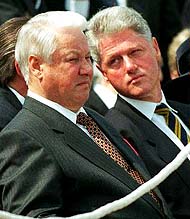
Yeltsin &
Clinton
|
No
mercy: no right for self-determination
When
Chechens asked for self-determination and the recognition by the
international community of the republic's sovereignty, no country in
the world replied, with only one exception: the Russian government
itself during a short period before CW2 broke out and the Afghan
Taliban government (tough to late, on January 16th 2000).
And the West now wonders how it is possible that among some Chechens a
sympathy for
Islamic extremism surfaced! The leitmotiv is that Russia has the right
to maintain its territorial integrity. Of course every country has this
right. But should Chechnya be considered part of Russia's territory?
History alone tells that Chechnya isn't part of Russian's territory, it
is part of the Russian Federation - an invention of the Bolsheviks -
which does not exist any more.
Chechnya
is under the Russian dominion and repression since almost three
centuries (in 1722 Peter the Great launched the first attack) and has
been slaughtered under the Tsarist as under the Soviet regime. The
inhuman deportation by Stalin of 400.000 Chechens in Siberia and
central Asia in 1944 (which followed the three already carried out
during the Tsarist era) is perhaps the most dramatic event in the mind
of contemporary Chechens. Chechens have been brutally, grotesquely, and
horrifyingly denied their freedom. They have a completely different
culture, language, religion and mentality and consider Russia as a
nazi-style barbaric regime as Russians consider Chechens altogether as
a bunch of "bandits", mafiosis and now terrorists. To put it in
Maskhadov's words: "We have nothing in common. After the shameful
barbarism that we’ve witnessed, what human relationship could we
conceivably have?"
Is it realistic to believe that now, perhaps some
political, economic and social machinery might lead to some form of
peaceful coexistence? Can there be peace in Chechnya without
independence, i.e. without questioning the so called "Russian
territorial integrity"? After all this brutality the hatred now is so
deep that the question is: can there be at all any reconstruction and
return to a durable normality under Russian sovereignty, even if the
best and most ideal agreement is achieved? I'm afraid, the times where
this option might have been available are definitively gone.
The other point is that the war is lost. As in Afghanistan, as with the
cold war, as in the first Chechen conflict, also this time Russia has
lost its second war in Chechnya. And it is time that once and for all
not only Russia, but also the so called "western world" begins to
realize this. The elementary lesson of history is that when a country
loses a war it has to retire its troops. If it doesn't, it can only get
tangled up in a never ending war impossible to win running after lost
causes and sinking deeper and deeper itself in a bottomless quagmire.
And this is precisely what we observe.
Only a strong and perfect censorship on the Russian mass media on the
issue of Chechnya makes it still possible for the government to
continue with a never ending slaughter which has already cost itself
25.000 casualties and without a general uprising of protest among its
citizens. A censorship which is not only a cause but also the symptom
of a collective psychological suppression of the recognition of its own
defeat.
What the West can do is to help Russians to realize how useless it is
to insist stubbornly in the attempt to keep its grip over a tiny
republic which it has already lost and over which it doesn't have and
can't never have any control over its administrative structure and not
to say over its "hearts and minds". If the so called "democratic"
countries really want to help Russia and honor also all the innocent
civilians killed they should convince them (and first of all
themselves!) that it is pointless to continue to deny this failure and
insist over and over again on the abstract and purely idealistic but
totally unrealistic principle of "territorial integrity", simply
because the war is lost.
Russia's territorial integrity has already been torn into pieces by ten
years of war. Physically, politically and especially psychologically. The Russians and the
Chechens have both dug
themselves into such a mutual hatred and bloodshed such that it goes
beyond any good commonsense to believe that there might be a reasonable
diplomatic and political machinery aimed at maintaining Chechnya as a
part of the Russian Federation. The attempt to preserve
Russia's territorial integrity in the frame of a durable peace
agreement is a lost cause ab initio. The insistence of the western
world on Russia to continue to pursue this vain chimera is a "no way
out" policy which has the only effect to prolong the status quo into a
never ending infinite guerrilla warfare, acts of terrorism and
atrocities.
Independence and peace are mutually interdependent, and not realizing
this is actually at the very root of this catastrophe.
But
here also the West had a clear opinion: it continued to consider the
Caucasian tensions and wars as an exclusively Russian domestic affair.
"Russia has the right to preserve its territorial integrity", is the
Western typical leitmotiv.
It is also
noteworthy that while Ukraine had been recognized by the US as an
independent entity, they did not recognize Georgia and the southern
Caucasus the same right to exist, because, so we are told, that might
have determined a chain reaction, the so called "domino effect" of
secessions among other republics and the dissolution of the Russian
empire with a possible political and military destabilization.
According to this theory a cruel and violent dominion of imperial
subjugation of millions is more effective in producing stability and
peace, than the dissolution of it and granting people the right for
self-determination. On the long run however, facts (and one might say
also the entire world history) seem to show quite the contrary. About
hundred different ethnic groups exist in the Russian Federation. The
attempt to impose any form of suppression on these ethnic identities
can only lead to centrifugal tendencies. The dogma of a "united and
integral Russia" is an obsession with everyone, and not only in Russia,
but apparently worldwide.
In the 1990s the
Georgian-Abkhazian and Armenian-Nagorni-Karabak conflicts broke out and
terrible civil wars and bloodsheds followed. It is almost unknown to
the Western public that in Abkhazia an ethnic cleansing killed 25.000
Georgians that were the majority (250.000) by the hands of a minority
of Abkhazians (90.000). This could happen only thanks to a massive
political and military support from Moscow, which as usual welcomes any
ethnic destabilizing war. Similar data one finds also for the Armenian
conflict (29.000 killed and 1.5 million refugees). Today the conflict
settled down but these regions remain still a place of tension and
uncertain future. The recognition of the Caucasian republics might have
instead contributed to sustain Russian moderate political forces, avoid
the electoral success of ultra-nationalistic quasi-fascist parties
(e.g. Zhirinovsky electoral success in 1993 and again ten years later)
and perhaps might have even controlled the renewed Russian expansionism.
But its too late
now. This worldwide refusal to recognize Chechnya's independence did
only enforce Islamic extremism demanding separation and finally led it
to terrorism. But just for this reason, the insistence to deny
self-determination finds now its new justification in turning upside
down the whole logic which goes like: "we can't recognize now the
independence of Chechnya because that would be a present to
terrorists". But can we pretend a moderate behavior from side of those
who have been completely abandoned from the international community and
to those any hope for a better future is refused? At the same time its
not entirely clear then why the very same people, after more than half
a century of war and terrorism in the middle-east, now advance the idea
that the Israel-Palestinian conflict can be solved only by building an
independent Palestinian state. And they don't see in this a present to
terrorism, but to the contrary, we are now told that it is the only way
out to it. Parallels and comparisons of Chechnya with the middle-east
conflict is always dangerous and frequently misplaced. However in this
case we can not refrain from remembering how the entire international
community pressured for an "autonomous" Palestine inside Israel. And
when, at the end of the last millennium, there has been the agreement
between Barak and Arafat, under the supervision of Clinton's
administration, where Gaza and the West Bank became finally the
"autonomous territories" of Israel, we could see how it ended. There is
no reason to believe that a Chechen "autonomous territory" inside the
Russian Federation will meet a different destiny. The hate and the
desire for wrath from both sides is now so deeply engraved that it
makes definitely the hope for a peaceful coexistence inside a Chechen
republic, with whatever "vast autonomies", a vain chimera.
Indeed, the point
is that we will have to accept sooner or later in the case of the
Caucasian republic too, that there is no other way out. To believe that
some peaceful solution might be found without Chechnya's independence
will reveal itself an utopia. There was, and still is, no other
choice than recognizing the goal of statehood and of a sovereign
independent Chechnya. Chechnya's secession, eventually under a
conditional independence under interim supervision of the UN or some
other multinational force, can help also Russia to
leave its past behind and hence step forward towards a new modern,
stable and democratic Russia. The Western refusal to grant recognition
to break away republics could instead only be interpreted by Russian
generals as a signal of a quite acceptance by the West in case of
invasion and a war in Chechnya or in every other Caucasian region.
Apparently it was
not clear enough what anyone with a reasonable common
sense knows: to suffocate the desire for liberty and oppose the logic
of history which drives towards the self-determination of peoples who
have been forced for generations to live under a repressive dominion,
could only generate renewed violence.
|
The
Kossovo war connection
In 1991
this was the same mistake the West did in refusing to recognize the
imminent dissolution of the former Yugoslavia. Western insistence to
deny people's sacrosanct right of self-determination did certainly
contribute to tensions which ended in the worst humanitarian disaster
in the Balkans since World War II.
Russia is
one of the greatest arms suppliers to authoritarian regimes like Syria,
the Iraq under Saddam Hussein, China, etc. It might be useful to
remember that in 1995, Moscow financed with $1.5 billion Slobodan
Milosevic's army which was already well known for its brutality (also
Russian volunteers were present among Serbian troops). Russia's
influence on the Serbian regime was well known too. The US had to hurry
up to convince Yeltsin to other tactics. It is no secret that in the
same year Clinton obtained the results that led to the Dayton
compromise on Bosnia only because Yeltsin had been convinced to abandon
Milosevic to his fate. While Clinton's secretary of state Madeleine
Albright was working hard to convince the international community in
recognizing Milosevic as a war criminal, she didn't however hesitate in
praising Putin as "one of the leading reformers" of Russia's history.
What did
Clinton and the allies of the North Atlantic Treaty Organization (NATO)
get in exchange? Despite the official Russian protests they got
carte-blanche from Russia for the war in Kossovo.
In April
1999, the NATO intervention in Kossovo took place. During the Kossovo
campaign, the Caucasus was a chip in the international poker game. In
order to buy Russia's passivity, it received another $4.5 billion and
the extinction of at least a part of its debts (decided in the
following G8 summit in June). In Brussels, NATO general secretary, Lord
George Robertson, condemned the offensive in Chechnya but immediately
underlined that it is Russia's domestic affair. The message was clear:
NATO asked Russia to renounce to its political and especially military
support of the Serbian regime and in exchange it got financial aid and
the Western silence on Chechnya. CW2 broke out at the end of the same
year.
|
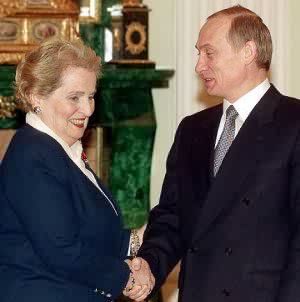 Albright &
Putin
Albright &
Putin |
The same strategy
worked during NATO's enlargement to the former Warsaw Pact nations.
Many observers advanced the hypothesis that during a summit in Moscow
in 1995, Russia obtained from the US many concessions in exchange of
its acceptance of this enlargement. One could also easily foresee that
this could give Russia only a reason more to conduct an aggressive
policy in the Caucasian region. Nowadays this hypothesis seems to be
amply confirmed.[9]
Today's Russia
has many similarities with the former Serbian regime under Milosevic.
And nevertheless, on May 28, 2002, Russia became a member of the NATO
Council. This is actually only a structure of consultation and
cooperation which has no real executive power, but a very shortsighted
and blind policy is imposing itself again which advances the proposal,
as several high ranking Western authorities do, to bring the Russian
forces, as they are today, that is without any reform and the rule of
law, effectively under the NATO umbrella. For example the Italian prime
minister Silvio Berlusconi wants Russia in the NATO and the EU. Romano
Prodi, head of the European Commission, however criticized this
proposal. Perhaps because of his concerns about human rights in the
Russian Federation and in Chechnya? No, because of purely economical
reasons.
Among other
things this policy has indirectly favored the perception based on a
widespread political cultural relativism, especially among pacifists,
according to which NATO's violations of humanitarian laws in Kossovo,
and we might also add those occurring later in the following US war in
Afghanistan and during the war in Iraq led by the Anglo-American
coalition four years later, were substantially comparable with the
abuses committed by Russian forces in Chechnya. But whatever opinion
one might have on these events it is undeniable that the number of
civilian casualties, the level of destruction and the atrocities
perpetrated in the first case, tough if present and deplorable, can not
in the least be paralleled with what happened in Chechnya. In Iraq,
Afghanistan and Kossovo, there was an attempt, even if perhaps not
sufficient and certainly not always efficient, to avoid civilian
casualties, to furnish a first humanitarian aid in form of provision of
food and medicines, to win over the population, and the press was
allowed to visit war zones and report worldwide what was going on. In
the Chechen conflict instead nothing alike could be seen: the disregard
for civilian casualties was amply evident, the deaths toll much higher,
the bombardments indiscriminate and almost no help was offered to
refugees while the media blackout was and still remains complete.
Moreover US and NATO forces did not fill Kossovo, Afghanistan and Iraq
with death squads, concentration camps and mass graves of thousands of
innocent civilians tortured and killed. Russian forces in Chechnya did.
The Chechen wars are not even remotely resembling these other
conflicts. This of course does not justify as such these wars, but a
lack of discrimination which tends to level everything on a common
denominator leads usually to falsehood and disinformation, doing after
all the interests of those who want war and not peace. In other words,
Western societies still have the right and duty to be critical on the
war in Chechnya. Its critique can not so simply be dismissed at once
simply on the ground of its violations of the Geneva conventions it
committed too in other conflicts.
Today Putin puts
into action in Chechnya what Slobodan Milosevic accomplished in a
rather botched way in Kossovo. And why does the latter
face the war crimes court, while the former is allowed to be called a
"friend" by Western realpoliticians? Of course Putin and Milosevic
can't be compared - the former has many more deaths on his conscience.
To put it in the words of the Danish expert on Chechnya, Norbert
Strade:
"The
persecution of war crimes is working well now with regard to former
Yugoslavia. But the cases against Milosevic and his gang members are
devaluated by the fact that other European leaders who have committed
far worse acts - like Yeltsin, Putin and their many accomplices - enjoy
a reputation as 'democrats' and 'friends'. This policy of screaming
double standards makes the Hague trials a farce, since it reveals that
Milosevic isn't persecuted because of the crimes he committed, but
because of his political activities against Western interests. It shows
that the Hague court isn't a legal, but a political instrument, just as
Milosevic claims. It also shows that in today's Europe you can behave
like Hitler and Stalin with total impunity, as long as you support the
geopolitical interests of the bigger powers. Of course this doesn't
mean that Milosevic, Milutinovic and the rest shouldn't be behind bars,
but they should be there based exclusively on legal reasons, and they
should be joined by everyone who committed similar or worse crimes."
Other
aspects of Western's "pragmatic realism"
However, this was
only the beginning of the cynical Realpolitik. What followed was the
Chechen humanitarian disaster. The EU, especially in its representation
under the flag of the European Commissioner for Humanitarian Aid, Poul
Nielson, was silent and inactive. In front of more than 100,000
refugees and the widespread atrocities, Nielson couldn't find in three
years the time to visit Chechnya. The curious and sad fact that for
some mysterious reason more than 70 % of the EU's humanitarian aid
"disappears" in the Russian's and/or Chechen bureaucratic quagmire, is
apparently of no concern for anyone.[10]
Meanwhile the
Western complicity seems to be not only passive but tends to become a
deliberate policy of conscious direct and active involvement in a
genocidal campaign against Chechens. According to Tilman Zülch, the
general secretary of the Society for Threatened Peoples, in March 2000,
that is immediately after the complete destruction of Grozny, a
delegation of the German intelligence agency (BND) met with Russian
special services in the Chechen capital. Thousands corpses of dead
Chechen civilians were still under the rubble and what was the subject
of discussion? The threat of Chechen terrorism! In April Germans began
providing Moscow with information delivering military intelligence for
battlefield use to the Russian side. The material delivered consisted
of information acquired through a German listening station in the Pamir
mountains, Pakistan, close to Afghanistan and China, code-name "Lanze"
(lancet), which was (or still is) able to scan the complete radio
traffic from Afghanistan and all the way to the Caucasus, including
Chechnya. Detailed information about the location of Chechen troops and
their operational plans came through BND agents working in Ingushetian
refugee camps who were (and still are?) systematically questioning
refugees about these details. The Russian side has been able to target
certain areas based on this information. After a secret session in the
parliamentary committee, a lid was placed on the story, the political
discussion stopped and the German press obediently didn't write about
it anymore.[11] Possibly the
activities are continuing even today (and this seems to be indirectly
confirmed by Germans renewed involvement on the Georgian side and
emphasized by the recent visit to Tbilisi, on 4 March 2003, of the
German interior minister Otto Schily who met with Georgian Border
Service head Lieutenant General Valeri Chkheidze, Interior Minister
Koba Narchemashvili, and President Shevardnadze. Topics discussed
included closer cooperation between the two countries' interior
ministries in the fight against international terrorism[12]). German's secret services complicity
with Russia's criminal activities seems not to stop here. J. Roth [12b], while detailing how German
investigators uncovered a complex web of relationships and transactions
that link the German company SPAG, a company set up ostensibly to
invest in St. Petersburg real estate where Putin was once a member of
the supervisory board, and his co-founder Rudolf Ritter in
Liechtenstein to the Colombian cocaine and transcontinental money
laundering for Russian criminal gangs, reports that a transcript of a
taped conversation between Ukrainian President Leonid Kuchma and his
security chief Leonid Derkach on June 2 and June 4, 2000, survived a
general attempt to destroy every information linking Putin to SPAG and
trying to shove the whole affair under the carpet. The conversation,
which was taped by former presidential bodyguard Nikolai Melnichenko,
who later fled to the U.S., had been judged to be authentic by a US
leading company run by a leading former FBI specialist, including the
conversation about Putin. If Putin's involvement in this criminal
affair is highly suspect but still lacks of a firm ground of evidences,
sure is that Russian secret services have done their utmost to buy up
all the compromising documents from their colleagues throughout Europe.
In particular according to Roth's transcript, the Germans sold them out
materials which are said to contain "genuine facts", helping them in
eliminating any possible evidence linking Putin to SPAG's illegal
behaviors. The BND's protection of Putin with regards to his possible
involvement in a cocaine cash laundering for the Cali cartel should
come as no surprise. As Roth says: "[German Chancellor Gerhardt]
Schroeder was very afraid that there were direct links between the
Liechtenstein investigations and Putin. This was a time when Russia and
Germany had good relations for the first time."
Almost certainly
all this is only the typical "tip of an iceberg". One must remember, too,
that everybody involved here keeps saying that "the others" (US,
Britain, France) "have done much more".
|
Later, in
April 2001 the EU not only ignored Maskhadov's appeals for help to
reach an armistice without any preconditions in the view of a political
solution, but even refused him a simple Shengen visa! And the last straw before the
attack of September 11th, came during the July 2001 meeting
between Bush and Putin. As it is well known the
Bush administration has on its agenda a system of national missile
defense. However on its way stood the modification or abrogation of the
Anti-Ballistic Missile Treaty (ABM) which the Russian side still
considered a valid agreement. In an extreme attempt to change Putin 's
mind on the subject, Bush made extraordinary public endorsement of him,
sympathizing with Putin's deep "concern about extremism and what
extremism can meant to Russia". His public support and unwillingness to
criticize Russian means in Chechnya, abdicating US authority to speak
out about human rights in Russia, did however not convince the Russian
President to follow him in the so called "star wars" project, and
obtained only the result of reassuring him that he continues to have a
free pass in Chechnya.
|
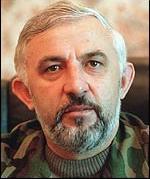 Aslan
Alijewitsch Maskhadov
Aslan
Alijewitsch Maskhadov |
The alliance
between the Western liberal and democratic nations with a rising
illiberal criminal power nostalgic of its imperial past was already
strong and an established fact. Only two months later Bush will have to
confront with the most devastating terrorist attack in US history led
by extremists once supported by the United States and inspired and
financed by an Afghan Taliban regime which was after all the outcome of
another Russian-Soviet senseless war: today one of the most cited and
well known results of pragmatic realism.
The
holy "anti-terorism" alliance
After
the attacks on the Twin Towers, the West has deep concerns on Chechen's
terrorism and its state heads don't miss a chance to express their
condolescence to Putin when someone dies by the hands of Chechen
terrorists. Immediate are the US' and EU' offers of logistic and
intelligence support in sign of solidarity when Chechen terrorist stage
an attack. This is obviously all fine and well: acts of terrorism must
of course be unreservedly condemned. In different occasions
they expressed their condolescence also when Russian soldiers died
during military operations (typically when Russia suffers heavy
casualties because of Chechen rebels shooting down military
helicopters). This is fine too: every loss of life, be it of civilians
or soldiers, is regrettable.
But
not a word of condolescence came for the 150,000 civilians bombed,
tortured, raped and killed by Russian forces. Not a single question
came from Western state heads for the whereabouts of the 3000
"disappeared". And not a single offer of humanitarian aid for the
hundreds of thousands of refugees has been heard from the side of
Blair, Chirac, Bush, etc. With the war on Islamic
terrorism the West found a reason more to continue with its deafening
silence, almost never rising its voice against Russia's federal forces
daily abuses. If on terrorism now it rages a war, on state terrorism at
best it turns blind eye and frequently it even allies with it. US
Deputy Secretary of State Richard Armitage during a visit to Moscow
said that the United States are working "very closely" with Russia and
that "anyone who kills civilians for political aims is anathema to us".
One should have asked him why then he was shaking the hands of those
responsible of the slaughter of thousands of innocent civilians and why
the administration he makes part of now considers the sufferance of
those crippled, tortured and robbed only a little disturbing but quite
normal necessity to establish a worldwide anti-terrorism alliance and
"security" system.
Chechens
separatism is now frequently linked with Al Qaeda. Interesting is that
Putin has played a major role in changing the image of Chechens from
"separatists" (early in his presidency in 1999-2000) to "international
terrorists" (especially after September 11th) to "Islamic
terrorists with global ambitions" (after October 23, 2002). However,
fact is that, so far, not a single Chechen was found among the
Talibans in Afghanistan (but Americans and Australians have been
found), nor has any Chechen been arrested in the worldwide sweeps
against international terrorism after September 11th. There
was not a single Chechen in Guantanamo Bay, the US naval base in Cuba
where suspected Al-Qaeda and Taliban militants are being held (but
there were eight people from Russia and another eight from Britain!).
That stories about connections between al-Qaeda figures Mohammad Atta
and Ayman al-Zawahiri, who supposedly trained in Chechnya, are not
well-documented and came out long after the fact and in the context of
the post-September 11 anti-terrorism efforts. There are a number of
Arab fighters who were detained in Georgia's Pankisi Gorge, an area not
far from the border with Chechnya, where many Chechen militants are
believed to shelter, but this is all one-way traffic: this might hint
to extremist Arabs taking an interest in Chechnya but there are so far
no confirmed reports of Chechens actually leaving Chechnya and fighting
outside.[13] Also during the war in
Iraq, Chechens fighting for Saddam were reportedly arrested and
detained. Considering that Saddam stood officially always on the side
of Russia against the Chechen cause this sounds really strange and
would require a better check. But in spite of all these statements,
none of the Chechens were ever shown, whether dead or alive, and these
rumors so far had not been confirmed officially. Thousands of western
journalists visited Afghanistan and reported about every sort of
findings among the Taliban sympathizers but not one journalist reported
about an encounter with a single Chechen. Among the 3,500
al-Qaeda/Taliban prisoners of war held by the Northern Alliance at
Shiberghan, not a single Chechen has been identified.[13b] Finally it is also noteworthy that
during the ten years long conflict, so far, not a single human being
has been killed by chechen rebels beyond the Russia-Chechen borders.
Indeed
strange coincidences occur which might in fact suggest links with
international terror organizations. A terrible suicide bombing in
Chechnya on May 12, 2003, against the police and FSB headquarters in
Znamenskoye, which killed 55, was followed by explosions that
devastated Western compounds in the Saudi capital, Riyadh, 14 hours
later. Russian officials immediately sought to link the two events.
President Vladimir Putin said the attacks 1,300 miles apart followed an
"absolutely identical" scheme and caused "absolutely comparable"
devastation. Alexander Yakovenko, a spokesman for the Russian Foreign
Ministry, said, "The blasts in Saudi Arabia, Chechnya and other places
-- these are links in the same chain." However, again officials didn't
offer any evidence beyond mere speculations for their claims. Also this
hypothesis remains so far only a part of a great Chechen-Al Qaeda
unproved conspiracy theory.
Summarizing,
If there is an Al Qaeda link it can't be that great and extensive as it
is continuously suggested. After all its not difficult to understand
how all this can be. Actually Chechens have much more serious things to
worry about than fighting in Afghanistan, Iraq or elsewhere outside
Chechnya! And if there is any Al-Qaeda's embrace of Chechnya or some
Al-Qaeda website featuring scenes from the Chechnya war in order to
motivate their own sympathizers, this does not necessarily mean that
Chechens have embraced Al-Qaeda. It is not unlikely that the Russian
FSB works hard to exaggerate and manipulate such stories because of
Russia's interest in positioning its war as part of the wider fight
against terrorism (like for instance to stage a farcical attempt to
kill Putin by chechen snipers, as it turned out on October 2003 in
London). Moreover there is definitely a difference between an Al Qaeda
and the Chechen separatists demanding self-determination: with the
former there is no chance of any possible negotiation, whereas the
latter are only waiting the Kremlin for a political talk which however
refuses to engage in any negotiations. But the central point remains
that Chechen terrorism, with or without having any sort of links with
international terror organizations, has its source in a frustrated and
brutalized generation compelled to live in a territory without rights
in which laws and international conventions are suspended. Things can
not be simplified by a mere ideological embrace of Islamic
fundamentalism. The origins of terrorism in Chechnya have noting in
common with what induced the well educated and well-off Saudi Arabian
kamikaze to fly into the Twin Towers. Chechen terrorists simply don't
need Al Qaeda. The basic human rights violations against their families
is amply sufficient to motivate them and it is easy to predict that
unfortunately suicide attacks will remain commonplace if nothing
changes for the better in the little break away Chechen Republic.
And
the West approves. The already extremely reluctant and inactive Western
policy with regards to human rights is now definitively fading away as,
after September 11th, Putin asked free hand to abuse without
criticism combatants and civilians in Chechnya, in exchange of his
active engagement in the holy alliance against the global war on
terrorism. The US blind eye on Russia's genocidal activities, abusing
the concept of a "war on terrorism", increased also because of its
desperate search for allies in an attack on Iraq (just during the Iraq
crisis the US State Department declared three Chechen organizations to
be terrorists: two of which apparently don't exist and one isn't even
considered a terrorist organization by Russia itself! [14]). This led the Bush administration more
than ever into complicity with the most bloody regime in Europe since
World War 2. This did however not lead to the hoped results: Russia
finally opposed the intervention in Iraq.
Anyhow,
even if Al Qaeda is or will be present in Chechnya this should not
surprise: Chechens, devastated by the Russian onslaught and by western
cynicism, might now take help from wherever they could get it. Or, to
put it in Jessica Stern's words, an expert on terrorism at Harvard
University: "The
conflict in Chechnya is about independence, it has nothing to do with
Islam, but this is a good example of a group of rebels who recognize
that if they describe themselves as mujahedeen, money will come pouring
in." Vain seem to be the appeals of Elena Bonner (widow of Dr. Andrei
Sakharov, the renowned Soviet physicist and Peace Nobel laureate), who,
when asked about the roots of terrorism in Chechnya, replies: "It comes
from a decade of war, chaos and corruption in the Russian army,
marauding, robbery, endless cleansings of civilian population, the
disappearance of people, torture, execution without trial of civilians,
and secret mass graves that have been discovered in almost every region
of Chechnya."
Most
Chechen are Sufi Muslims, i.e. belong to the mystic and more peaceful
stream of Islam, and have no sympathy for Islamic fundamentalism.
However, the brutality of the conflict is forcing them towards the
extremism of the Wahhabi Muslims - exponents of one of Islam's most
belligerent movements. Wahhabi militants had until recently almost
none support among the Chechen population. Even now, Chechen human
rights workers estimate that only around one tenth of the population is
sympathetic to the Wahhabis. The term "jihad" and the notion of a holy
war was practically unknown in a secularized chechen society. Still in
the 1997 presidential elections, a candidate as Movladi Udougov, who
placed the Islamic rhetoric at the center of his electoral campaign,
could not score higher than a 0.9% of preferences.
Unfortunately
some Chechen warlords, Russia and the international community seem to
do their best so that this might change with time passing by. The
danger is that just this realpolitical international "anti-terrorism"
policy, which leaves a desperate population alone, will instead
definitely open the gates of Chechnya to international Islamic
extremism. Because it is this what might now appear, in the mind
of many Chechens, left alone and confronting with a genocide, the only
possible solution left.
There
seem to be also other interests behind American's anti-terror policy
which are less known. In the Pankisi Gorge, which is populated by
Georgianized Chechens and many Chechen refugees, is officially
considered by the US administration as an al-Qaeda terrorist hangout.
Colin Powell told to the world about al-Qaeda agents located in the
Pankisi Gorge during his speech before the UN over Iraq. But again, so
far no convincing and tangible evidence has been found and at no time
before September 11, 2001 did anyone credibly propose that al-Qaeda
terrorists were present in Pankisi. Also several journalists, looking
high and low through Pankisi, staying with the Chechen guerrillas and
refugees, tried to find evidence for al-Qaeda's existence. Turks,
Azerbaijanis, Afghans and according to M. Irkali, even one Japanese
fighter was found, but no al-Qaeda. And, apart from these sporadic
guerrilla, generally the situation appears to be calm: even President
Shevardnadze invited French Interior Minister Daniel Vaillant to
Pankisi gorge to get him familiar with the current situation there and
"to make him sure that there is no danger there", he declared during a
briefing held in the State Chancellery on May 12, 2003.[15]
Perhaps
one key to understand US insistence on the al-Qaeda presence in Pankisi
is to recall that the American army is already in Georgia and the
forces stationed there will soon - without any enemy - be much larger.
A US-Georgian military agreement is opening up the country to an
undetermined number of American bases: it provides without visa the
entry into the republic of US soldiers, positioning on its territory of
American military technology, armaments and their free movement.
Officially to train Georgian armed forces in the fight against al-Qaeda
terrorists. Russian and the U.S. security agencies take part in the
"normalization" of the situation in Pankisi. Then one should also not
forget that the US are building the Baku-Tbilisi-Ceyhan oil pipeline,
which will be operational by 2005. Georgia, eager to move out of the
shadow of its huge neighbor Russia, has aggressively pursued ties with
the United States and offered use of Georgian air bases for the war in
Iraq. In summary the al-Qaeda/Pankisi theory is at least partially a
fabricated myth. It looks much more as a pretext to justify US growing
military presence in Georgia and to guard future military, strategic
and commercial interests which are still in Russia's sphere of
influence.
The
«Chechen terrorist trace» seems to have been fabricated for political
purposes or, if it really exists, it has been greatly exaggerated. The
frequency and continuity of these unconfirmed reports seems to hint at
the conclusion that it is supposed to leave a trace in the minds of the
Western public in order to weaken the opposition against Russian abuses
and crimes in Chechnya.
However
it is, the main point is that political, strategic and economical
interests are put forth on the back of Chechen refugees who are now
continuously accused of protecting al-Qaeda members in their community
and the Chechen cause is criminalized worldwide, because this turns out
to be a convenient and easy strategy to achieve some precise goals.
Especially in Georgia and Ingushetia arrests of refugees as "members of
terrorist organizations and gangs" in the context of a general
anti-terror campaign does not have to be based on convincing evidence.
Illegal detentions, improper behavior towards people, and looting in
the course of a sweep-up in the region are an everyday occurrence.
There seem to be cases of refugees disappeared without trace after
being arrested by Georgian police. Refugees complain that the
activities of the Georgian security forces are no different from the
barbaric tactics employed by the Russian occupying forces in Chechnya.
Russia then asks for them to be handed over, accusing them of terrorism
and other serious crimes. For a Chechen to be extradited to Russian
prisons frequently means that he will have to go through the torture
chamber and die. Moreover, the indirect effect of this criminalization
is that humanitarian support and medical assistance (many of them are
chronically ill, and struggled to survive the winter) is absolutely
insufficient with an international community that remains almost
completely indifferent. As Ozerskaya writes[15b]
: "The precarious situation of Chechen refugees in Georgia may
deteriorate even further in response to world events. Moscow's
disapproval of the military agreement between Georgia and the USA may
force Tbilisi to reach some compromise with Russia, for example in
resolving the painful question of the Chechen refugees. They may become
pawns in the great political game being played out by states in
conflict. What will become of them, desperate to find shelter no matter
where, yet kicked under the carpet by Moscow's military policies, the
inhumanity of Georgia's security forces, and the apathy of the whole
world?"
In
the Arabic world and also in Turkey every sober man on the street knows
very well that the Chechen fight for freedom and independence from the
Russian repression is justified on every ground. One has not to be a
fanatic follower of the Jihad or devotee to an Islamist sect to have
this view. If the Western society will continue to allow only Al Qaeda
to be the only helper of the Chechen cause, the war on terrorism might
take the wrong way. The former Israeli Defense Minster, David Levy, who
declared that "Russia has no other way... than to fight against
terrorism with all available means"[15c] underlines only how he
has no understanding of the situation. The idea that Russia's "war on
terrorism" might be a guarantee against the proliferation of Islamic
extremism in Asia and abroad sounds as an irony. And it seems that
Russia, Europe and the USA did not learn the lesson of Afghanistan. The
Taliban government came to power as a direct consequence of the
yearlong Russian invasion that bombed Afghanistan back to the stone age
reducing the population to desperation, misery and illiteracy. In this
material, social and political environment Al Qaeda found a fertile
ground to grow up. Will Chechnya meet the same destiny?
The
double standards policy
Only
recently, fortunately, after the constant pressure of human rights
NGO's and the rare but sometimes effective media reports about the
atrocities in Chechnya, it became clear that the Chechen problem is
also a political one and can not be solved only by military means. Now
the West conducts a double standard policy: it expresses pity for
civilian victims and pleads for a vague "political solution" but, at
the same time, it never forgets to add its "understanding" for the
difficult situation the Russian authorities have to confront with. An
unambiguous message does however not emerge. And so far, to these
declarations, did not follow a clear pressure on Russia. The West
continues to be far away from taking any necessary initiative. A
resolute condemnation of Russia's war crimes and crimes against
humanity from the side of its state heads, as they do with Chechen
terrorism, is not contemplated. This typical attitude, full of
carefully modulated statements of "alarm", "concern" and "humanitarian"
declarations seems directed much more towards its own human rights
groups, which after all can't be totally ignored in a liberal system,
than really aiming towards a change of mind in Moscow's authorities.
Because the same statements are frequently mixed with an
"understanding" for the perpetrators of the crimes they denounce.
But
Chechnya serves also as a reminder of the double standards that persist
in the international public opinion and in the so called "antiwar
movements". If an Israeli army colonel abducted, raped, and strangled a
Palestinian woman, the case would likely send shock waves around the
world and we would see mass demonstrations all over Europe. Yet we
don't see almost no Western "intellectuals" comparing the Russian
military to the Nazis or that are somehow engaged for a peaceful
resolution of the Chechen case (there are however notable exceptions as
for instance the French philosopher André Gluksmann or British Oscar
winning actress Vanessa Redgrave). No one is calling on universities to
divest themselves from companies that trade with Russia or for
boycotts, as it is frequently the case with the state of Israel. And
nevertheless the human rights violations in Israel are incomparably
less than those occurring in Chechnya. Double standards appear also
among pacifists: the violations of the Geneva Conventions to Taliban
prisoners held at Guantanamo Bay in Cuba inflamed European public
opinion. However the fact that thousands are illegally detained,
tortured, raped and killed in Chechny's filtration camps seems to be of
no concern for anyone of them.
What lacks is a
psychological identification with the Caucasian culture, story and
history. Most Europeans and Americans even don't know where Chechnya is
and almost no one perceives it as a part of Europe. It simply doesn't
resonate with peoples psychology, imagination, feeling and perception.
A lack of oneness with its culture is the missing link. But this has no
justification and is based only on ignorance. Chechens are far more
likely to dress in leather jackets or traditional headscarves than
chadors.
The
approval to a genocidal policy by the "humanitarian" Europe
It is quite clear
that the commercial and political consequences, in case of criticism,
might be unpredictable for most politicians with weak ideals. The fear
to irritate the Russian bear is strong in almost any politician,
diplomat and bureaucrat who are not accustomed to manage truth. The
grip of the powerful forces of fear play with their shortsightedness
and their empty moral status, controlling almost entirely their
political actions to such a degree that even the structures originally
conceived for humanitarian purposes became instead just the voice of
those they were supposed to resist. Putin can conduct his bloody war in
almost perfect tranquillity.
Among other
things the Council of Europe (CoE), its parliamentary assembly (PACE)
and especially the Organization for Security and Cooperation in Europe
(OSCE) have been conceived for monitoring and controlling the respect
of human rights throughout 55 European states. The OSCE mandate spelled
out that it had a duty to "promote respect for human rights and
fundamental freedoms, and the establishment of facts concerning their
violations." But its far too mild criticism against human rights
violations has been so far its distinctive sign.
The aims of the
CoE are among other things those "to protect human rights, pluralist
democracy and the rule of law and to help consolidate democratic
stability in Europe by backing political, legislative and
constitutional reform". The statute of the CoE states that every
"European state can become a member of the Council of Europe provided
it accepts the principle of the rule of law and guarantees human rights
and fundamental freedoms to everyone under its jurisdiction".
Russia's
accession to the CoE required that it prosecutes crimes from CW1, but
nevertheless its failure to do so has never seriously jeopardized its
membership. How could Russia, despite its gross human rights
violations, become a member? The facts are well
described by Ib Faurby[16]:
"In May
1992, Russia had applied for membership of the CoE, which had initiated
the procedure for evaluating the Russian application. In early February
1995, however, PACE suspended the procedure due to the war in Chechnya.
[...] Despite reports from its sub-committee on Human Rights, which
documented continued violations of international humanitarian law, the
CoE resumed deliberations on the Russian application for membership. As
late as January 1996, the subcommittee delivered yet another report,
strongly critical of the general legal situation in Russia. Regarding
Chechnya it stated that the war had intensified and that the Russian
forces were committing severe human rights violations, contrary to the
promises given to the Council of Europe. Nevertheless, a week later the
Parliamentary Assembly voted in favour of admitting Russia to the
Council of Europe. The original demand that the war in Chechnya should
be brought to an end before Russia could become a member was dropped.
And this was precisely at a time where the war was escalating with
large scale attacks on undefended villages and towns - notably the
atrocious attacks on Sernovodsk and - for the second time - Samaski in
March 1996."
After all Russia
pays $25 million a year to PACE. No peanuts!
Miriam Kosmehl
recalls how it was just Rudolf Bindig, a German European
parliamentarian and a PACE member of the Legal Affairs and Human Rights
Committee, who justified admitting Russia to the council by saying that
council members should differentiate between the "human rights
situation" and a "political evaluation of the chances and perspectives
for an improvement [of the situation]."
"Bindig
admitted that Russia had not fulfilled the conditions for admission,
but argued that the key question was whether Russia's entry could
prompt it to move closer to the standards of the Council of Europe. The
majority of members gave Russia the benefit of the doubt, and accepted
Russia as a full member, assigning it 18 seats in the council's
parliamentary assembly and making Russia one of the five largest
national delegations alongside France, Italy, Britain and Germany."[16a]
The former
dissident Sergei Kovalyov, Russia's best-known human rights defender,
has recounted a sharp exchange he had with Ernst Muehlemann, the Swiss
chairman of the Council of Europe's committee on Chechnya during the
1996 presidential election campaign. Kovalyov complained that the
council was being soft in its criticism of Russian war crimes. He says
that Muehlemann responded by saying, "What do you want? For [Communist
Party leader Gennady] Zyuganov and not Yeltsin to be chosen at the
elections?"[16b] This reflected
what would have become a quite normal state of affairs.
During CW2 in
fact the same policy continued. While the refugees crises was becoming
increasingly unsustainable (200.000 living in the worst material,
sanitary and hygienic conditions in tent camps) no country which signed
the Geneva convention was willing to pretend an application of the
international humanitarian law. Russia bombed schools, hospitals and
market places with no regard for the civilian population, and those who
survived were forced to flee. Meanwhile, on May 5, 1998, Russia
ratified the European human rights convention and the convention for
the prevention of torture and inhuman or degrading treatment or
punishment. At the end of July 1998 it passed a law on the suppression
of terrorism which far from offering protection from human rights
abuses, encourages them: article 21 states that those involved in
counterterrorist operations cannot be held legally liable for injury to
the life or health and damage to the property of terrorists. On October
20,1999, Russian Scud missiles stroke on an open market place killing
137 civilians and injuring 260. The images went throughout the world
media. On October 25, the Italian foreign Minister Lamberto Dini said
that the EU is discussing eventual "restrictive measures" against
Moscow. Obviously nothing concrete followed, and Europe's infinite
patience towards Russian's war crimes continued more than ever. And
also the public opinion did not feel it necessary to manifest against
the "collateral effects" of a war, as it is usually accustomed to do.
On November 17 Médecins Sans Frontiéres sent an open letter to all the
presidents and prime ministers of the OSCE asking to intervene and help
with humanitarian supplies. A couple of days later the OSCE member
states in Istanbul call for a political solution and on December 6
Moscow launches its ultimatum to the population of Grozny: they have to
surrender or will face a massive and fast extermination. This was
perhaps a little bit too much and on December 10, at a summit of the EU
heads in Helsinki, a clear condemnation of Russia with the request of
an immediate ceasefire was voiced otherwise the threat to cut some
financial aids could become an option. This had some effect: the
ultimatum was suspended. At this point Moscow realized what kind of
strategy would have been the best: not a massive bombardment which
could penetrate the heavy censorship curtain, but a silent terrorizing
action of kidnappings, torture and extrajudiocal killings by Russian
death squads on the civil population was the key. A slow genocide. And
indeed, from that point on no European authority felt that it had any longer to take
any new concrete action against the war in Chechnya. When the Spanish
diplomat and Commissioner for Human Rights of the Council of Europe, Mr
Alvaro Gil-Robles, visits on February 24, 2000, the capital city of
Chechnya, Grozny, which is completely razed to the ground, he
apparently didn't feel any shame in declaring his satisfaction about
how Moscow is doing great efforts in helping civilians. Independently,
in an issue of the same month of the German quarterly "Der Spiegel",
Lord Robertson added that the West must "understand" the Kremlin's
intervention in Chechnya, because NATO possesses evidences that
"without doubts prove how there are terrorist" in Chechnya.
PACE suspended on
April 6, 2000 the voting rights of the Russian delegation. But the real
exclusion of Russia could have followed only through a meeting of
European foreign ministers. Obviously no European foreign minister or
member state wanted to break with Russia on account of human rights
violations. On
September 29, 2000, the CoE adopts a resolution that condemns Russia
for its "indiscriminate attacks and bombardments", but magically begins
to talk again about how "encouraging progresses have been made".
Therefore on
January 25, 2001 the 18 Russian representatives triumph striking back:
their rights have been reinstated. The official justification forwarded
by president Lord Russel-Johnston was again that the CoE sees "a change
of attitude by the Duma [Russia's lower house of parliament] and in the
Russian delegation".
The magical wand
of the right for a "humanitarian interference", so insistently
advocated for Kossovo and later for Irak, suddenly disappears for the
Caucasian crises. Article 8 of CoE status, which governs expulsions from the
CoE, has so far shown to be meaningless.
On 16 April 2002
the Russian President's special representative for human rights in
Chechnya, Vladimir Kalamanov, who received more than 2,000 applications
from Chechen inhabitants complaining about the actions of Russian
servicemen and who declared that "no crime will be left unpunished",
while until today almost none of these found any resolution, received
from CoE's Secretary General Walter Schwimmer a Pro Merito medal in
recognition of his efforts to protect fundamental rights and freedoms
of individual citizens in the Chechen republic! And at the end of 2002,
Schwimmer felt free again to state that "in six years Russia [...] has
adopted its legislation to the necessities of the European Convention
on human rights" because "it abolished de facto the application of
death penalty". Not a word came in this statement about the fact that
this legislation was only a piece of paper of no value in the true
Russian and that summary extrajudical executions were a daily reality
in Chechnya[16c].
Finally the CoE
submitted itself to the Russian criminal regime again and in fact
became its obedient puppet.
Another typical
and frequent diplomatic strategy aimed at downplaying Russian's
responsibilities by overemphasizing the abuses of Chechen militants
placing them at the same level of devastation and terror of federal
troops during their cleansing operations, so called "zachistkas", or
even equalizing the aggressor with the victim. This is again another
symptom of the international unwillingness to tackle with the problem
seriously. Using Zakayev's words[17]:
"It is not
Russia, but Chechnya that is ablaze today. Mass graves of people
tortured to death are not in Russia, but in Chechnya. It is not
residents of Russian, but Chechen cities and villages who completely
disappear at night. It is not one third of Russia's, but Chechnya's
population that is living in tents and wandering around the world
without accommodation and the right to self-defence. [And we might add
that it is not 15% of Russia's, but of Chechnya's population that has
been exterminated.] For this reason, it is hardly correct both from a
legal and moral point of view to equalize the actions of butchers and
victims - the Russian military grouping and Chechen resistance
fighters."
|
The
CoE was and remains substantially passive. For three years, especially
through the voice of the former mandate of the CoE for Chechnya, Lord
Judd, it boasted about the "progresses being made" and the "gradual
improvements of the situation". Judd declared candidly to Politkovskaya
that he will never take any steps and do nothing to break the
impenetrable information ring which surrounds him and filters his work
in Chechnya, simply because it is more peaceful for him. This
incredible confession was complemented by Mr. Jorma Inki, a Finnish
diplomat, head of the permanent mission of OSCE observers in the
Chechen Republic up to 1 January 2003, who went on about his being
"just an old Finnish man" and about "a pension soon". He wants to live
until he reaches it and he is just about to get it.[17a]
Iits
now almost ten years that we hear uncountable declarations which
announced a positive change but it still remains a mystery where all
these encouraging progresses, improvements and changes of attitude have
taken place. Facts showed that truth is different. And true seems to be
also that a sort of unconscious fear hampering any real action against
Russia favored unrealistic views according to which a long and
painstaking quite diplomatic work should lead to some betterment. The
common belief of the European diplomats was that talks and cautious,
indulgent and long private diplomatic efforts, mixed with a tendency to
excuse Russia's crimes, would sooner or later produce better results
than clear public criticism. And while the CoE seems more interested in
passing (sometimes very ambiguous) resolutions, in holding seminars and
meetings, its weakness in actively bringing humanitarian relief to
refugees who are starving and freezing in tent camps or forcibly
returned to the war zones, remains amply evident: doing otherwise would
entail an indirect recognition of Russia's responsibilities.
|
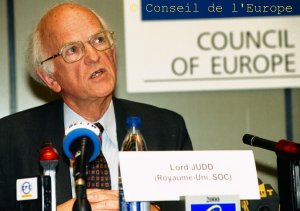 Lord Judd
 |
It
was easily predictable that this cynical policy could not change
anything. Quite the contrary, while Europe was talking and writing with
tact, Moscow showed to be quick to seize on its self-serving motives or
double standards as an excuse to ignore its advice. The adoption of an
obsessing political correctness and indulgence with regards to Russia's
war crimes is obtaining the opposite results: now the CoE is used by
Russian media to suggest that in Chechnya things have changed
substantially, that schools are being filled, houses are being built
and that jobs are available. Just that organization originally
conceived to monitor on human rights violations is now used to shield
it.
One
example of the Council's ineffectiveness might be clarified by
observing its attitude to a recent referendum held in Chechnya. Let us
focus in detail particularly on this event.
Putin's stratagem was to stage in March 23, 2003, a referendum in which
Chechen voters were asked to approve a constitution that, according to
the propaganda, purports to give Chechnya a "large degree of autonomy",
including its own president and parliament. It will be followed by
elections by the end of the year. This might sound interesting and be
welcomed by everyone who hopes for a political, democratic and peaceful
solution of the conflict. However, looking behind the scenes, things
acquire a very different aspect and it becomes clear that everything
points exactly in the opposite direction. Those having the skills to
understand the intricate bureaucratic and legal language of the
constitution proposed in this referendum realized that Chechnya will
remain part of the Russian federation and the right for independence
isn't contemplated. The President of PACE, Mr Peter Schieder, asked a
Commission to draw up an opinion on the draft Constitution of the
Chechen Republic on January 17th 2003. On March 14-15 (only
a week before the voting!), without expressing an opinion whether it is
opportune to hold the referendum, they however clearly outlined how
such Constitution doesn't meet in many regards the standards requested
for a democratic country: it reiterates Chechnya's status as part of
Russia (the word "sovereignty" mentioned in the constitutions of other
ethnic republics like Tatarstan and Bashkortostan isn't mentioned), the
Chechen citizenship is abolished while other national republics of the
Russian Federation have their own citizenship, only the Russian
language, which is a mother tongue of less than 5% of the Chechen
population, is established as the only official language, any candidate
for presidency who espoused an independent republic was not allowed to
register and run in the election campaign, the Chechen president can be
deposed by the Russian president (and the Chechen president needs not
to be an ethnic Chechen or a person who has had any connection to
Chechnya), contrary to any international standards the Chechen
president can appoint half of the members of the Central Electoral
Commission, the Chechen parliament can be dissolved by the Russian
parliament, there is no mention of Chechen institutions belonging to
education and culture (i.e. the Kremlin can impose its desires even on
this aspect), the federal procuracy will have complete control over the
Chechen procuracy, including appointments, and determining the duties
and responsibilities of the republican procuracy officials, the judges
"answer to" Federal law but are only "guided by" Republican law,
contrary to other federal constitutions there are no human rights that
can not be restricted in case of emergency, the exploitation of
Chechnya's resources by federal institutions without Chechens consent
remains possible, and if Chechen political organizations are not
branches of all-Russian political organizations their right to
participate in the elections as independent entities is denied.[18] This is what Putin calls a "broad
autonomy" for Chechnya.
In
any case, this referendum has been held despite that there was a lack
of any public security, there were no free pluralist media (many
families in the war-torn republic do not even have a television), there
was no freedom of political parties, no public debate, that those who
were allowed to compete for office have been handpicked in advance by
the Kremlin and are unlikely to raise objections to Russian forces'
repressive behavior in Chechnya, that there was no participation of the
earlier elected representatives (e.g. Maskhadov), Chechens had no
opportunity to oversee the vote counting and apparently no organization
dared to present itself as a political opponent: no groups have
registered to campaign against the referendum. "Improper results" of
the referendum in any city or village could at any moment be punished
by a punitive raid – a so called ‘zachistka’. In Chechnya the
population was facing a dilemma whether to go to a «polling station» or
disappear in filtration camps and, just to add some more humiliation,
the 36,000 Russian permanently stationed soldiers (23,000 of the
Russian Defense Ministry, 9,000 of the Russian Interior Ministry, and
4,000 border guards) were allowed to vote, while most of the displaced
people were not. Last but not least, it goes beyond satire that,
because of an outdated census held in Chechnya in 1989, and another
ridiculous one of October 2002 (where, despite the war and refugees,
the residing population has grown!) it seems that hundreds of thousands
dead were allowed to participate: there is no guarantee that those dead
souls have not been "resurrected" into pro-Moscow voters!
During
the last weeks before the vote, authorities were using threats to
pressure people into voting. Chechen refugees were requested to fill
out a consent form to taking part in the referendum. Those who refused
to fill out the form were automatically denied their bread by the
Ingushetia Migration Service. Officials have struck off the bread lists
a large number of refugees. Authorities silently warned that if a
street, region or village won't vote as it suppose to, problems might
begin - there will be no electricity, gas and pensions will arrive late.
Was this a
fair and democratic referendum? Does a referendum held under gun
barrels shoved to people's heads and in such social and political
conditions mean anything? Is it sensible to expect that this
Soviet-style maneuver, executed under the bayonet, might act as a magic
wand and bring peace? Or to put it in Olivier Dupuis words, a European
parliamentarian of the Transnational Radical Party, isn't this a "farce
of democracy in which tens of thousands of Russian soldiers will vote
in place of the very people they murder, imprison and torture every
day, in place of the hundreds and thousands of Chechens who have been
driven into exile"? Or, as Ilyas Akhmadov, the Minister of Foreign
Affairs of the Chechen Republic of Ickheria says, isn't this apparently
democratic referendum not instead a "crime against democracy", a
"travesty of free will" itself?
But
perhaps the most important and urgent question we should ask ourselves
is why after all Moscow's authorities were so anxious to held as
quickly as possible a referendum and elections which, according to
international law and any democratic rules, have clearly no value?
After
the terrorist attack on the Dubrovka theater, which showed clearly and
worldwide that, contrary to official statements, the situation in
Chechnya is far from normal, Russia' strategy is now that to use this
referendum and election in order to reach some precise goals:
1) Setting up an apparently democratic process that should "save the
appearances", to give the impression to its own internal public
opinion, but also and perhaps especially to Western governments, how
Chechnya is returning to normality.
2) To put everyone in front of the given fact: the Russian backed
government has to rule over Chechnya and that Chechens must forget
about self-determination. After having been slaughtered, tortured,
crippled, raped and robbed for centuries this "referendum" should show
how Chechens still agree to be part of the Russian federation and want
to be guided by a government which is after all only the Kremlin's
voice.
3) Convince everyone that, having this new government, a political
solution between Russia and those moderate forces struggling for
democracy and human rights is no longer needed.
In
other words: Moscow was trying to sell, especially to the West, its
policy in Chechnya.
And what was Europe's answer?
Continues
--->>
Bibliography & References
[1]
From "North Caucasus Conflict: a day by day timeline",
http://www.cdi.org/issues/Europe/feb.html.
[1a]
From an Interview with Sergei Stepashin in the Nezavisimaja Gaseta,
14th January, 2000. & NBC interview with Stepashin - NBC exclusive:
"Former prime minister held secret meetings to discuss assault", by
Dana Lewis, NBC News correspindent, Moscow, Feb. 2, 200.
[1b]
The Russian Politician: War in Chechnya - honourable resistance or
terroirism? by Anssi Kullberg- pubblished in Finnish in Turun Sanoma, 8th
Nov. 2002.
[1c]
"Against deadly silence, the truth", by Michaela Pohl/Vassar College.
Review of Anna Politkovskaia, "Tschetschenien: Die Wahrheit ueber den
Krieg", The Chechen Times, http://www.chda.nl/details.php?id=561〈=eng.
[1d]
From a speech of Zbigniew Brzezinski at the American Enterprise
Institute in Washington D.C., December 10, 2003.
[2]
"The Drama Behind 'Nord-Ost'", by Vyacheslav Izmailov. Perspective,
Volume XIII, Number 2 (November - December 2002).
[2b]
"The Big Boss Runs for President", by Usman Dikayev, August 24th 2003.
The Prague Watchdog.
[3]
AFP September 26, 1999.
[4]
Anne Nivat, the Moscow correspondent of the Le Nouvel
Observateur, "Chechnya: Brutality and Indifference", January 6, 2003.
Nivat is one of the most experienced Western journalists covering
Chechnya. Her reporting is based on months of living in wartime
Chechnya. She is also author of the book: "Chienne de Guerre: A Woman
Reporter Behind the Lines of War in Chechnya".
[4b]
http://www.lenta.ru/russia/2003/04/25/litvinenko/
& from an Anna Politkovskaya article on Novaya Gazeta of May 5,
2003.
[4c]
"Russia - Annual Report 2003", Reporters without
Borders. http://www.rsf.org/article.php3?id_article=6529.
[4d]
Chechnya Weekly: News and analysis on the crisis in
Chechnya, 26 September 2003, Volume IV, Issue 34.
[4e]
"Where is Abubakar?", Chechnya Weekly Volume 4, Issue
19 May 29, 2003.
[4eb] "FSB never forgets insults", 3.11.2003, PRIMA
News Agency & "Real Moscow apartment blocks explosions organiser
named", 14.11.2003, PRIMA News Agency.
[4f]
"The Moscow Hostage Taking: One Year Later", by
John B. Dunlop, Regional Analysis, RFE/RL, 27 October 2003.
[4g]
"Role of one Dubrovka hostage
taker
is questioned...", Checnhya Weekly: News and analysis on the crisis in
Chechnya, 30 October 2003, Volume IV, Issue 39. The Jamestown Foundation.
[4g2]
John Dunlop, a three-part series by the "Organized Crime and Terrorism
Watch" of Radio Free Europe/Radio Liberty from December 18, 2003, to
January 15, 2004. (Part 1:
http://www.rferl.org/reports/corruptionwatch/2003/12/42-181203.asp /
Part 2:
http://www.rferl.org/reports/corruptionwatch/2004/01/1-080104.asp /
Part 3:
http://www.rferl.org/reports/corruptionwatch/2004/01/2-150104.asp).
[4h]
From M. Ulveman's book "I spidsen for Europa" (At the
peak of Europe) and the Danish public service TV station DR1 in "The
Sunday Magazine", 26.10.03.
[5]
"The Second Russo-Chechen War Two Years On", John B.
Dunlop, Matthew Evangelista. http://www.peaceinchechnya.org/paper1.htm
[6]
"Chechnya: Tombstone of Russian Power", Anatol Lieven,
Yale University Press, 1998, p.86.
[7]
"Administration Sees No Choiche but to Support
Yeltsin", Elaine Sciolino, New York Times, January 7, 1995.
[7a]
"The new Great Game - The 'war on terror' is being used
as an excuse to further US energy interests in the Caspian", by Lutz
Kleveman, The Guardian, October 20, 2003
[8]
RFE/RL Vol.3, no. 6 Feb20, 2003: Crime in Putin's
Russia
[9]
For an interesting account (in Italian) on the
connections between the Yugoslavian and Caucasian conflict see :
"Caucaso, Iugoslavia: geurre dimenticate e paci precarie", Nodar
Gabashvili, Antonio Stango Editore.
[10]
From a statement of Olivier Dupuis at the European
Parliament sitting of Wednesday, 10 April 2002.
[11]
From the German ARD tv's political magazine
"Monitor" of the 13 April 2002 as referred by Norbert Strade to the
author.
[12]
"German Interior Minister visits Georgia", RFE/RL
Newsline, Vol. 7, No. 42, Part I, 5 March 2003.
[12b] "Die Gangster aus dem Osten", by Juergen Roth,
Europa Verlag. & "New book links Putin to underworld", by Catherine
Belton, The Moscow Times, October 2, 2003.
[13]
"Chechnya: Experts Play Down Links With International
Terrorism", Valentinas Mite - Radio Free Europe / Radio Liberty, Inc.
(5 Feb. 2003 )
[13b] "Shattering the al Qaeda-Chechen myth", by Brian
Glyn Williams. Chechnya Weekly Volume 4, Issue 35 October 2, 2003. The
Jamestown Foundation.
[14]
"The US list of Chechen terrorist organizations",
Department of State [Public Notice 4286] [FR Doc. 03-4781 Filed
2-27-03; 5:00 pm] BILLING CODE 4710-10-P
- Interesting is the somewhat sarcastic answer of Akhmed Zakayev saying
that the "List is incomplete", referring to the fact that the US
Department "forgot" to mention the Russian occupation forces as a
terrorist organization. Grani.ru/CP: Ahmed Zakayev: "The list of
terrorist organizations is incomplete".
[http://www.chechenpress.com/news/03_2003/6_01_03.shtml] - Another
source of useful information might be S.Akhmadov's account on:
http://www.kavkazcenter.com/russ/article.php?id=4419.
[15]
"Georgia : Welcome to America's new El Salvador",
by M. Irkali, Diacritica, March 12, 2003 & "President Shevardnadze
invited French Interior Minister to Pankisi", Gerogian Times News, May
12, 2003.
[15b] "Fallen between two millstones", by Albina Ozerskaya,
22.April, 2003. MSK PRIMA News Agency.
[15c] Itar-Tass press release of December 2, 2000.
[16]
"The Failure of Conflict Prevention and Management: The
Case of Chechnya." Part II: "International Reactions to the War. By Ib
Faurby [From: Tom Trier & Lars Funch Hansen (eds.), Conflict and
Forced Displacement in the Caucasus. Perspectives, Challenges and
Responses. Copenhagen: Danish Refugee Council, 1999, pp. 72-81.
Copyright: Danish Refugee Council and the author] (Found on the
Japan Center for Conflict Prevention website - http://www.dwcw.org/).
[16a] "Suspend Russia From the Council of Europe", by
Miriam Kosmehl, The Moscow Times Wednesday, Sep. 17, 2003.
[16b] The
Chechen Conflict
outside world, by Thomas de Waal, The Crimes of War Project.
http://www.crimesofwar.org/chechnya-mag/chech-waal.html
[16c] Le Monde, 26 November 2002 (as cited in "Tchètchènie:
dix clès pour comprendre", Editions La Dècouverte, 2003)
[17]
"Joint address by Zakayev and Khasbulatov", London BBC
Monitoring Service - United Kingdom; Mar 8, 2003. http://www.chechenpress.com/news/03_2003/16_08_03.shtml
[17a] "The profanation of Europe. The OSCE mission has left
Chechnya" by Anna Politkovskaya, Novaya Gazeta, No 1, 9 Jan 2003.
[18]
Council of Europe - Venice Commission - Opinion on
the draft Constitution of the Chechen Republic, Venice, 14-15 March
2003. See also a letter by Ruslan Badalov, Chairman of the Chechen
National Salvation Committee, to PACE. March, 21, 2003.
http://www.chechenpress.com/news/03_2003/5_21_03.shtml (in Russian)
& NIS OBSERVED Volume VIII, No. 7, 23 April 2003, Chechnya part.
Click
here to keep up to date with the press releases on western policy.