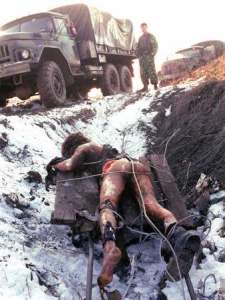
A
report by Human Rights
Watch - (January 2003, Vol. 15, No. 1(D))
Read
the complete report
Executive
Summary
The conflict in Chechnya
continues to take a huge toll on civilians.
The October 2002 hostage crisis in Moscow, which left 129 dead, has
been followed by reports of abuses by Russian and rebel forces in
Chechnya, and accelerated efforts by Russian authorities to force
displaced people living in tent camps in Ingushetia back to Chechnya.
Russian authorities have also significantly restricted access to the region, blocking access for international monitors, including those from the Organization for Security and Cooperation in Europe (OSCE). The Russian government claims that the armed conflict in Chechnya is over and that the situation is normalizing. Therefore, it argues, an OSCE presence is no longer needed and displaced people face no serious obstacles to return. But as attested by the Moscow hostage-taking itself and subsequent incidents described below, the armed conflict grinds on and civilians continue to face life-threatening conditions.
Concerned by these developments, Human Rights Watch conducted an eleven-day research mission to Ingushetia, from December 10-21, 2002. Through interviews with some sixty-two people, we documented a pattern of threats and intimidation by migration authorities to compel the approximately 20,000 displaced people living in the six remaining tent camps to return to Chechnya. We also gathered eyewitness accounts of conditions in Chechnya, including forced disappearances, extrajudicial executions, looting, and arbitrary detention. This report first documents the Russian government’s attempts to forcibly return displaced people to Chechnya, and then examines new evidence of continuing humanitarian law violations by Chechen and Russian forces inside Chechnya.
The international
community should act now to ensure that Russia does not return
displaced people to Chechnya against their will, and to reinstate the
OSCE Assistance Group to Chechnya. More international scrutiny in the
region, not less, is needed. Two incidents in late 2002 that caused
enormous loss of civilian life demonstrate vividly that the armed
conflict in Chechnya has not ended. On October 23, about fifty Chechens
took hundreds of civilians hostage in a Moscow theater, an act that, as
already noted, resulted in the deaths of 129, mostly due to the effects
of a debilitating gas that Russian special forces used in their rescue
operation. On December 27, Chechen forces blew up the main government
building in Grozny, killing at least seventy-two civilians and wounding
210. Chechen forces also are believed to be responsible for a
continuing pattern of assassinations of village administrators and
other civil servants working for the pro-Moscow government in Chechnya.
At the same time, abuses by Russian forces in Chechnya—forced
disappearances, extrajudicial executions, looting, and arbitrary
detention—have continued unabated.
See also: Asylum
Politics - Refugee centers flooded with hundreds of Chechens in search
of a safe home
By Dinah A. Spritzer, The Prague Post (May 29, 2003)
Thousands of Obstacles in front of the
Humanitarian Aid: Fire Dance of NGO's in Caucasus
A report by the Caucasus
Foundation
Read the complete report
The Experiences of the NGOs in Caucasus
Since September 1999 when 401 thousand people have turned out to be refugees, the Chechen history has become the source of incredible tragic stories, and since the arrival of the first UNHCR aid in the region in Ingushetia via Stavropol on 1st October 1999, humanitarian aid volunteers and the workers have lived through lots of experienced full of risk.[49] As some sector have shrunk to a great extent and some have totally collapsed after the political crises that started in 1990 and the war conditions that have existed since 1994, in all field some illegal activities have been observed and have accelerated.
After
a certain point although it is not compatible with the general nature
of the society, the illegal behaviours have turned out to be common
practice. There still exists a war case in Chechnya for 11 years which
has been fighting a war of independence against the Russian Federation.
Besides, the actions which are totally unacceptable in the Chechen
culture such as abduction and asking for ransom, robbery and bribery,
are continuing as criminal mechanisms and destroying the texture of the
society in a way that will be decade’s work to recover. Unfortunately,
this criminal mechanism is also harming the activities of international
and independent aid organisations. However, the existence of such
criminal groups is not the only and even major agent hindering the
humanitarian aid that is meant to be sent Chechnya. Despite having to
pause their efforts, the humanitarian aid organisations have tried to
provide help for Chechnya and Chechen refugees.
Russian Federation: -
Covering events from January - December 2002
A report by Amnesty International
Read
the complete report
RUSSIAN FEDERATION
Head of state: Vladimir Putin
Head of government: Mikhail Kasyanov
Death penalty: abolitionist in practice
International Criminal Court: signed
Russian security forces committed serious human rights violations and
breached international humanitarian law in the continuing conflict in
the Chechen Republic (Chechnya), with almost total impunity. In the
wake of the hostage incident in Moscow in October, law enforcement
agencies cracked down on Chechen civilians throughout the Russian
Federation. Chechen armed groups committed serious human rights abuses.
An estimated 110,000 internally displaced Chechens lived in harsh
conditions in neighbouring Ingushetia. They reportedly faced forcible
return to Chechnya, in conditions where their security and dignity
could not be assured. Elsewhere in the Russian Federation there were
continuing reports of torture and ill-treatment. Prison conditions were
often cruel, inhuman and degrading. Members of ethnic minorities faced
widespread discrimination and racist attacks were often carried out
with impunity. Refugees and asylum-seekers were sent back to countries
where they faced human rights violations.
Endless Genocide at Caucasus and Chechen Tragedy
A report by the Caucasus
Foundation
Read the complete report
Excerpt from chapter I: "Endless exile and genocide"
Despite the endless exile and several genocide cases they were subjected to, in the field of International Law where basic human rights are guaranteed, the rights of the Northern Caucasians have not been a case of pursuit yet. The 1864 exile and genocide recorded by the Ottomans and the British officials at the time is not just an unlucky event that has remained to be forgotten in the dusty archives of history, but a fault the repercussions of which are still being observed in the present day Caucasus.
The results of the plight of the 1864 looks as if it has been inherited by the grandchildren of the victims, moreover new exiles have been added to the destiny of these people and the sorrows which have never ended have been aggravated. Ethnic cleansing that was started in the Northern Caucasus by the Russians of the Tsar period following their defeat between the years of 1859 and 1864 with a big dislocation has turned out to be a case to be defined as genocide in the realm of international law. The Tsar's Russia in the 19th century, the USSR in the 20th century, and now the Russian Federation have made it the fate of the north Caucasians to be exiled. As a result of the settlement policy of the Russians in the North Caucasus, over one million Caucasians have been displaced in 1864. Thousands have died on their cruise to the Ottoman lands, several ships full of exiled people have sank, thousand have got diseases; and many have become slaves and concubines. The land and other properties they left behind were given to the new settlers brought to their land, who were Russians and Cossacks brought their by the Russian authorities.
There are records that about 30% of the people deported from the ports on the Black Sea such as Taman, Tuapse, Anapa, Tsemez, Sochi, Adler, Sohum, Poti and Batum and destined to reach the Ottoman port cities of Trabzon, Ordu, Samsun, Sinop, Kefken, Varna, Köstence, Istanbul and the Aegean ports died on their way to these destinations. For example, the Russia Consulate in Trabzon, one of the destination ports records in May 1864 that, 30, 000 people died of starvation or illnesses, people who got ill on board were dropped into the sea right away... and that one man in Trabzon where 3493, 124 people landed, was told to have taken 30 or 40 concubines. There are records that mass graves were found around these Ottoman shore cities.[45]
At
those times the Russian Consulate in Trabzon, writes to the Russian
general Katrachev who was in charge of the deportation to state that
"70,000 thousand people have arrived in Batum to be sent to Turkey,
around 7 die per day. On reaching Trabzon, 19,000 out of 24,700 died.
There are 63,900 people there and about 180-250 of them die per day.
Out of the 110,000 in Samsun about 200 die every day. I heard that out
of those 4650 who were sent to Trabzon, Varna and Istanbul about 40-60
die per day."[46] To
avoid accusations of exile the Russian authorities try to present the
case as migration. However, the decree sent to the Western Caucasians
in August 1864 by the Tsar's representative in the area Granduke
Mitchel why these people have had to face death, it reads: "Those who
do not leave in a month will be sent and located in several different
parts of Russia as war captives."[47]
The dislocated Caucasian people were later settled in Turkey, Syria,
Jordan, Egypt, Israel, Iraq, Lebanon, Libya, Greece, Macedonia and
Kosovo in brief in about 40 different regions in the world. Russian,
European and Ottoman records mention that between 1,2 million to 2
million people exiled during 1859 and 1879 years. About 500,000 people
died during their cruise and after arriving to the Ottoman harbours.[48] Those exiled were never
let to go back to their homeland. Very few of their grand children who
went to their home after the collapse of the USSR have had no
authorities to turn to or any official will to claim their
grandparent's heritage.
Russia Last Seen. . . : Continued
"Disappearances" in Chechnya
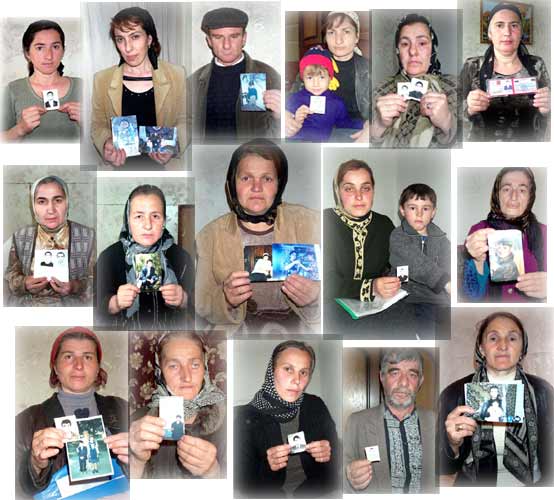
Click on the image to magnify
"A human
being is not a match, or a cow or a sheep that one can simply let
vanish."
(relative of
"disappeared" Adlan Eldarov, who requested to remain anonymous.)
A report by Human
Rights Watch - (April 2002 Vol.14, No. 3
(D))
Read
the complete report
Introduction
Despite the nominal end of large-scale fighting in Chechnya, Russian security forces continue to detain hundreds of non-combatants in their ongoing operations against Chechen rebel forces. While most of those detained are subsequently released after periods in acknowledged detention, dozens remain unaccounted for— “disappeared”— and are not seen alive by their families again. Relatives’ inquiries to Russian authorities as to their whereabouts are met with denials that the “disappeared” persons were ever in custody. The unacknowledged detention of civilians places them outside the protection of the law, making them vulnerable to extrajudicial execution and torture. Families of the “disappeared” make enormous efforts to visit police stations, military bases, and detention centers throughout Chechnya and elsewhere in the Russian Federation, lodging petitions and complaints with officials at all levels. It is not uncommon for a family to be searching for more than one “disappeared” relative. Some of the “disappeared” are later found dead in makeshift temporary graves, sometimes bearing signs of torture. Most are never heard from again, denying their relatives even a body to grieve over. This report covers eighty-seven new cases of “disappearance” documented by Human Rights Watch since its last report on “disappearances” in Chechnya in March 2001.[4] Eighty of these took place in 2001, a scale belying any notion that forced disappearances of civilians in Chechnya is a problem of the past.
The rise in the number of “disappearances” during targeted raids on private residences is a particularly disturbing development. While the majority of forced disappearances in the March 2001 report took place during large-scale “sweep” operations and at checkpoints, almost half the cases in the present report occurred during raids targeting particular individuals. The raids often took place before dawn and generally involved masked and heavily armed Russian security personnel without identifiable insignia traveling in unmarked armored personnel carriers (APCs). The elements that make up a forced disappearance—chiefly the unlawful and unacknowledged deprivation of liberty by the government—and the torture and killing that frequently result, are prohibited under international human rights law. Despite its international legal obligations, Russia is failing to prevent “disappearances” by its security forces, and failing properly to investigate and prosecute such cases after they occur. The response of the civilian and military procuracies—the agencies charged with the investigation and prosecution of “disappearances”—remains inadequate, allowing abusive security personnel to act with impunity. Since March 2001, there have been cosmetic improvements in the response of the civilian procuracy to complaints of “disappearance”: most complaints now lead to investigations being formally being opened, and far fewer problems relating to access to the civilian procuracy are being reported by relatives. However, the main obstacles to accountability remain. The civilian procuracy has jurisdiction over the police, but has no legal authority to investigate abuses by members of the armed forces. It also receives little cooperation from the military and security services, including in some cases concerted obstruction by top officials, who transfer service personnel out of Chechnya to evade investigations. The civilian and military procuracies do not conduct aggressive investigations, and few investigations lead to prosecutions. To date, not a single serviceman or officer has been convicted for their involvement in a forced disappearance.
Relatives
still have little access to the military procuracy, even at a local
level. A decree issued March 29, 2002 by Gen. Vladimir Moltenskoi,
commander of the United Group of Forces in Chechnya, implicitly
acknowledged that certain factors were facilitating impunity for abuses
committed by federal forces in Chechnya. Among other things, the decree
required military personnel on search-and-seizure operations in private
homes to identify themselves, and reinforced the requirement that
procuracy and other civilian officials be present during targeted
operations and sweep operations. That requirement had been introduced
in July 2001 in the much-lauded Decree No. 46, to improve civilian
procuracy oversight over security forces during sweep operations. But
to date, Decree No. 46 appears to have had little impact. The decree
requires that civilian procuracy officials and other local officials be
present during sweeps when detentions occur, and that a written record
be kept of the names of detainees and places of detention. In practice,
the decree has been regularly ignored. This report documents four cases
of “disappearances” during sweep operations since the decree came into
effect on July 25, 2001; some of these were multiple disappearances.
Moreover, the decree apparently does not apply to targeted raids, the
use of which is on the increase: of the thirty-six “disappearances”
that took place during targeted raids documented in this report, ten
took place since July 25, 2001. The March 29 decree, issued by Gen.
Moltenskoi, addressed this point by requiring the presence of civilian
officials during targeted operations; as of this writing, it was too
early to determine the impact it has had. The Office of the Special
Representative of the President of the Russian Federation on Human
rights in Chechnya, at the time headed by Vladimir Kalamanov, has been
stymied by its lack of authority. The office in January 2002 publicly
criticized the failure of the security forces to comply with Decree No.
46, but the Russian government has not acted on this criticism.[5] Its coordinated
efforts, including those through its working group with the civilian
and military procuracies, have created a positive dialogue but borne
little fruit. Russian security forces currently commit abuses with
impunity in Chechnya. Creating accountability is the key to any effort
to curb “disappearances,” torture, and killings flourishing in this
climate. Russian authorities must ensure that the civilian and military
procuracies are both able and willing to carry out effective
investigations, that both branches of the procuracy receive full
cooperation from the security services, and that the perpetrators are
prosecuted and punished in accordance with the seriousness of their
crimes.
Chechnya - Terror and Impunity. A Planned System.
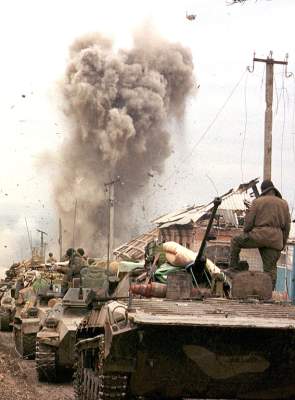
Federal troops bombing and looting houses
(carpets on tank)
A report by the International
Federation for Human Rights (La Fédération internationale des ligues
des droits de I'Homme) - (March 2002)
Read the complete report (.pdf format)
Introduction
The conflict in Chechnya has been going on for two and a half years now. The Russian forces have kept perpetrating, behind closed doors, massive human rights violations -attested and condemned since the beginning of the conflict by NGOs as well as international organizations (United Nations, Council of Europe, European Union). The crimes committed have remained unpunished. The Russian authorities continue to justify this war by the legitimate fight against terrorism, but the methods used belong to a wholly different reality. In Chechnya, the civilian population is still the first victim of a conflict which the Russian government is unwilling to put an end to, in spite of their obligation and commitment to do so. As the 58th session of the UN Commission on Human Rights has opened, the FIDH again wishes to raise the alarm with the international community. On the basis of the previous FIDH/Memorial1 joint reports that characterized the facts exposed as war crimes and crimes against humanity, the FIDH has chosen to analyze the mechanisms of the system implemented by the Russian forces allowing the perpetration of systematic human rights violations and providing impunity to the perpetrators of these crimes. The violations cannot be reduced to isolated acts and attributed only to uncontrolled soldiers. In that perspective, the FIDH mandated an international investigative mission in Ingushetia and Moscow in February 2002, in order to collect testimonies on the sweep operations and on the systematic lootings and rackets. The mission consisted of Anne Le Huerou (France), academic, Bleuenn Isambard (France), academic, and William Schabas (Canada), professor of international law. The heads of mission would particularly like to thank the representatives of the Memorial Human Rights Centre and the members of Memorial’s representation in Nazran for their welcome and assistance. This mission comes within the framework, and in support, of the research and investigation activities carried out by Memorial in Moscow as well as in Ingushetia and Chechnya since the conflict started. Besides, this report relies on the testimonies collected in Chechnya and Ingushetia by Memorial and published in the last six months.
Memorandum to the United Nations Commission on the
the Human Rights Situation in Chechnya
From a memorandum by Human Rights Watch to the
United Nations Commission on Human Rights - (March 18, 2002)
Read
the complete report
Introduction
One year ago, for the second consecutive year, the United Nations Commission on Human Rights adopted a resolution expressing concern about the situation in Chechnya. The resolution called on Russia to curb abuses by its forces, establish a meaningful domestic accountability process, and invite several of the Commission's key special mechanisms to visit the region. The Russian government rejected the resolution out of hand, as it had done a year before, and refused to implement most of its key requirements.
Today, as the Commission opens its 58th session, Chechnya remains the only place in Europe where civilians are killed on a daily basis in armed conflict. Russian and Chechen rebel forces subject civilians to a vicious cycle of abuse. Since the 57th UNCHR session, abuses by Russian troops-particularly "disappearances" and extrajudicial executions-did not relent. In fact, Human Rights Watch found that at least one "disappearance" occurred each week between September and December 2001. In the absence of meaningful government investigations into abuses, Russian forces continue to operate with an undiminished sense of impunity. Chechen rebels and their supporters have stepped up their intimidation campaign against those who cooperate with the Russian government, assassinating dozens of local Chechen civil servants, and making death threats to many more. This volatile security situation continues to prevent more than 200,000 internally displaced persons (IDPs) from returning to their homes in Chechnya. The majority remain in Ingushetia, although Russian authorities there continually pressure them to return to Chechnya.
In 2001 and 2002, Human Rights Watch conducted four field missions to the Northern Caucasus region. We published our findings in a February 2002 report documenting abuses in military sweep operations of June and July 2001, and a March 2001 report on forced disappearances.[1] This memorandum provides an updated overview of these issues, based on more than fifty interviews conducted in December 2001 and February 2002. It summarizes violations committed by Russian forces in six military sweep operations between August and December 2001, and documents nine forced disappearances as well as five cases of indiscriminate shootings and use of force. It also describes assassinations and threats against civilians by Chechen forces. Additionally, it analyzes the Russian authorities' meager efforts in investigating abuses, which have stunted any domestic accountability process.
After the September 11 attacks in the United States, the Russian government has labored to link its campaign in Chechnya with the global campaign against terrorism, claiming it was fighting the same enemy.[2] International criticism of Russia's methods in Chechnya, summarized in this memorandum, has waned, as Russia has become a key partner in the international coalition against terrorism. But Russia's role in the coalition should not shield it from scrutiny or criticism by any fora, especially the highest international body solely concerned with human rights.
Human
Rights Watch urges the Commission to adopt a resolution on the Chechnya
conflict, calling on Russia to issue invitations to the relevant
thematic mechanisms and to invigorate the domestic accountability
process. A Commission resolution should deplore continued abuses, and
should note in particular the failure by Russia to establish a national
commission of inquiry, and the utter lack of an official public record
of violations of international human rights and humanitarian law
committed in the conflict.
Swept under: Torture, Forced Disappearances, and Extrajudical Killings during Sweep Operations in Chechnya
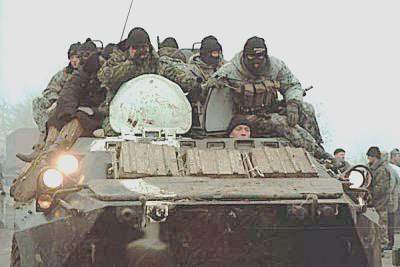
(Masked Russian
soldiers on top of an armored personnel carrier return from battle in
Chechnya.
Kavkaz border crossing, Ingushetia, December 13, 1999 - Human Rights
Watch)
A report by Human
Rights Watch - (February 2002, Vol.14, No. 2 (D))
Read
the complete report
Executive Summary
The Russian government's plan was to normalize the situation in Chechnya by 2001: with most troops withdrawn and most internally displaced persons expected to return to their homes. The events of three weeks in late June and early July 2001 shattered these hopes and painfully illustrated just how far removed Chechnya remained from lasting peace.
Between June 15 and July 4, Russian troops conducted exceptionally harsh sweep operations in at least six villages in different parts of Chechnya. Troops rounded up several thousand Chechens, mostly without any form of due process, and took them to temporary military bases in or near the villages. According to eyewitnesses, soldiers extrajudicially executed at least eleven detainees, and at least two detainees "disappeared" in detention. Human Rights Watch interviewed twelve former detainees who gave detailed testimony of torture and ill-treatment, including electric shock, severe beatings, and being forced to remain in "stress positions." They said independently that dozens, if not hundreds, of other detainees had also faced torture and ill-treatment. Eyewitnesses also gave testimony about widespread extortion, looting, and destruction of civilian property.
The sweep operations - a culmination of over a year of official tolerance of "dirty war" tactics in Chechnya - further eroded what little trust Chechen civilians retained in Russian troops and government structures, and underscored once again that a return to normal life and lasting peace in Chechnya is only possible if the Russian government takes effective steps to reign in its troops and remedy abuses. Hundreds of people fled border areas into Ingushetia in the aftermath of the sweeps and thousands of internally displaced persons already in Ingushetia were strengthened in their conviction that Russian troops made their safe return home to Chechnya impossible. Local officials, teachers, and other Chechens striving to return to a semblance of normalcy saw their efforts grossly undermined. As a teacher from Assinovskaia put it:
"Our school held on due to the efforts of the teachers, the students, and their parents. They worked, despite the real dangers. We received anonymous threats demanding that we close the school. Our wounds, caused by two wars, only just started to heal because we were thinking about the future. How are we going to restore the lost trust?".[16]
The sweeps, however, did not come out of the blue. They occurred against the background of a highly volatile security situation and continuing serious abuses by both sides to the conflict. Between November 2000 and April 2001, Chechen rebel forces operated throughout Chechnya, clashing with federal troops, carrying out bomb attacks on federal positions, assassinating Chechens seen as cooperating with the Russian government, and kidnapping a foreign aid worker in broad daylight. Russian forces responded to this rebel activity with the occasional use of heavy weaponry and frequent large-scale, targeted sweep operations, during which numerous civilians were killed, tortured, ill-treated and "disappeared."
To
address the persistent cycle of abuse, Human Rights Watch is calling on
the Russian government to investigate promptly and impartially all
allegations of violations of international human rights and
humanitarian law committed during the sweep operations and to swiftly
prosecute those found responsible. The government should fulfill the
requirements of U.N. Human Rights Commission Resolution 2001/24 of
April 20, 2001, by establishing an independent national commission of
inquiry into abuses and by allowing relevant U.N. special mechanisms to
visit Chechnya. The government should prevent further violations by
undertaking a number of measures. It should, for example, put all
forces in Chechnya on notice that noncompliance with international
human rights and humanitarian principles will not go unpunished. To
prevent "disappearances," Russian forces should immediately cease the
practice of secret detention and make public regularly updated data on
the numbers of arrested and charged for security-related crimes in
Chechnya.
In its recommendations to the international community, Human Rights
Watch is calling for the establishment of an international commission
of inquiry to monitor, investigate and publicize violations of
international human rights and humanitarian law in Chechnya and make
compliance with U.N. Resolution 2001/24 a key element for cooperation
in their relations with Russia. Human Rights Watch additionally calls
on the United Nations, the Council of Europe, and the Organization for
Security and Cooperation in Europe to make full use of their respective
mandates and mechanisms to establish an official record of abuses
committed during the armed conflict in Chechnya and hold the Russian
government to obligations for an effective accountability process.
Chechnya/Ingushetia: Vulnerable Persons Denied Assistance
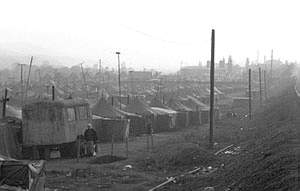
Refugee tent camps
in Ingushetia
A report by Médecins Sans Frontières
(Doctors without Borders) - (January 2002)
Read
the complete report (in MS Word document format)
From the introduction and the conclusion of the report
In November 2000, Médecins Sans Frontières testified before the Parliamentary Assembly of the Council of Europe as to the grave humanitarian situation in Chechnya. At the time, we denounced the policy of terror conducted by the Russian and pro-Russian authorities following the resumption of war in 1999, and the difficulties encountered by civilians seeking access to vital health care. Testimony gathered in the field by our staff illustrates the arbitrary and violent nature of treatment meted out to civilians.
Today, it is harder than
ever to deliver humanitarian aid inside Chechnya, because of the
deterioration in security conditions for aid workers and the
increasingly obstructive bureaucracy. In fear of their lives, and
without access to assistance in their home country, civilians continue
to flee in massive numbers to neighbouring Ingushetia. There they are
forced to live in inhumane conditions.
These observations are
based on testimonies heard by MSF staff working in Ingushetia whilst
providing assistance to the displaced, and on a study concerning the
beneficiaries of aid there, conducted by MSF.
[...]
Seeking refuge in Ingushetia has been a matter of survival for thousands of displaced persons. Yet for many of them, this refuge is only a cold cellar where they are forced to live like rats.
Clearly, the strategy of providing no assistance to these IDPs in the hope that this will force them to go home, has failed. Maintaining these displaced persons in such deplorable, inhuman and humiliating conditions has not halted the exodus. Nor will it push these exiles to return to Chechnya and to a prison-like environment rife with arbitrary violence and lootings.
The reality of this exodus and the true number of IDPS present in Ingushetia must be acknowledged, so that sufficient quantities of decent aid may be provided to this population.
[Update:
The federal government is precipitating a humanitarian catastrophe in
Ingushetia, the effects of which may become apparent as early as this
summer, Medicines Sans Frontiers said. MSF has constructed 18
houses in Ingushetia with room for 1,000 Chechen refugees, but the
buildings are standing empty because local prosecutors say they do not
conform to building regulations. MSF last week gave reporters copies of
a document from a local prosecutor's office ordering that the buildings
be demolished. This means that if the refugee camps are closed as
pro-Moscow Chechen officials have promised, thousands of refugees will
essentially be forced back into a conflict zone in violation of the
Geneva convention on human rights, MSF officials said. If plans by MSF and other
international humanitarian organizations to build housing for the
estimated 14,000 Chechen refugees in Ingushetia are not approved soon,
the refugees could find themselves without a roof over their heads when
the camps are closed down -- leaving them with no choice but to go back
to Chechnya, the MSF said.]
Russia/Chechnya - Burying the Evidence: The Botched Investigations into Mass Grave in Chechnya
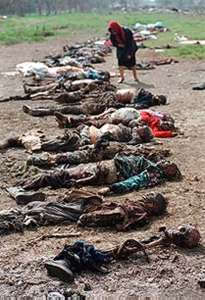
Click on the image to see other photographs
A report by Human
Rights Watch - (May 2001 Vol. 13, No. 3 (D))
Read
the complete report
Introduction
On
February 24, 2001, a dumping ground for human remains was discovered in
the village of Dachny (also called Zdorovye), located less than a
kilometer from the main Russian military base in Chechnya. The corpses
of fifty-one people were eventually found in the vicinity; nineteen
bodies were identified, at least sixteen of which were the remains of
people who were last seen alive in the custody of Russian federal
forces. Most were in civilian clothing, some were blindfolded, and many
had their hands or feet bound. The mass “dumping site”—the bodies were
dumped along streets in the village and in abandoned cottages over an
extended period of time—provides striking evidence of the practice of
forced disappearances, torture, and extrajudicial execution of
civilians by Russian federal forces in Chechnya.
Federal and local authorities denied responsibility for the deaths of
those found at the site and instead blamed the deaths on Chechen rebel
forces and criminal gangs. However, the area where the mass dumping
ground was found has been under Russian military control since December
1999, long before the vast majority of the bodies were deposited there.
The Russian government’s investigation into the circumstances
surrounding the deaths of those found at the site has been wholly
inadequate. Russian authorities failed to provide adequate time or
information for identifying the bodies, so that the victims’ relatives
often did not know that they could view the bodies or learned about the
identification process only through word of mouth. Russian authorities
also conducted the investigation in a manner that did not preserve
potentially crucial evidence that might have led to the identification
of those responsible for the torture and execution-style killings of
the more than fifty persons found at the site. The investigation
provided further evidence of the Russian government’s refusal to take
meaningful steps to identify the perpetrators of serious human rights
abuses by its forces and hold them accountable. Dachny was not the
first site of unmarked graves to be found in Chechnya, although it is
the largest found to date. In March, Human Rights Watch issued a
report, “The ‘Dirty War’ in Chechnya: Forced Disappearances, Torture
and Summary Executions,” documenting eight mass graves and eight other
makeshift burial sites where corpses of the “disappeared” and others
had been found.[11]
Most
of the people whose bodies were found in those graves were last seen in
the custody of Russian federal forces, and most bore unmistakable signs
of torture. Injuries commonly found on the bodies included broken
limbs, flayed body parts, severed fingertips, and knife and gunshot
wounds. Human Rights Watch researchers interviewed nineteen individuals
who searched for “disappeared” relatives at Dachny village or at the
identification site. This report is based on those interviews, on
information from the Moscow based Memorial Human Rights Center, and on
photographs and videos taken of the bodies.[12]
The Dirty War in Chechnya: Forced Disappearances, Torture, and Summary Executions
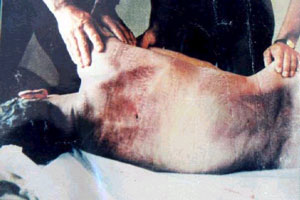
Click on the image to see other photographs
A
report by Human Rights
Watch - (Vol. 13, No. 1 (D), March 2001)
Read
the complete report
Summary
The "disappearances" of detainees in the custody of Russian federal forces in Chechnya is a major human rights crisis that the Russian government and the international community must address. The discovery of the mutilated corpses of some of the "disappeared" has substantiated fears that they have been tortured and summarily executed. While combat between federal forces and Chechen rebels has for the most part ceased, the "disappearance," torture, and summary execution of detainees continues, marking the transition from a classical internal armed conflict into a classical "dirty war," where human rights violations and not the conquest or defense of territory are the hallmarks. Because criminal investigations into "disappearances" have been shoddy and ineffective, impunity for such atrocities continues.
Human Rights Watch has documented more than 113 cases of "disappearances" in Chechnya since the military operation began there in September 1999.[17] A leading Russian nongovernmental organization, the Memorial Human Rights Center, has documented approximately 150 such cases. The true figures, however, are believed to be much higher. The first such case dates back to December 1999. The most recent happened in February 2001. The risk of "disappearances" affects everyone in Chechnya. Victims are predominately male and range from fifteen years of age to forty-nine; among them have been dentists, drivers, and auto mechanics.
In all of the cases documented by Human Rights Watch, witness testimony confirms undisputedly that federal agents-from the military, police, or security forces-took the individuals into custody, either during "sweep" operations, at checkpoints, or during targeted search and seizure operations. After the initial detention, however, all trace of them was lost. In many cases, officials deny that the individual was detained; in others, they acknowledge the initial detention, but then claim the individual was transferred, released, or otherwise no longer their responsibility. The wall of denial and the obfuscating, contradictory information provided by officials compounds the anguish and frustration experienced by relatives searching desperately for their "disappeared" loved ones. This has led one such family member to reflect in exasperation, "[They tell me] `our people didn't take him,' `the FSB didn't take him,' `the GRU didn't take him,' `the MVD didn't take him.' You get the impression that extra-terrestrials seized my son."[18]
Perhaps
the most pitiful picture today in Chechnya is that of relatives rushing
to newly reported mass grave sites to search for the remains of the
"disappeared." Indeed, the corpses of many of the "disappeared" have
subsequently been found in unmarked, makeshift graves and body dumps
throughout Chechnya. The discovery of a cluster of graves containing
about sixty corpses near the federal military base at Khankala
generated intense media attention. While it contained an unprecedented
number of corpses, it was not the first such burial site to be found in
Chechnya. Human Rights Watch has documented at least eight makeshift
graves containing mutilated bodies of individuals that bore
unmistakable marks of torture. In another eight cases, the dead bodies
were dumped by the side of a road, on hospital grounds or elsewhere. In
one case of base corruption, a military serviceman insisted that the
parents of two "disappeared" brothers pay him to sketch a map to their
makeshift burial site. He apparently promised them, "If they're not
yours, I'll give you back your money."
The Obligation to Investigate
"Disappearances" happen when government forces take people into custody, hold them in secret, and then refuse to acknowledge responsibility for their whereabouts or fate.[19] It is a phenomenon that has ravaged other parts of the world, notably Latin America. Following the emergence worldwide of patterns of "disappearances," the international community, and particularly the United Nations, responded by compelling states to take action to prevent and investigate "disappearances," and by creating mechanisms dedicated to this end. In 1980, in response to a request by the U.N. General Assembly to consider the issue of involuntary disappearances, the United Nations Commission on Human Rights created the Working Group on Enforced or Involuntary Disappearances.[20] The working group's mandate is to "assist the relatives of disappeared persons ascertain the fate and whereabouts of their missing family members."[21] It requests governments to investigate cases it has identified as warranting concern.
In 1992, the U.N. General Assembly adopted the Declaration on the Protection of All Persons from Enforced Disappearances[22], which recognizes the practice of "disappearances" as a violation of the rights to due process, to liberty and security of person, and freedom from torture. It characterizes the systematic practice of enforced disappearances as being "of the nature of a crime against humanity."[23]
The declaration exhorts states to prevent "disappearances" by upholding habeas corpus and other due process rights, ensuring access to all detention facilities, and maintaining a central registry of all detainees. Because an essential feature of "disappearances" is the official obstruction of effective investigations, the declaration calls on states to diligently investigate "disappearances," and hold their perpetrators accountable. The Russian authorities have not fulfilled this obligation. They have not committed the necessary resources to investigations, nor are they empowering the relevant agencies to conduct them. Indeed, to our knowledge, none of the thirty-four criminal investigations into "disappearances"-which include most of the cases documented in this report-has resulted in the discovery of the whereabouts of the "disappeared" or in an indictment of the perpetrator.
Searches by Relatives
"Disappearances" in Chechnya are prolonged tragedies for the victims' relatives. Desperate for information on the fate and whereabouts of their loved ones, relatives of the "disappeared" in Chechnya muster resources and courage to mount their searches. The families interviewed for this report generally leave no stone unturned. They write or visit every conceivable government agency or official at all levels that they believe could possibly have any information on the whereabouts of their loved ones, or influence their fate: the police, the civilian and military procuracies, the FSB, military officials, and local, national, and inter-government structures, right up to PresidentVladimir Putin, and to the OSCE Assistance Group for Chechnya in Moscow and other international organizations. They travel to reported sites of mass or unmarked graves anxious to find the remains of their loved ones.
Relatives travel at great personal cost to any place they believe they can find information, be it to prisons in cities hundreds of kilometers away, to Nazran, Ingushetia, where journalists and human rights activists are active, or even to Moscow. Almost all relatives of the "disappeared" interviewed by Human Rights Watch had traveled to detention centers around the North Caucasus searching for their relatives. Many said they had sold their personal belongings or borrowed large sums of money to conduct this search, often to no avail. Detention centers all over the North Caucasus are tableaus of desperation: relatives of the "disappeared" scour lists of prisoners, are compelled to pay venal prison guards to look in registries for their loved ones' names, and to pay sometimes large sums of money to predatory middlemen who frequent the centers, offering their "services" in locating the loved ones. Indeed, the enormous scale of detentions in Chechnya, combined with the artificial vacuum of official information, has created an entire informal infrastructure dedicated to collecting, exchanging, and buying and selling of information on the whereabout of detainees.
This
report is based on Human Rights Watch research conducted in November
and December 2000, and in February and March 2001 in Ingushetia with
the family members of the "disappeared." It is based on dozens of
interviews, as well as on correspondence between family members and
federal and Chechnya Republic law enforcement agencies.
Memorandum on Domestic Prosecution for Violations of International Human Rights and Humanitarian Law in Chechnya
A memorandum by Human
Rights Watch - (February 9, 2001)
Read the complete report
Introduction
Russian authorities have concealed and obstructed the prosecution of Russian forces for violations of human rights and international humanitarian law in the Chechnya conflict. The failure to hold violators accountable can be expected to encourage Russian federal forces to continue to perpetrate abuses. Announced investigations into three well-known massacres believed to be committed by federal forces in the first six months of the war--at Alkhan-Yurt, Staropromyslovski, and Aldi--have been incomplete, haphazard, or suspended altogether. To our knowledge, no investigations have been launched concerning the widespread allegations of torture and ill-treatment of persons in custody. A few cases of torture in which the victim was later judicially executed are under investigation. Of the many evident cases of disproportionate use of force by Russian forces, only six incidents are currently under investigation. Military claims of jurisdiction over many of the most serious of the reported crimes have posed seemingly insurmountable obstacles to justice, and good faith investigations have been largely absent.
This memorandum is based on Human Rights Watch's active correspondence with the Russian military and civilian procuracies[3], and on a November 2000 field mission to Ingushetia, during which researchers gathered information from victims, witnesses, and law enforcement agencies concerning progress on investigations.
Russian officials have shown a lack of commitment to a meaningful accountability process by their public statements, by the low number and evidently poor quality of investigations, and by the failure of law enforcement and other government agencies to build an atmosphere of trust among victims and witnesses. Government officials continue to downplay serious abuses committed in Chechnya as "incidental" and "exceptional."[6] As far as Human Rights Watch is aware, none of the commanding officers who presided over massacres were suspended pending the outcome of investigations. Instead of taking this kind of confidence-building measure, for example, Gen. Vladimir Shamanov, who had direct oversight over troops that committed the massacre in Alkhan-Yurt, was awarded a "Hero of Russia" medal for his service in Chechnya mere weeks after the massacre took place.[7] Russian legislation undermines the accountability process by creating wholesale exemptions from prosecution for serious violations committed by Russian forces in the course of anti-terrorist operations. The Law on Suppression of Terrorism contains no provisions regarding the responsibility of anti-terrorist units for possible abuses of power. In fact, the law explicitly exempts servicemen, experts and other persons from liability.[8]
Human
Rights Watch is aware of only one case--the March 2000 rape and murder
of Kheda Kungaeva--that top officials publicly acknowledged and
promised to investigate swiftly. At around 1:00 a.m. on March 27, 2000,
Russian soldiers, under the command of Colonel Yuri Budanov, took
eighteen-year-old Kheda Kungaeva away from her parental home. The next
evening, soldiers returned her dead body. The criminal investigation
was completed in January 2001 and forwarded to a military court.
Colonel Budanov was charged with premeditated murder, kidnapping and
abuse of office. Three of his subordinates were charged with
desecrating a corpse and covering up a serious crime but the
investigation against them was dropped before trial.[9] Prosecutors did
not charge Budanov or his subordinates with sexual assault, even though
forensic examiners had determined that the girl was anally raped with a
hard object and that her hymen was ripped in three places approximately
one hour before her death.[10]
Endless Brutality: Ongoing Human Rights Violations in Chechnya
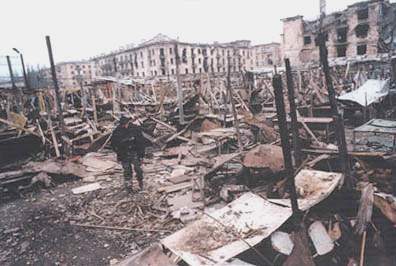
October 21th 1999.
A Russian air strike kills at least 100 people on the main Grozny
market.
(See also a recent report by Memorial six years later:
link)
(Photo by Bruno Stevens Source: Liberation)
A report by Physicians
for Human Rights - (January 23, 2001)
Read the complete report
Introduction and summary
For more than a year, Russia's federal forces have inflicted wanton violence on civilians in Chechnya in violation of international human rights and humanitarian law. While the most intense period of the war in Chechnya ended in the spring of 2000 with the occupation of the capital, Grozny, and most other areas, the behavior of Russia's forces toward the civilian population continues to be brutal, corrupt and illegal.
Physicians for Human Rights documents that, as of December 2000, Russia's forces continued to engage in arbitrary arrests, unlawful detention, torture, murder, attempted murder, disappearances, bribery, and shelling of population centers. Civilians are arrested on flimsy pretexts, interrogated, beaten, and sometimes thrown into pits in the ground, only to be released when relatives pay significant bribes. Some disappear. Russia's military units sweep through cities and villages ostensibly in search of fighters on the Chechen side, arrest civilians, shoot into homes, take property, and leave. Travel within Chechnya requires civilians to run a gauntlet of checkpoints, where they also may experience extortion, arrests or beatings.
Although there was considerable variation in the details provided by witnesses in their accounts to PHR of human rights violations, common elements appear throughout: The violations committed by Russia's forces came suddenly, often without warning or reason, to people merely trying to survive in a war-devastated country. Individuals were arrested and detained while walking on a road in their villages or towns, standing in their front yards, shopping at a market, driving, crossing a checkpoint that they had navigated hundreds of times before, or just sitting in their homes with their families. One man was arrested because he could not produce a case of vodka, another because he protested the arrest of his son. Sometimes individuals were arrested en masse, especially during 'sweeps' through the villages by Russia's soldiers.
During the first six months of the second Chechen war of the decade, which began in September 1999, war crimes by Russia's forces were documented and condemned by numerous organizations. In February and March 2000, Physicians for Human Rights assessed patterns and prevalence of abuse and found extensive evidence of war crimes and other human rights violations. PHR conducted a random survey of 1,143 persons displaced from Chechnya by the war. Respondents and members of their households alone witnessed almost 200 killings of non-combatants. 46% of the 1,143 surveyed reported witnessing at least one killing of a civilian by Russia's federal forces. Survey respondents reported 77 instances of torture.[13] The survey was accompanied by corroborated witness case testimonies of massacres at Katr Yurt and Aldi, and atrocities at the Chernokozovo filtration camp.[14]
In April, 2000, the United Nations Commission on Human Rights demanded that Russian President Vladimir Putin conduct an independent investigation of serious breaches of human rights by Russia's forces and hold accountable those responsible for them. But when Russia failed to perform the demanded investigation or to end impunity, it suffered no consequences. Instead, Russian authorities continued to block the entry of human rights monitors from international bodies including the Organization for Security and Cooperation in Europe and the United Nations, preventing them from investigating ongoing violations or preventing new ones. Other than eliciting verbal protests, the international community, including the United States, took no effective action and declined to use tools at its disposal to require President Putin to stop Russia's massive violations of human rights and humanitarian law. The abuses continue into the present day.
The recent PHR investigation was designed to document human rights violations in the last five months of 2000 and evaluate changes in the scope of abuses since PHR's earlier investigation.[15] From December 8 to December 24, 2000, PHR Executive Director Leonard S. Rubenstein and Ondrej Mach, M.D., a consultant with extensive experience in the region, investigated violations in Chechnya. They interviewed more than 50 witnesses to human rights abuses that took place during the last five months of 2000, focusing especially on events in October, November and December.
The violations documented in this report take place in the context of widespread violence. Although by the spring of 2000, Russia's federal forces claimed to occupy all of Chechnya, they were unable to stop hit and run attacks against them by fighters on the Chechen side and suffered serious losses when Chechen fighters blew up trucks, armored personnel carriers and other vehicles. In some areas of Chechnya, including Grozny, Russia's federal forces responded to these losses by shooting at and killing civilians in their homes and on the streets; by shelling villages where rebels are suspected of operating; by illegally arresting, detaining, and torturing Chechen men, causing some to disappear; and by extorting money from civilians to permit the release of loved ones or to allow them to cross checkpoints.
Arbitrary Arrests and Disappearances
The circumstances and manner of the arrests suggest that they are often executed by units without any pretext of legal authority or regularity. Although some of the men arrested were brought to conventional detention facilities, others were thrown into pits in the ground or held in fuel dumps or cellars. Local military commanders sometimes did not know men had been detained or where; in other cases the commanders helped secure release. Some men simply disappeared after arrest.
Beatings/Torture
Individuals interviewed by PHR who were arrested were always beaten, often repeatedly and severely. Some of the men PHR interviewed were tortured with electricity. One was shot while riding on a truck. Another was mutilated. Their documents were confiscated, creating new risks when they were finally released. While detained they were deprived of food for days at a time and sometimes kept in cells or pits so small that all of the men could not sit down.
Arrests as a Form of Extortion
The men interviewed were released only when families paid a bribe demanded by the unit holding them or when families used whatever political influence they could muster to secure the release.
Shelling / Explosives
Civilians are also victimized by assaults, murders and the shelling of cities and villages. While Physicians for Human Rights was conducting this investigation, Russia's forces shelled the area around the university in Grozny. At least six were killed. The university had re-opened despite a lack of electricity and books. In other cases, explosive devices, including landmines, injured and killed many people.
Medical Neutrality
No respect is shown by Russia's forces for the principle of medical neutrality, recognized in the Geneva Conventions, which provides that medical personnel, facilities and conveyances are off-limits to attack by military forces so long as they retain their medical character. Russia's forces harass health workers at checkpoints, interfere in the provision of medical care at hospitals, and even seek to arrest individuals at hospital. They have taken over one hospital for use as a military barracks—a blatant violation of international humanitarian law.
Abuses by Chechen Fighters/Criminals
Russia's forces are not the only ones committing human rights violations. PHR received reports that fighters on the Chechen side threaten and sometimes kill civilians, including local administrators, alleged to be collaborating with Russian authorities. In addition, the PHR team received reports that criminals engage in murder and assaults on civilians. These violations of human rights warrant condemnation.
Health Impact
The destruction of homes and buildings, combined with the atmosphere of terror and insecurity has deeply affected the health and hopes of almost one million people. About 760,000 people remain inside Chechnya, of whom 150,000 are displaced from their former homes. Another 155,000 are in neighboring Ingushetia, doubled up with other families or living in camps, railroad cars, warehouses and other inadequate facilities. They have suffered enormous trauma.
International Law
Russia's
forces and fighters from the Chechen side have obligations under
international human rights and humanitarian law, as well as domestic
law, to pursue political and military objectives without raining death
and brutality on the unarmed population of Chechnya. The Russian
Federation has permitted war crimes and violations of human rights to
take place with impunity.
A report by Human
Rights Watch - (October 2000)
Read the complete report
"Welcome to hell. You're lost now. You will die a slow and painful death. We will teach you to respect Russian officers." [Reported comments of Russian guards to detainee at Chernokozovo.]
"They used the iron part of their sticks to beat me on the bottoms of my feet. They put a cloth in my mouth so I couldn't scream, and they handcuffed me. They made me lay down on my stomach with my head under the table. They took off my boots and socks, and beat my soles, especially on the heels. Then they made me stand against the wall with my hands up, lifted my shirt and beat me on the kidneys with the sticks." [Former detainee describing torture at Chernokozovo.]
"I heard the soldiers say while they were kicking me on the floor, 'Let's fuck him.' Then they said 'we won't dirty ourselves.' ... I was taken from the cell, and by the time I got to the questioning room, I was already only half-conscious. I was taken from this room to another where they said they would fuck me. It was February 7, late at night. I was lying on the floor, two guards held my legs while another kicked me in the testicles. I lost consciousness and would come around, I lost consciousness four times. They hit me around the head, there was blood. They would beat me unconscious and wait until I came round: 'He's woken up,' and they would come in and beat me [again]." [Former Chernokozovo inmate.]
Summary
Chechen detainees who arrived at the Russian Chernokozovo "filtration"
camp in January 2000 received an ominous welcome. "Welcome to hell,"
the
prison guards would say, and then force them to walk through a human
corridor
of baton-wielding guards. This was only the beginning of a ghastly
cycle
of abuse for most detainees in early 2000, who suffered systematic
beatings, rape, and other forms of torture. Most were released only
after their families managed to pay large sums to Russian officials
bent on extortion.
Those forced to run the gauntlet were among the thousands of Chechens detained by Russian forces on suspicion of collaboration with rebel fighters. Since September 1999, Russia has waged a military campaign to reestablish control over Chechnya that has cost thousands of civilian lives, displaced hundreds of thousands of people, and caused massive destruction to civilian infrastructure. Civilians bore the brunt of Russian forces' indiscriminate and disproportionate bombardments, of summary executions, and other violations of the rules of internal armed conflict. Although the military offensive tapered off by April 2000, tens of thousands of displaced Chechens fear returning home lest they or their husbands, sons, fathers, or brothers be arrested or killed by Russian forces. Thousands more in Chechnya do not dare leave their communities, even to seek medical treatment. There is a lot to fear: by the end of May 2000, the Ministry of Interior claimed that more than ten thousand people had been arrested in Chechnya since the beginning of 2000, of whom 478 were on the "wanted list," and more than a thousand of whom were "[Chechen] rebels and their accomplices."[24] Arrests continued throughout Chechnya as this report went to press. Most of the detained we1re taken to detention centers set up throughout Chechnya and elsewhere in the North Caucasus, where they were subjected to severe abuses.
This report documents arbitrary arrests and the abuses that occur in detention in Chechnya, focusing on Chernokozovo and six other detention facilities identified in the region: in Tolstoy-Yurt, Khankala, and Urus-Martan, all in Chechnya; in Pyatigorsk and Stavropol, in Stavropol province, and in Mozdok, North Ossetia. It is based on the work of Human Rights Watch researchers who identified and interviewed dozens of former detainees over a four-month period from February to May 2000, carefully cross-checking and corroborating individual accounts with the information gathered from other interviews.
The torture and other abuse documented in this report are serious violations of Russia's obligations under the Geneva Conventions of 1949, and of Protocol II to the convention which elaborates the rules for internal armed conflict, and under the instruments of international human rights law to which Russia is also party.
Arbitrary
arrest and torture in detention centers are not a new phenomenon in
Chechnya. During the 1994-1996 Chechen war, Russian forces also rounded
up thousands of Chechen civilians and took them for interrogation to
detention centers in Mozdok, Grozny, Pyatigorsk, and Stavropol.
Detainees were abused and tortured
in these camps during the first war, and frequently were exchanged for
captured
Russian soldiers or cash. Many detainees never came home,
"disappearing" forever following their detention by Russian forces.
From an individual
testimony of the former Minister of Health of Chechen Republic of
Ichkeria, Doctor Umar Khanbiyev.
Russian
Retributive System and Classification of Methods of Tortures appleied
on Chechen Prisoners in Filtration Camps.
Khanbiyev
is the minister of a regularly and democratically elected government
under the head of president Maskhadov.[19] When Khanbiyev has been
released after his imprisonment, he wrote this testimony of the systems
of tortures applied in Russian filtration camps against Chechen
prisoners. Significance of this analysis is, that the author claims not
only to have been the witness of horrible mockeries and tortures, but
that he has been tortured himself. Given the impossibility of any human
rights organization to visit filtration camps in Chechnya, his
assertions can not be verified and the reliability of this report
remains therefore uncertain.
Russian Federation: Chechnya for the Motherland - Reported Grave Breaches of International Humanitarian Law. Persecution of Ethnic Chechens in Moscow
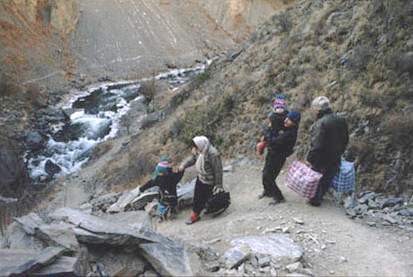
This family of
refugees from the village of Satoy (South-West of Grozny) attempt to
reach the georgian border through a high mountain gorge.
(Photo by Bruno Stevens Source: Liberation)
A report by Amnesty
International - (December 1999 - AI
Index: EUR 46/46/99 DISTR: SC/PO/CO/RAN)
Read
the complete report
Introduction
While civilians continue to suffer in Chechnya, they are also being targeted on the streets and in police stations in Moscow. Amnesty International is concerned that the way in which the Russian forces are waging war in Chechnya -- that is, in apparent disregard of international humanitarian law -- and the discriminatory manner in which Chechens have been targeted by the authorities in Moscow, suggest that the government has been involved in a campaign to punish an entire ethnic group. “Fighting crime and terrorism” is no justification for violating human rights. Amnesty International’s report details testimonies from civilians who have fled the Russian military offensive in Chechnya. On the basis of these testimonies and official Russian statements on some incidents, it appears that Russian forces have carried out indiscriminate attacks or direct attacks on civilians, which are grave breaches of international humanitarian law. Amnesty International is appealing to the Russian authorities to respect their obligations under international humanitarian law. The testimonies further reveal the existence of secret “filtration camps” where Chechen men and women are detained after being singled out at the border and checked against a list of alleged Chechen fighters and their supporters. Eyewitnesses reported seeing visible signs of beatings on people who had been detained at the Russian border crossing checkpoint “Kavkaz 1" after “filtration”. The organization documented a large number of cases of torture and illtreatment in “filtration camps” during the 1994 to 1996 conflict and is concerned that similar abuses may be occurring now. The Russian government should disclose the names of all those detained in “filtration camps”, including at border crossings, and grant the International Committee of the Red Cross immediate access to any such detainees.
Amnesty International is also calling on the authorities of the Chechen Republic and the leadership of the Chechen armed groups to respect international humanitarian law. Since the bombing of residential buildings in Moscow last September, the Russian authorities have embarked on a campaign code-named “Operation Whirlwind”. Although no one has claimed responsibility for the bombs which killed nearly 300 people, the Mayor of Moscow has publicly stated that he believes Islamic groups from Chechnya were responsible. Non- Muscovites are being required to register or re-register with the authorities. Up to 20,000 people have been rounded up by the Moscow police and 10,000 have been expelled from Moscow after being refused a permit to reside in the city. Over the past three months Amnesty International has collected testimonies from Chechens and other people from the Caucasus in Moscow who have been subjected to arbitrary detention, torture and ill-treatment in custody, and forcible expulsion. Many alleged that they have had drugs and weapons planted on them which were used as the basis for criminal charges.
Chechen engineer Badrudy Eskiev was taken by Moscow police on 15 September from his apartment, allegedly beaten and later arrested. The police said that he was apprehended on the street at 2am in possession of drugs. However Badrudy’s family witnessed police finding nothing when they emptied his pockets at 5am in the apartment. Badrudy’s Russian wife was told by police that “the only good Chechen is a dead Chechen”. Many Chechens have sewn their pockets up in order to prevent anything being planted on them if stopped by police. One young Chechen exclaimed: “This is how we live, thanks to the Department on Fighting Organized Crime. First we were bandits, then became terrorists, and now we are becoming seamstresses.” Malika Takayeva and her brother had been living in Moscow since 1995. Their residency permits had run out when they were arrested on 13 September and sentenced to five days’ imprisonment on a charge of ‘petty hooliganism’. They were reportedly threatened with being put into a cellar “to rot” and told their sister would be killed. Upon being released they were instructed to remove their belongings from their home within 24 hours. A police officer allegedly told them that Chechens should not just be expelled but destroyed.
Amnesty
International is urging the government to stop the campaign of
intimidation against ethnic Chechens who reside in Moscow and other
cities, and to investigate reports of human rights violations.
Russia is Committing War Crimes and Genocide
A
memorandum of Gesellschaft für bedrohte
Völker (Society for Threatened Peoples) - International (18
November 1999)
Read more on this
memorandum here.
Introduction
Chechnya: Genocide is not an internal affair
Since 5 September 1999 Russia has been engaged in renewed aggression against the small Caucasian nation of the Chechen people. Approximately 400,000 Chechens have fled their homes under the onslaught of Russian bombardment, many for the second time in five years. Mosques, hospitals, market places and refugee convoys have all been attacked. According to Chechen government estimates, between 5.9.1999 and 1.11.1999 over 3,000 people were killed by bombs and shells. No-one has counted how many have perished from exhaustion and hunger. By their new war, the continuation of their genocide of 1994-96, the government of Yeltsin and Putin has demonstrated one thing clearly: the Stalinist tradition has survived intact in Russia.
The Chechen people must likewise give up their unlawful practices of hostage-taking and trafficking in human beings and distance themselves from their extremist military commanders. The Society for Threatened Peoples condemns the atrocity of the bombings carried out in Moscow and Volgodonsk, whoever they may have been committed, as well as Russia's terror bombing of Chechnya. Genocide is the most heinous crime of which human beings are capable. This is a matter on which there can be no compromise. Extremists such as Hattab, Raduyev and Bassayev are popular because of the courage they have shown in fighting the criminal activities of the Russians in Chechnya. However they have brought ruin to Chechnya. The Russian human rights activitist Sergei Kovalyov was right when he called for the Chechens to build themselves a humane legal system: "They must renounce the barbaric system of Sharia law. People do not chop hands and feet off."
Most importantly, though, the international community of nations, which intervened in Kosovo and East Timor and put an end to genocide, has given its pledge of support. The pioneering work done by the OSCE in Chechnya in 1996 was remarkable. The inhabitants of Grozny still remember with gratitude how the leader of the OSCE mission, Tim Guldimann, stood by them in adverse circumstances, in the face of the Russian bombing attacks, and organised the democratic elections from which President Aslan Maskhadov emerged as victor.
However, the international community has abandoned Chechnya. Out of consideration for Moscow's shrill cries of protest against alleged interference in its internal affairs the democratic world has made no effort to restore stability in Chechnya and contain the influence of the Islamist extremists. In February 1999 the newly appointed German Foreign Minister Joschka Fischer, representing the environmental and human rights party, the Greens, responded to Russian protests by abandoning support even for humanitarian projects to assist Chechnya: support for a mine-clearance programme to train young Chechens in the removal of landmines laid by the Russian army at the time of its departure in 1996 and contaminating wide areas of Chechnya's agricultural land, was withdrawn.
The Russian president, Boris Yeltsin, and the government of the former KGB officer Vladimir Putin have no respect for their international commitments under the CFE Treaty limiting conventional ground and air forces, the OSCE Agreement, international humanitarian law - and the UN Convention on the Prevention and Punishment of the Crime of Genocide of 1948. Russia's war of aggression against Chechnya is not therefore a domestic matter. The European Union, the Council of Europe, the OSCE, the UN and the International Monetary Fund (IMF) must condemn the crimes being committed by Russia in Chechnya and use all political and economic means at their disposal to bring an immediate halt to Russia's bloody deeds in Chechnya.
Tilman Zuelch, President of STP International
For
a more recent memorandum by STP (but unfortunately only in German
language) see:
Chechnya: the Genocide Continues
A Memornadum by the Society for Threatened Peoples (May 19, 2003, in
German, .pdf format).
Behind their Backs - Russian forces's use of the Civilians as Hostages and Human Shields during the Chechnya War
A report
by Memorial, the
Russian human rights center - (1997)
Read the complete report
Introduction
During the course of military activity in Chechnya and in the neighboring territories, both sides involved in the conflict have used the civilian population as «human shields»[27], and took hostage large numbers of the civilians.[28]
During
the course of the Chechen-Russian war, the Russian side has used some
of the civilians detained at the filtration points as hostages.
Likewise, from the beginning of the war, the Russian side illegally
declared that captured Russian soldiers are «hostages» of the Chechen
fighters. This use of this term came about as the result of carefully
thought-out and systematically implemented policy to consider the
conflict in Chechnya outside the context of human rights. Russian
officials denied the presence of a conflict (of either an international
or non-international character) and reduced the situation to a
«disarmament of criminal formations» which was strictly an internal
affair of Russia. In accordance with the official position regarding
the conflict, the situation with prisoners and forcibly detained
individuals was systematically viewed in a criminal context. In other
words, the Chechen side was treated, not as a legitimate warring enemy,
but rather as a group of criminal formations which should be dealt with
outside the law. As a result, Russian soldiers captured by Chechen
detachments were deprived of the official status «prisoners». The
status of prisoners of war or of individuals forcibly detained by a
belligerent side provides for certain legal guarantees. The Russian
side did not respect these guarantees, rather they chose to free their
hostages from the «criminal formations» by way of exchange or ransom.
Beginning in December 1994, captured Russian soldiers were placed in
the headquarters of the army of the CPI. This was connected most likely
with the lack of development of their armed forces and also with the
absence of other separately guarded places or the strength to organize
necessary guarding elsewhere. Nonetheless, in the Presidential Palace,
the most well-known place for the detention of prisoners, those held
were kept in the most closely guarded parts of the basement. As the
fighting neared the center of the city, prisoners were divided into
smaller groups and evacuated.
According
to our sources, the first incident when captured Russian soldiers were
used as hostages by Chechen forces occurred on May 27, 1995 when the
commander of the Western division, Ruslan Gelaev, announced that if the
bombing of the village in the Shatoisky region continued, five
prisoners of war would be killed per day. Eight were killed altogether.[29] A second similar
ultimatum was made by Ruslan Khaikhoroev, the commander of the Bamutsky
battalion, but was later retracted by Khaikhoroev himself, by his
superiors and by the representatives of the Department of State
Security of the CRI.[30]
Beginning in Fall 1995, in addition to the capturing of hostages, the
Chechen side began to organize the kidnapping of civilians which took
on a mass character in December 1995.[31] In these particular
incidents, it is difficult to discern purely criminal acts from the
capturing of evident «collaborationists», «officials of the occupying
administration», etc. In kidnapping builders and electrical specialists
from Russia, the Chechen side noted the necessity of detaining
«officials of the secret service». There were, in fact, secret agents
of the Russian special services among those civilians (construction
workers, engineers, etc.) who were kidnapped[32], although, they formed a
minority. The majority of kidnapped civilians whose affiliations with
the secret service were not proved was released by way of ransom.[33] From the point of view
of the «Memorial» HRC, these incidents of kidnapping should be
qualified as the taking of hostages.
Various
officials of the Russian Federation have, from the very first days of
armed conflict, repeatedly blamed the armed forces of the
self-proclaimed CRI for using unarmed citizens as «human shields»
during the fighting. However, concrete facts supporting these
accusations have not been brought forth. The «Memorial» HRC does not
have any information which verifies that such acts occurred before June
1995.[34]
It is well known that in June 1995 and in January 1996 a detachment of
Chechen fighters attacked civilian points in Budennovsk and in Kizlyar,
captured the city hospital, rounded up many civilians (including
children, women and elderly people) and declared those captured as well
as hospital personnel and patients to be hostages. Then, using them as
«human shields», they retreated beyond the borders of the territory
controlled by the RF. In Budennovsk, many of the hostages were shot.
During
the course of the entire war, detachments of the armed forces of the
self-proclaimed CRI repeatedly chose military objects in densely
populated regions and conducted warfare in populated areas that had yet
to be evacuated by the civilian population. Such action is considered a
violation of humanitarian norms, although it should not really be
qualified as using a «human shield».[35] Both sides could be
blamed for the fact that before the start of armed fighting the
civilian population of Grozny was unable to leave the city. Neither the
government of the RF nor the leadership of the CRI took any serious
measures to evacuate the civilian population before the bombing
started. Only after the bombing had begun did the Ignushetia Ministry
of Emergency Situations permit three groups of buses filled with
civilians to leave. However, the fourth group of buses was directly
impeded by the leadership of the CRI. On the orders of those closest to
D. Dudaev, the group of buses was stopped and forced to return to
Grozny. There are also other known incidents when the evacuation of
civilians from Grozny was impeded by formations of the CRI.[36]
Beginning in the spring of 1995 when the fighting spread outside of
Grozny, Russian troops repeatedly hindered the evacuation of the
civilian population from populated areas that were being subjected to
shooting, armed attacks and bombing.
In
March of 1996, the «Memorial» HRC for the first time received news that
the Russian troops were using the civilian population as «human
shields.» (The «Memorial» HRC does not have information which hints at
the use of «human shields» by the Russian side before this time.) In
the course of the fighting in Grozny in August 1996, the use by the
Russian forces of captured civilians as hostages took on a mass
character. In this report, there are also examples given of several
incidents when the Russian forces used civilians detained at filtration
points as hostages. However, most attention will be given to the their
new practice (used in the last six months of fighting — from March
until August 1996) of capturing civilians during the fighting and using
them as «human shields». A part of the IA MIA RF (including the 101st
brigade, which was permanently stationed in Grozny) and a division of
the MIA sent to Chechnya is primarily at fault in these acts.
Conditions in Detention in
Chechen Republic Conflict Zone. Treatment of Detainees
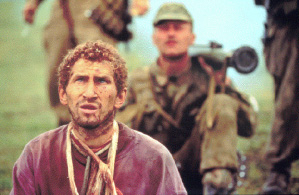
Russian "Spetsnaz"
in Chechnya (during the first war 1994-6)
(By Eric Buvet 3rd prise under "Events" category at
World Press Photo-95)
A report by the Human Rights Center in Moscow Memorial - (1995)
Read the complete report
Introduction
On
December 9, 1994, the Russian President issued a Decree «On Measures on
Preventing Illegal Armed Formations Activities in Chechen Republic and
in the Zone of Chechen-Ingush Conflict». The Decree instructed the
Russian Government «to
use all the power of the state to ensure state security, rule of law,
basic
rights and freedoms of citizens, public order, curb criminal activities
and
disarm illegal armed formations». Russian Army and Interior Ministry
units
were deployed in Chechnya amidst resistance of Chechen forces. These
events
triggered proxy war in the North Caucuses.
The authors of this report consider resulting large scale hostilities
as internal armed conflict, whose victims are entitled for protection
in strict conformity with Common Article 3 of 1949 Geneva Conventions
and Additional Protocol II. Reports from the conflict zone about gross
violations of humanitarian law and human rights resulted in launching
on December 15, 1994 the activities of Russian Human Rights
Commissioner Group there. Due to the absence of law
on Human Rights Commissioner in Russia, S.A.Kovalev (appointed by State
Duma)
indeed found himself deprived of rights and powers and was left without
staff
to operate in the conflict zone. In this situation, a number of Russian
human
rights NGO’s facilitated the Group’s functioning and delegated its
members
to work there.[25]
Since March 1995, Human Rights NGOs’ Observer Mission headed by
S.A.Kovalev has functioned in the region, after the State Duma sacked
Mr.Kovalev from the post of Human Rights Commissioner. The Mission was
initiated by HRC Memorial
with representatives from its regional branches (Moscow, St.Petersburg
and
Ryazan), the Human Rights Project Group and State Duma members working
as
observers. The Open Society Foundation has provided support.
Since January 1995, Human Rights Commissioner Group and later NGOs’
Observer Mission have been receiving complaints concerning torture and
cruel and degrading
treatment from persons detained in the conflict zone. They reported
about
so called filtration camps (FC). On the other hand, Russian officials
claimed
that persons suspected in fighting against federal forces were treated
humanely.
Thus, Chief of the General Staff M.Kolesnikov stated that «the
prisoners
were being treated normally, though from the formal point of view they
should
have been shot by firing squad as bandits».[26]
The Group managed to find out that filtration camps were organized on
the basis of Russian Interior Ministry Directives No 247/12.12.94 in
late 1994 — early 1995 in Mozdok (North Ossetia), Stavropol and
Pyatigorsk (Stavropol Region) and later in Grozny to check the identity
of those detained, their responsibility for crimes and participation in
fighting against the Russian army and interior troops.
Filtration camp in Mozdok uses several railway carriages for inmates.
In Pyatigorsk and Stavropol these camps are situated in pre-trial
detention facilities (PDF). After Russian forces gained control over a
major part of
Grozny, a filtration camp was also set up there in the last week of
January. Initially, it was situated at diary factory and then
transferred to administrative quarters of an autotransportation company
in the north-eastern part of Grozny.
In the course of public investigation of these reports, accumulating
testimonies of those who had been taken to FC, as well as direct visits
there, the Human Rights Commissioner Group found gross and systematic
human rights violations there and made these findings public through
several Russian and foreign periodicals.
Russian public, press and international organizations’ resulting
pressure against mistreatment in detention in FC contributed
significantly to certain improvements of conditions in detention, but
in general the fate of detainees in the conflict zone is still tragic.
The following report is based on:
—
Testimonies of those who have been detained at FC. (Interviews in
Chechen Republic and Ingushetia taken by Human Rights Commissioner
Group and NGOs’ Observer Group);
— Information from official sources in Ingushetia;
— Information obtained by S.A.Kovalev, members of his group and NGOs’
Observer Group, members of State Duma during their visits to FC in
Grozny, outside Mozdok, Pyatigorsk and Stavropol.
— Materials presented to the authors by human rights organizations,
such as Freedom House, «Grazhdanskoe Sodeistvie» Committee,
Memorial/Ingushetia, etc.;
— Mass media reports, if confirmed by other sources.