On
Chechen's War Crimes, Terrorism and Hostage History or other mysterious
terror acts
Even
if the scale of demolition and the number of deaths among the
population resulting from Chechen armed formations is incomparably less
than those resulting from the actions of Russian's federal forces, it
must be emphasized that parts of the Chechen guerrilla have been also
responsible for many cruel acts. Many have been ruthless warriors for
their cause and have indeed resorted to terror. Chechens fighters and
their sympathizers assassinated, attacked, or threatened also Chechen
civil servants, seeking to intimidate Chechens who might cooperate with
the Russian government. Some wings of the Chechen guerrilla fails
frequently in differentiating between civilians and combatants too.
Cases of torture on Russian prisoners or policemen and their
extrajudical execution have been reported in some cases. The killing or
torture of a war prisoner is a gross violation of the Geneva convention
but is nevertheless frequently encouraged among Muslim extremists
fighters. Chechen terrorists began to organize the kidnapping of
civilians which took on a mass character in December 1995. These acts
of terrorism are now, especially after the attack on Moscow's theater
Dubrovka, worldwide known. Chechens have been utterly unable to form a
stable government and Chechnya had become an outpost of organized
crime, gun-running and drug smuggling. However with time passing by and
indications emerging from different apparently disconnected facts, it
becomes slowly clear that the Russian secret services must have been
the cosponsor of at least some of these terror acts. More details in a chapter on the background on the
Chechen Conflict.
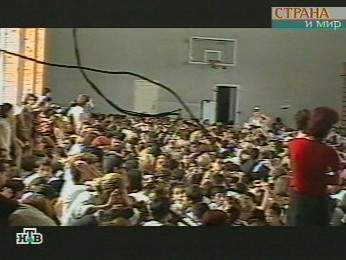
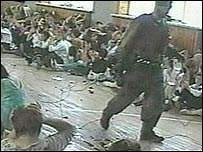
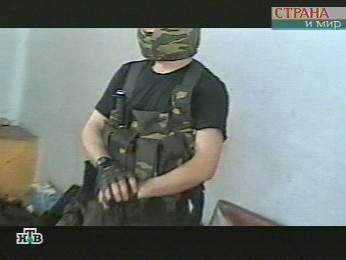
The Beslan Horror
The
crisis began on 1
September when armed men and women burst into the school as
approximately one thousand children, their parents and teachers had
gathered to celebrate the beginning of the academic year. The
composition of the group of hostage-takers has not been clarified,
however, it has been reported that some of their demands were related
to the armed conflict in Chechnya. The armed group held the hostages
without food or drinking water for over 48 hours before Russian
security forces, at approximately 13:00 on 3 September, stormed the
school in circumstances that still remain unclear. It has been reported
that over 325 hostages, almost half of them children, were killed;
hundreds more were taken to hospital suffering from injuries of varying
degrees of severity.
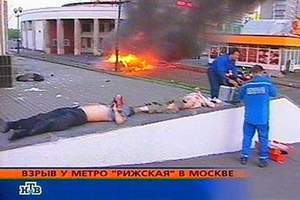
Moscow metro station
terrorist attack kills 10
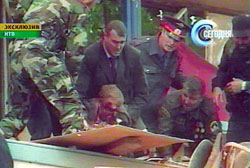
On 31 August, 2004, a Moscow
'suicide blast' happened at the end of the evening rush hour. At least
10 people have been killed in an explosion outside an underground
railway station in Moscow. More
than 50 others were hurt in the blast outside the Rizhskaya station in
the north of the city. Russian
officials are blaming the attack on a female suicide bomber, seen
outside the station before the blast.
Terrorist bombs brought
down two airplanes: 89 dead
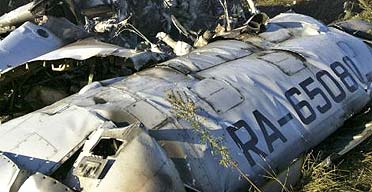
On August
25, 2004, two Russian passenger planes were blown up in a terrorist
attack and crashed almost simultaneously killing 89 people.
The FSB security service, which discovered traces of explosives in the
wreckages of both aircraft said the planes were brought down by bombers
on board. Officials have refrained from blaming Chechens for the
crashes, but theories in Moscow suggest that women believed to be
Chechen took explosives on board and brought the planes down ahead of a
coming election of a new president in the turbulent region.
Metro blast in
Moscow kills 49
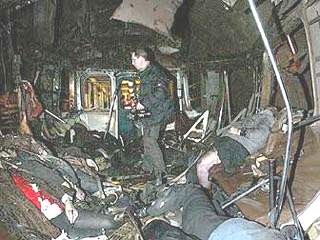
On February 6,
2004 49 people were killed and more than 100 injured after an explosion
ripped through a busy underground train in central Moscow during the
morning rush hour. Russian authorities blamed the apparent terrorist
attack on Chechen suicide bombers, although no group has so far claimed
responsibility. Immediately Vladimir Putin, Russian president, speaking
on television, accused Aslan Maskhadov, a Chechen rebel leader, of
being behind the attack. "We do not need any indirect confirmation. We
know for certain that Maskhadov and his bandits are linked to this
terrorism," he said. However again the Ministry of Foreign Affairs of
the Chechen Republic of Ichkeria, Ilyas Akhamdov, and Maskhadov's
deputy PM Akhmed Zakayev resolutely condemned the attack: "It is a
horrific crime which cannot be justified by any cause. We condemn any
form of terrorism whoever stands behind it. We insist that we do not
employ terrorist methods", said Zakayev.[*]
Train blast near Chechnya kills 41
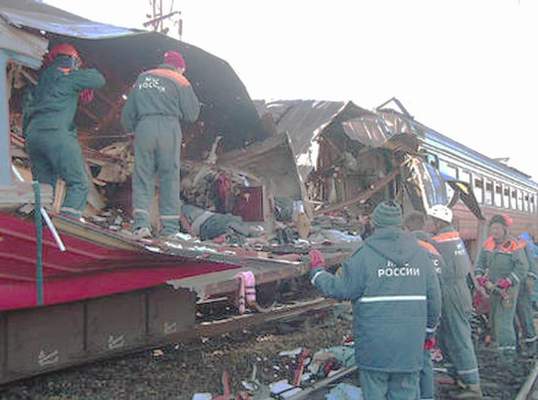
On
December 5, 2003, a train blast near Chechnya tore through a commuter
train near Chechnya (Yessentuki railway station), killing 41people. The
device was estimated to have the force of 22 pounds of TNT. Shamil
Basayev claimed responsibility again. Whereas the Ministry of Foreign
Affairs of the Chechen Republic of Ichkeria, Ilyas Akhamdov, distanced
Maskhadov from this attack saying: "We have not, do not and will not
employ Russian methods that make no distinction between civilians and
combatants, between legitimate and illegitimate means, targets and
ends."[*]
Russian military hospital blast kills 50
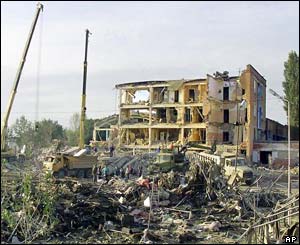
A vehicle exploded outside a Russian military hospital in Mozdok, North Ossezia, near Chechnya in August 2, 2003. The blast completely demolished the four-story red brick hospital. At the moment of the explosion, there were 115 people inside the building, including medical workers and patients. Leader of the Islamic extremist wing of the Chechen resistance, Shamil Basayev, claimed responsibility.
(Photo AP)
Two female suicide bombers kills 16 people outside a rock festival near Moscow
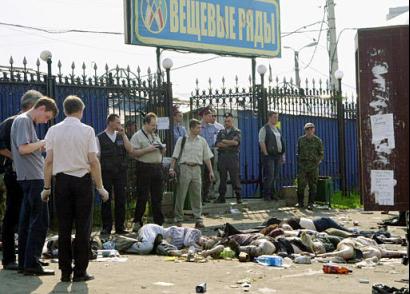
On July 5th 2003 two women came up to the perimeter of the Tushino airfield north of Moscow, where they were stopped from entering the concert. The first blast occurred when one woman stopped by guards at the festival entrance detonated an explosives-laden belt. The belt only partially exploded. About 15 minutes later, the second woman detonated explosives at another entrance, the authorities said. The explosives and pieces of metal were strapped to her body. However many mysteries surround this terrorist attack which has never been vindicated: if it is of Chechen matrix remains unsure.
(Photo: AP)
Bomb Attacks on Government Buildings kills 72
At about 2:30 p.m. on December 27, 2002, Chechen rebel forces carried out a suicide truck bombing at the headquarters of the pro-Moscow Chechen government in Grozny, one of the few fully reconstructed buildings in Grozny. Media have reported that the suicide bombers wore Russian military uniforms and had forged Russian documents, which enabled them to make their way through several checkpoints in the vicinity. Two massive blasts destroyed the building, killing at least seventy-two people in the building and wounding another 210. On a regular day, an estimated 150 to 200 civilians worked in the building.
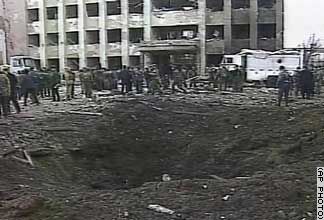
On May 12, 2003 a truck bomb ripped through a compound of the pro-Moscow government, the police and Russian secret services headquarters in Znamenskoye, northern Chechnya, killing 55 people and wounding more than 100 others. Northern Chechnya has been so far considered more secure and under control than its southern part. Only two days later a female suicide bomber blew herself at a religious service still in northern Chechnya, killing over 20 people and wounding dozens of others. Leader of the Islamic extremist wing of the Chechen resistance, Shamil Basayev, claimed responsibility.
The Moscow Hostage-taking
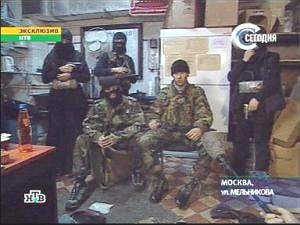
On October 23, 2002, around fifty armed men (only fifteen according to other sources) took about 800 people hostage at a theater in Moscow during a performance of a musical play, “Nord Ost.” They threatened to kill all the hostages if their demands were not met. Under the leadership of Movsar Baraev, the nephew of a notorious Chechen warlord who was killed in June 2001, the gunmen held their hostages for three days, and killed two of them. On the morning of October 26, Russian special forces stormed the theater, after pumping an anesthetic and lethal gas into the main hall to incapacitate or kill the hostage-takers. As a result of the operation officilally 129 hostages died all due to the effects of the gas. The attack has been vindicated by the notorious Chechen warlord Shamil Basayev. Maskhadov condemned the attack. However many pieces of evidence indicate that Russian special services must have been somehow involved in this hostage-taking too.
Chechen's Rebels' Hostage History
A BBC correspondence (updated to October, 2002) - From kidnapping aid workers, journalists and businessmen to seizing hospitals and now a theatre, Chechen rebels have become notorious as hostage-takers. They have often used civilians to draw international attention to their demands, ratchet up pressure on the Russian authorities and simply to extract hefty ransoms.
A couple of chapters on abuses by Chechen forces by Human Rights Watch: chapter I & chapter II.
See
also pages 13 and 14 of the previous report
and a short account of suicide
attacks in Chechnya since 1999 (updated to June 2003).