Human Rights Violations in Chechnya

"It is inconceivable that in Europe there hasn't been any movement of rebellion against all this, a rally, not a symbolic one, but a huge and imposing rally that says how all this is intolerable! - The tragedy of Chechnya is the tragedy of Russia. - Europe is a happy and thoughtless continent. A continent that doesn't think about it. About nothing. When it will be forced to think about it, it risks to pay a very high price. Its better it would begin to think about it."

(Adriano Sofri)


" Think, Europeans. Decide. And having decided, demand. Chechnya is tired of waiting."

(Anna Politkovskaya)
chechnya
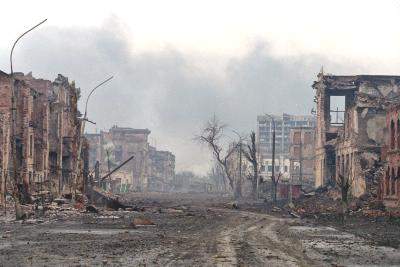
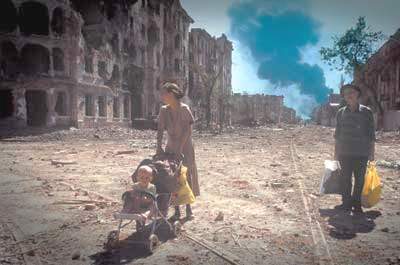
Grozny, the capital of Chechnya, razed to the ground - 150.000 dead - 300.000 refugees. War on terrorism or state terrorism?
Click on the image to see some geographic and ethnic maps of Chechnya

(Photo by Laurent Van der Stockt)

"There is nothing more dangerous in the war of ideas than the "realpolitik" approach which brought us so many disasters in the past. After all, was not Osama bin Laden a by-product of similar "marriage of convenience" at one point? Was it not true also in the case of Saddam Hussein? And is it not true that your new "partners" such as Russia secretly sell military equipment (including nuclear technology) to the Axis of Evil countries even now?

" Will the United States ever learn this lesson, or will it continue forever to build up new enemies while fighting present ones?"


From an open letter of Elena Bonner and Vladimir Bukovsky to President Bush


Latest Press Releases on Human Rights in Chechnya


You can put this banner on your site. Please inform: radical.party@radicalparty.org
Invite also others to do so!

Press Releases on
Western Politics


   Society for the Russian-Chechen Friendship
Urgent appeal!

The Society for the Russian-Chechen Friendship, a human rights NGO monitoring human rights violations in Chechnya, is threatened with closure by the Russian government.

Read why and take action!

The analysis on Chechnya carried out by many non governmental humanitarian organizations as for instance Amnesty International, Human Rights Watch, the Moscow's based human rights center Memorial, the German Society for Threatened Peoples, or other governmental organizations as the U.S. Department of State or the Parliamentary Assembly Council of Europe, and finally credible reports coming from sources living inside Chechnya, all report that large scale human rights abuses in Chechnya are occurring, and that Russian federal forces commit systematically war crimes and crimes against humanity. Everything confirms that the grave breaches of humanitarian laws in Chechnya are not an accident or a consequence of Russian's inability to control its own forces, but appear to be the basic psychological strategy by which the Russian authorities hope to submit the Chechen resistance.[1] Even if not comparable in magnitude with Russian's violations, also a part of the Chechen guerrilla resorts to terror acts like suicide bombings and hostage takings. The following overview of the selected reports, which you can read in the next page, summarizes the situation.

The conflict in Chechnya is not only endangering the future of the little Caucasian Republic, it is also reversing the political, social and civil development of the Russian Federation. A reversal which inevitably reflects itself on the whole international stability. The Russian Federation's permanent human rights violations in Chechnya is not only brutalizing the Chechen population but also Russia's own society, leading it towards an authoritarian and xenophobic involution. The danger that, among other things, also and especially the Chechen-Russian conflict might precipitate Russia, from Grozny to Moscow, towards a new nuclear capitalist-Stalinist criminal regime is no longer an abstract hypothesis but is becoming an increasingly concrete reality.

An Overview


Casualties in ChechnyaCasualties: Estimates indicate that during the first and second war in Chechnya, on a Chechen population of 1 million, 150,000 - 200,000 civilians died or disappeared. This amounts to 15% - 20% of the entire population. About 30,000-40,000 children died and 20,000 - 40,000 Russian soldiers lost their lives during the same time. Casualties between the Chechen forces might be comparable.[2]
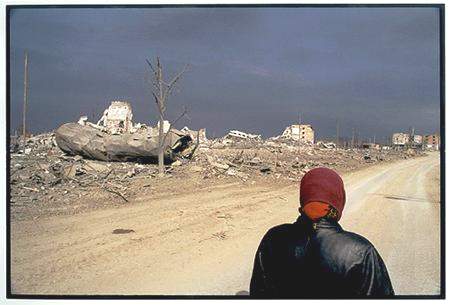
Photo Gallery

Bombardments in ChechnyaBombardments: Numerous indiscriminate disproportionate bombardments and artillery shelling throughout Chechnya, in apparent disregard for the physical security of the civilian population (including the Russian ethnic one), caused an unnecessary loss of tens of thousands (see the satellite images of Grozny before and after the second Chechen war).[3] Chechnya is one of the world deadliest area for mines. More than 5,600 people were killed by mines in Chechnya in 2002 alone.[3b]

Filtration camps in ChechnyaFiltration Camps & Points: During the first war 10,000 - 20,000 were detained in so called "filtration camps", which were officially large scale non-selective detainment of individuals who were gradually "filtrated" to find members of armed forces and their associates who resist the federal forces. However, too many testimonies and especially the continuous disappearances of the detainees made it clear that these must have been Russian's new gulags, i.e. concentration camps where extrajudical executions, the practice of torture, ill-treatment, and killings, mostly of innocent civilians, occurred continuously.[4] In the second war in Chechnya the strategy changed: there are now no permanent detention centres but "filtration points". These are all "temporary filtration points" and are used for a day, a week or more. They are guarded areas – perhaps a disused factory or farm or just a bit of land enclosed with barbed wire, perhaps even tents, sometimes people are just detained in the open air but in an enclosed area. The detainees are brought in, undergo checks, may be tortured, are interrogated and very often held in covered vehicles. They bring the detainees in one at a time for questioning, they torture them, usually using electric shocks, they let them go, or sometimes they don't, they take them away and bring in the next ones. When they finish their work they leave, it's a temporary set-up. A "temporary filtration point" is the official name given to such set- ups by the federal forces, although there is no understanding of such a concept in any Russian legislation. Sometimes relatives must pay bribes to liberate prisoners or even to return the corpses of the victims.[5]

Destruction in Chechnya
Complete destruction in Chechnya.
A war against terrorism?
(Photo by Eric Bouvet)

Destruction of the center of  Grozny
The center of the Chechen capital Grozny in early 2000

Disappearances in ChechnyaDisappearances: Thousands of disappearances of civilians have been reported after Russian federal forces took them in custody. The true number of the Chechen "desaparecidos" is uncertain, but at least 3,000-3,500 since 1999 are confirmed, while it is estimated that the true figure might be twice as high. Many of the "disappeared" have been found in unmarked burials or mass graves with unmistakable signs of torture.[6] More recently the cases of "disappearances" and "sweeps operations" spread out to Ingushetia.[6b]

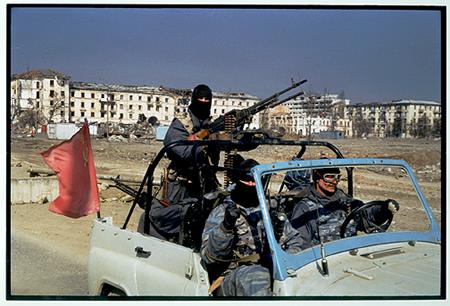
Death squads in ChechnyaDeath Squads: Also during military Russian "sweep operations" many disappearances occur on a daily basis. Squads of masked and heavily armed personnel without identifiable insignia traveling in unmarked armored personnel carriers, kidnap, torture, rape and kill civilians.[7] Several Russian soldiers serving in Chechnya are in many instances not military professionals, but mercenaries-contract killers, not servicemen. There is also a Chechen militia, loyal to the pro-Russian government, which takes part in these sweep operations. Moreover, hostage taking and repressive actions against relatives of alleged combatants are considered “new” methods of an anti-terror policy.

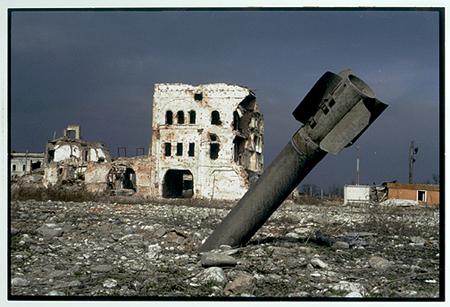
Minutka square in Grozny
Grozny's Minutka Square in early 2000
A flattened land where once the presidential Palace stood.
(Photos by Eric Bouvet)

Chechen human rights violationsChechen Violations: Even if the scale of demolition and the number of deaths among the population resulting from Chechen armed formations is incomparably less than those resulting from the actions of Russian's forces, the Chechen side must be blamed for grave human rights abuses too. Part of Chechen guerrilla organizes terror acts like suicide bombings and hostage taking.[9] Some Chechens fighters and their sympathizers assassinated, attacked, or threatened Chechen civil servants, seeking to intimidate Chechens who might cooperate with the Russian government.

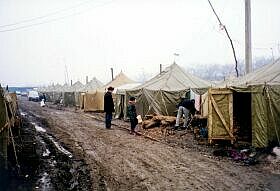
Education in ChechnyaRefugees: The number of refugees was about 300,000 in 2000. About 150,000 Chechens remain displaced inside Chechnya, about 50,000 are scattered throughout Russia, in other Caucasian republics or around the world. Hundred of thousands of Russians moved outside Chechnya too.[11] Displaced people fear to return to their homeland preferring to stay in the winter coldness in refugees camps. About 80,000 lived in Ingushetia in tent refugee camps or spontaneous settlements, but in order to support the claim that the war is over, authorities forced these displaced people to return against their will to refugee-style camps in Chechnya.[11b]  Tent camps have been closed now and refugees had no other choice than to fled back into their war- ravaged homeland. Ingushetia still shelters about 50.000 refugees.[10] The programme of compensation for destroyed housing and lost property, launched by the Government in mid-2003, did never become effective.

death squads in Chechnya
Russian forces squads at "work" flying the old Soviet flag
(Photo by Eric Bouvet)


Survival in ChechnyaSurvival in Chechnya: Of about 800,000 people, 150,000 remain displaced from their former homes inside Chechnya and now eke out an existence in bombed-out buildings. The city of Grozny and several villages were practically razed to the ground into mountains of rubble. Most must survive with sporadic running water, heating or electricity. Jobs available involve working for the Russians, and most Chechens won't take them for fear of being considered traitors. Chechens were isolated from the world: telephone lines had been cut and were operative only for Russian forces. Slowly this is returning to normality but the internet, fax or other media remain almost inexistent luxuries.

Education in ChechnyaAbsence of Education: For many years most schools and universities remained closed and a new illiterate Chechen generation grew up. Many schools still aren't in session because there are no teachers. Frequently authorities fail to provide textbooks in Chechen language to children who can't speak Russian ending up unable to read or write either in Russian or Chechen.[11d] And islamic extremism is gaining momentum winning these adolescents, brutalised by war and with little or no education. Meanwhile, Russia seeks patriotic comfort in history books: the textbooks for Russian high school seniors touts the Soviet system's achievements but treads lightly, if at all, on its failures and abuses.

Education in ChechnyaThe war spills over:  The disregard for human rights which characterize the continuing conflict in the Chechen Republic is spilling over to the neighbouring republic of Ingushetia governed by Murat Zyazikov, the Kremlin backed president of Ingushetia and fromer KGB agent, Daghestan, Kabrdino-Balkaria and possibly next also other Caucasian republics: the spread of Chechnya-type Human Rights Violations Ingushetia, North Ossetia and Kabardino Balkaria are observed with ever increasing concern. Abuses, as killings, "disappearances" and kidnappings organized by the police and governmental authorities which have so far characterized the ongoing conflict in Chechnya are now occurring with alarming regularity also outside of it. The reaction to this repressive policy came on June 21, 2004 when a coordinated violent attack of hundreds of Chechen and also Ingush guerrilla attacked various police and government targets in Ingushetia, killing about hundred people. Refugees in Ingushetia are therefore under constant attack and intimidated by the local authorities who held them responsible for the ongoing situation. Masked man raids in Chechen refugee camps occur daily and locals threaten them with pogroms.[11c]
Education in ChechnyaSanitary Structures: Most hospitals have been bombarded. Only few exists and are inefficient. Meanwhile Chechnya is stricken by Tuberculosis.[12b] Only one baby on eight comes to the world in healthy conditions and as many as 84 percent of Chechen children suffer from neurological and psychological illnesses.[12c] In general Chechnya is a medical disaster.[12d] Thirty-one per cent of Chechnya's children show symptoms of ill health recognizable as post-traumatic stress syndrome.*  A health crisis brews in Russia's Chechnya.
 
Humanitarian aid in ChechnyaHumanitarian aid: Only 20-30 % of the EU's humanitarian aid reaches Chechnya. The rest is mysteriously lost in the Russian-Chechen political-bureaucratic quagmire.[13] Chechnya's rebuilding continues to be announced since years now, but so far has been ineffective.[14]

Ecological disaster in ChechnyaEcological Disaster: Parts of this tiny republic have been turned into an ecological wasteland.[15] Air and artillery bombardment of oil wells, chemical and oil refinery plants and radioactive sites have caused grave water, soil and air pollution. Waste products from the petrochemical refineries have impregnated the ground up to 17 meters in depth, which is causing severe pollution of subsoil water.  The presence of heavy metal, e.g. copper, nitrogen, manganese, and aluminium, was discovered in nearly all the main rivers throughout the republic. An oil deposit has formed beneath the ground surface slowly moving toward the reservoir which provides drinking water for Grozny. Chechnya may eventually end up without safe drinking water.[16]
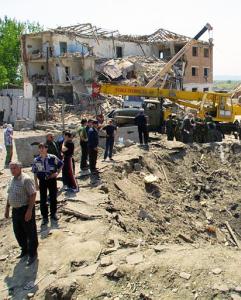
Znamenskoe suicide bombing
A huge crater left by a suicide bombing
(Photo AP)

Demoralized Russian troopsHungry and demoralized troops and the cost of war: After two wars and more than a decade of decay in Russia's demoralized, under-funded armed forces in Chechnya (70-80,000 officially, more than 130,000 troops according to other sources) and a poverty-stricken country, violence against young soldiers is on the rise, sparking a wave of mass desertions from the 1.1 million-member federal force. Frequently Russian soldiers are abandoning their units in organized groups. Post-traumatic stress, alcoholism, random violence and suicides among Russian soldiers are increasing. The paradox of poverty, which is at the root of a widespread corruption, is that some members of the Russian forces are now selling weapons to the rebels they are supposed to fight. Because of the brutality soldiers experience on the Chechen battle fields, or because of the violence among the military themselves, they often pour on civilians afterwards even at their homes where they return back after the conscription time. The war in Chechnya has an economic Cost to Russia. It is a colossal misallocation of scarce economic resources. The first Chechen war is estimated to have cost at most $5.5 billion, while by November 2001 Russia has spent c. $8 billion on it. Russia was slated to spend c. $516 million on rebuilding Chechnya but only $158 million of these resources made it to the budget. According to some analysts it is through off-budget clandestine bank accounts owned and managed by the Kremlin which continue to finance the war. Oil prices are bound to come down one day and when they do Russia will discover the true and most malign cost of war - the opportunity cost.

Censorship in RussiaChechnya's closure: Chechnya is closed to the world. Russia has prevented internationally authorized human rights investigators and monitors from entering Chechnya. It doesn't allow the press to visit the war zones, in a manner unrelated to the legitimate protection of military secrets. Facts about military losses and the names of those killed, wounded, or missing in action, and those taken prisoner are not available. Russian military authorities obstructed for a long time the shipment of humanitarian supplies violating the norms of international humanitarian law.[16] Chechnya was and still remains like a huge concentration camp fenced with countless checkpoints and command headquarters. It is hard to escape the impression that Russian authorities are withholding the truth on what is really going on in Chechnya and that they must have something embarrassing to hide. Something that can not be confessed especially to their own public opinion and conscience.
Chechen refugees camp Ingushetia
Former refugees tent camp in Ingushetia
(Photo: Help-Germany)
Censorship in RussiaDisinformation and censorship: Russian public opinion is told that the war in Chechnya ended in April 2000. However, while organized large scale combats between federal forces and Chechen rebels has for the most part ceased, a guerrilla warfare continues and the "disappearances", torture, and summary execution of detainees and civilians continues, marking the transition from a classical internal armed conflict into a classical "dirty war," where human rights violations and not the conquest or the defence of territory are the hallmarks. Generally, while hatred against Caucasians is encouraged nationwide, the Russian public opinion is scarcely aware of what is going on and of the numerous abuses committed by federal forces on civilians. A government-controlled information blockade and campaigns of disinformation or falsified information is withholding facts.[17] A widespread disinterest and silence from the side of Western mass media, which much too frequently takes the Russian government propaganda and information at their face value, left a similar lack of awareness and understanding in Western societies too.

Abductions in ChechnyaMurder and abductions of Journalist and Aid Workers: Also some journalists investigating on the Chechen conflict and humanitarian relief worker have been abducted or murdered.
Dozens of humanitarian aid workers had been kidnapped in the Caucasus region, including Chechnya, since 1994.[18] The government force in power has done its utmost to pressure and intimidate journalists from reporting (generally, in Russia, hundreds of journalist died because of "unnatural" causes since the Soviet breakup.[19] & [19b]) The result is a whitewashed portrayal of the Chechen conflict that has left Russian readers with little sense of the war's true costs -- in casualties, manpower, resources, military morale, and national conscience.

Abductions in ChechnyaThe West approves and turns blind eye: From Egypt to Pakistan to Indonesia and from China to Vietnam, through Uzbekistan and Turkmenistan, governments are heightening their repression on ethnic minorities, political dissidents and human rights activists, selling it to the world as part of the war on terrorism. President Vladimir Putin links the war in Chechnya with that against international terrorism and wants that its daily abuses against civilians are acknowledged not in the context of human rights abuses but in the context of the war against terrorists. Mass terror is carried out by the very people who are supposed to be conducting a counter-terrorism operation. Religious fundamentalism and Chechen terrorism finds a fertile soil among a population brutalized by these "counter-terrorism operations". However, the Western side deliberately ignores the problem because of its interests in maintaining a good relationship with a Russian government which is still convinced of a "terror for terror" military solution. Western's lack of support to moderate forces in Chechnya has indirectly strengthen the Chechen radical Islamists. Western's tendency to play down Russian war crimes has provided a kind of protection for Russian's international standing and contributed to the development of Chechen terrorism. It has allied with a force which is damaging Russia. Fascist and xenophobic forces are staedily growing in a nuclear armed Russia while Europe remains indifferent and passive as during the German invasion of Czechoslovakia. While it is mainly concerned with the Khodorkovsky case, which after all is only the tip of the iceberg of a predictable authoritarian involution occurring in Russia, and of which Chechnya is only its utmost manifestation, the West seems not to be aware of the grave threat it is posing itself by turning a blind eye on the Caucasian conflicts. For a more detailed analysis on Western politics towards Russia and Chechnya click here.
 
Home
Latest Press Releases on
Human Rights in Chechnya
-- A Critical Analysis of Western Politics--
-- Western Politics: Press Releases --
Press Review &
Other Reports or Appeals
Links
The Reports
on Human Right in Chechnya

Donate