|
PACE's
answer before March 23 was that it "is concerned that the necessary
conditions for holding such a referendum are unlikely to be met by this
date", and it "calls upon the competent authorities to take essential
steps to achieve such conditions", but it is "recognising the role of a
referendum in deciding the future democratic structure and constitution
of the Republic".[19] In other
words, in its usual very diplomatic way that shouldn't upset Russia too
much it said: "you could make it better but after all its fine and go
ahead". It accepted a constitutional referendum that contradicts the
norms of international law (according to which the absence of violence
or a threat of violence is a mandatory condition for conducting free
elections) and would have no legal grounds in any Western democratic
country. Later Gil-Robles, stated that "holding the referendum is a
beginning" of a political resolution in Chechnya.[20]
But short after, responding to a Chechen journalist: "...there is no
hope that immediately after the referendum life will become normal in
Chechnya".[21]
But the
still unanswered question was if PACE should send observers to the
referendum. If it would send observers who eventually failed in finding
illegal voting procedures (Russia had no necessity to falsify the
voting session making it appear perfectly legal, because, as we already
outlined, the overall conditions were illegal from the outset) then it
would have been forced to recognize the result. On the other side, not
sending any observer implicitly meant Europe's denial to recognize the
referendum. And that could obviously make the relationship with Moscow
troubling. So PACE had the wonderful idea not to send observers but
added, through the voice of its deputy speaker Mikhail Margelov, that
"this decision was made for security reasons, not political" and that
"in the meantime PACE is very positive about the referendum itself, and
believes it will mean a considerable step towards achieving a political
settlement" and moreover, after having been perfectly silent and
indifferent on a genocide, suddenly "they deemed that they have no
right to put the lives of Russian soldiers in danger for their
security".[22]
|
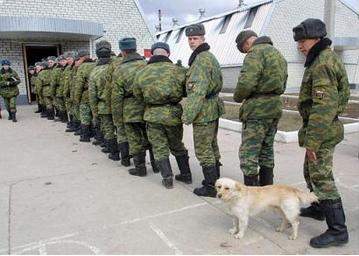
Russian soldiers (and a dog?) voting for a "Chechen constitution". |
On
the day of the referendum, according to Russian sources[23], 96% of voters have approved the
constitution, over 88 per cent of Chechnya's adult population took part
in the voting and two other laws, on electing a president and a
parliament for the republic, were approved by 96 per cent of voters. In
other words, after centuries of slaughters, torture, rapes,
deportations and humiliations, an incredible 96% of Chechens still
wants to "stay Russian"!?
It
seems that all kinds of manipulations were possible (to the point that
two journalists of the "Le Figaro" and "The Guardian" were able to vote
when they showed their French and British passport) and the rate of
participants is, to say it euphemistically, somewhat "surprising"
considering that, according to an opinion poll conducted by the Russian
human rights organization “Memorial“ in Chechnya and Ingushetia between
February 22 and March 14, only 12% of the Chechen population had
planned on taking part in the constitutional referendum. And according
to the few observers allowed, while at the polling stations the number
of people entering were counted in few hundreds the number of votes
cast ran in the thousands.
But
this didn't discourage Europe's "optimism". The following day, Diego de
Ojeda, the EU commission's external affairs spokesman, said "the EU
today welcomed yesterday's constitutional referendum in Chechnya as a
'positive step'", that the referendum "becomes a basis for a
'comprehensive' political solution in Chechnya" and that "it had
achieved a high turnout".[24]
French Foreign Minister Dominique de Villepin, at a session of the
United Nations Human Rights Commission in Geneva, was no less cynical:
"Bearing in mind the challenges facing Russia in the North Caucasus",
we must see how, "the referendum in Chechnya is the first step towards
political settlement". After having used this quite doubtful double
standard policy on human rights, Mr. de Villepin spoke out for an
"objective approach to human rights matters" and against "the use of
double standards in this area", stressing that "none of us should try
to teach lessons to others".[25]
Which means that, for Mr. Villepin, silence is the best answer and that
the European institutions should make themselves accomplices of the
Russian propaganda farce, the so called "referendum". And about three
weeks later, one source of the senior EU officials in a talk with
Russian Foreign Minister Igor Ivanov said that "we are seeing some
positive signs, such as the high participation in a recent referendum
and the proposal for a new constitution".[26]
But perhaps the champions of cynicism were the French Defense
Minister Michele Alliot-Marie who said: "...we know that the population
of Chechnya has long been dreaming of this", and some months later the
Italian foreign Minister Franco Frattini introducing the Italian
European presidency: "This [the referendum] has shows that the Chechen
population, tired of the war, has chosen for the political solution and
wants to remain in the Russian Federation. At the same time this has
shown that the separatist leader and rebel Maskhadov and his followers
has to a good degree lost the recognition of the civil society."[26b]
If
Europe will continue to stand against its own values accepting this
blatant falsification and humiliating falsehood, practicing a brutal
cynicism, believing that this might somehow help to build a base for a
new political process in Chechnya, it will not only insult others but
also its own intelligence. Because if Europe and its CoE
representatives, will subject itself to this verdict they will not only
send the terrible message that they agree that Russia can continue to
rule over Chechnya with its usual brutal means, and that people as
Maskhadov can be brushed aside (and in more practical terms they might
be forced to recognize afterwards Kremlin's puppet government of
Kadyrov), giving even more power to extremism and encouraging a radical
feedback, but they will increasingly shift themselves to a position
that is willing in being the tool of those forces who regularly commit
human rights violation and war crimes, i.e. they will be used just by
those they were originally supposed to resist and defeat.
OSCE's
attitude hasn't been an example of "humanitarian correctness" either,
quite the contrary. Its silent complicity became evident since the
beginning of CW1. Moreover, one of its main characteristics has always
been its smallness and its permanent state of staff and money shortage
because of the member states refusal to deliver appropriate fundings.
In a
December 1994 OSCE meeting in Budapest, while Russian's military
aggressive intention against the Caucasian Republic was already clear
to anyone, no one of the members of this "security" organization dared
to rise its voice of opposition, they even didn't ask a question about
the matter. Instead it signed an agreement on a military code of
conduct with Russia. That this code didn't have any value for both
sides became clear only few days later when Russia violated it by
Chechnya's invasion, whereas OSCE replayed that after all the Chechen
conflict should be regarded only as its "domestic affair", just as
Russia expected.
On
November 19, 1999, OSCE signed with Russia during a meeting in
Istanbul, an agreement according to which the organization had to play
a humanitarian rule in Chechnya, trying to set up a policy that should
prevent ethnic cleansings as those that occurred in the former
Yugoslavia, and build a civil structure aimed at organizing fast and
efficient interventions in case of a humanitarian catastrophe. But the
final declaration reads "we fully acknowledge the territorial integrity
of the Russian Federation and condemn terrorist attacks in all its
forms". They forgot however to condemn also terrorist attacks from all
the sides. And that this was only a farce became clear almost
immediately, when on November 29, Putin (still not president) told to
Knut Vollebaek, president of OSCE, how Russia doesn't need external
observers in order to regulate its internal affairs, declaring with
this that Russia regards the agreement, signed only ten days earlier,
as having no value. OSCE replied with silence.
However,
a little OSCE mission could nevertheless operate on the Chechen
territory under severe restrictions on freedom of movement. This lasted
three years when the OSCE mission of observers in Chechnya has been
closed by Russian authorities again at the end of December 2002.
Despite ongoing reports of rampant human rights abuses by Russian
troops in the war-torn republic, the Kremlin said the mission's closure
is possible because the situation in the region has returned to normal.
Meaningful is that representatives from Chechnya's separatist
government said they do not regret the change, as the OSCE played a
passive and largely ineffective role. Spokesman for President Maskhadov
said that the mission was "inactive" and that "repeated complaints from
the Chechen side against abuse and violence against civilians by
Russian federal forces fell on deaf ears." On the other side the West
expressed its anxiety with respect to the dismissal of the OSCE mission
in Chechnya. But this anxiety is hardly credible: it seems to be more a
justification aimed at its public opinion or the future generations of
Europeans and Americans who will know about the genocide. OSCE's role
in contributing to find a political solution to the conflict has so far
been almost completely without any value.
Meanwhile
the European reluctance to grant some support (not to say asylum) to
exiled Chechen representatives continues. Mr Akhmed Zakayev, the
Minister of Culture, from 1997 to 1999 in the Chechen government of
President Maskhadov is threatened with extradition in Great
Britain. Mr Lom-Ali Aldamov, the minister of Trade and a refugee in
Georgia, presented an application for asylum in France. The application
was rejected by the Home Minister first, but a court recognized it and
the proceedings are now under way. Still France rejected the asylum
application to Ruslan Maigov and his family. Ruslan Maigov is the
brother of the former Chechen representative of Maskhadov. Despite the
fact that he had been more than once arrested and severely beaten by
Russian authorities and has been even kidnapped, the OFPRA (the French
refugees office) nevertheless refused him asylum justifying this with
the fact that his brother, who lives in Moscow, has so far not been
subjected to any threat. Similar fate met Mr Khanbiev, the Health
Minister, whose Schengen visa has not been renewed, and Mrs Dudaeva,
the widow of President Dudayev, whose passport has not been renewed
either. And several less notorious Chechens have been extradited from
Austria, Sweden, Belgium and other European countries with hardly
credible justifications. Refugees frequently get a refusal to cross
boarders. Others have been expelled from France, Germany, Austria, the
Netherlands and other European nations back to Russia. According to the
German Society for Threatened Peoples the Lower Saxony refugees comitee
claims to be able to document cases where refugees, once they had been
forced back by the Germans towards Russia, were tortured by the Russian
authorities which took them in custody.
Apparently
the Council does not believe that it should proceed without further
delay to a "white list" of Chechen figures to whom the Union could
grant visas, stay permits and other documents necessary to allow them
to carry out their activities in favor of a political settlement of the
Chechen tragedy. One sometimes wonders if it is the voice of a
libertarian and democratic Europe or the hostage of Russian's
bureaucrats? (And by the way, the US are apparently not doing it much
better: Mr Akhmadov, the Foreign Minister, is blocked in the United
States without a passport too.)
The
new order word Putin is now trying to sell as part of his "peace plan"
in Chechnya, together with this farce constitutional and presidential
elections, is a so called "amnesty". An amnesty which is supposed to
pardon Chechen militants if they depose arms and is apparently offering
them the possibility to return to "a normal and peaceful life". The
amnesty, approved by Russia's parliament, was touted as a step toward
peace, offering immunity from prosecution to rebels who give up their
weapons by September 1, 2003. Apparently a serious act of state
forgiveness and mercy which should convince the Chechen guerrilla at
least to a cease fire and subsequently to give up their arms and stop
the warfare.
But
what stands really behind this apparent chance of peace and political
opening?
First
of all, one has to recall that this is not the first time that an
amnesty is being used as a political tool for pacification. It follows
at least two others. The most significant was the one proclaimed in
March 1997, another pardon followed in March 2000, shortly after the
second conflict began. Many of those who gave themselves up later
regretted doing so. Aslambek Aslakhanov, a State Duma deputy from
Chechnya, stated that in that of those rebels who surrendered, "500
people were released, from among them, not many are alive today. Many
have been secretly liquidated by special services"[26c]
In other words, the amnesty showed to be only a trap. The Chechen
rebels soon learned the lesson and it is unlikely that they will now
come to surrender so easily. After all one has only to look back in the
Russian-Chechen history to remember that also in 1930 a revolt in
Chechnya ended in an armistice and amnesty, but one year later Stalin's
authorities killed all the Chechen rebel leaders who showed up. The
rebellion began all over again until 1936, where Stalin's purges put
everything to an end. Things seem not to be different for this amnesty
either. According to an article [26c2]
on the Prague Watchdog Website the Russian human rights NGO
Memorial cited the case of a rebel group headed by Abubakar Magomadov
that had surrendered near the town of Komsomosk on March 21, 2003.
“Immediately after appearing on television, 13 of the men were shot.
The soldiers then cut off the head of one victim and placed it in a
pail of boiling liquid. Seventy other captives were later transported
to Alkhan-Kala where several received 3 to 5 year sentences, so amnesty
will certainly never be granted them,” Baysayev declared. And Andrei
Riskin of Nezavisimaya gazeta is not among those impressed by the
actual results of the amnesty for surrendering Chechen rebels that took
formal effect earlier this month. "So far only [June 36, 2003] seventy
guerrillas have given themselves up," he wrote, "and by the way who has
actually seen them?" [26c3]
Then,
in this amnesty, as in the previous ones, there is no offer for a
political dialogue from the Russian side. What is offered to the
Chechen leadership who will surrender is an unconditional acceptance of
the Russian rule over their country. Moreover, just during the same
days where Putin launched the proposal of an amnesty, he clearly
reiterated his refusal to open any political talks and vowed to crush
rebel resistance. "We will certainly finish this task", he said.[26d]
Therefore,
in the best case what has been offered is not an amnesty but simply an
unconditional surrender.
But
this turned out to be a still too optimistic view. According to Anna
Politkovskaya, Lev Levinson[26e],
an expert from the Human Rights Institute who worked in the Duma for
many years and who analyzed the text of the presidential amnesty, and
which has now been approved by the Duma, makes it clear that not only
isn't there any kind of "amnesty" for Chechen rebels, but on the
contrary it is a subtle but decisive move to introduce the use of
torture and legalize crimes against humanity committed by the Russian
servicemen. What it really amnesties, i.e. in fact legalizes, is the
use of Russian or international mercenary soldiers or contract killers
who, if recognized guilty of torture and genocide for facts committed
in the past, present or future, can be forgiven:[26e]
"All of
those who held a weapon in their hands (but who, we might ask, has not
held one during the period since 12 December 1993, the amnesty's point
of departure?), all of them, without exception, can stop wondering: The
presidential amnesty will not apply to them. Of course, certain
sections of the Criminal Code are excluded from the amnesty, such as
murder (Sec 105), kidnapping (Sec 126), robbery (Sec 162), terrorism
(Sec 205), the taking of hostages (Sec 206), the desecration of corpses
(Sec 244), and many, many others: These are grave and completely
indefensible crimes, but.... The amnesty also does not cover
individuals guilty of the following: Section 295 (attempted murder of
an individual administering justice or conducting a preliminary
investigation), Section 296 (threats or acts of violence during the
administration of justice or a preliminary investigation), Section 317
(attempted murder of a law enforcement officer, a serviceman, or
members of their families) and, finally, Section 334 (acts of violence
against a superior).... All of those who laid mines, and even those who
carried ammunition or simply stood guard, or knew about this--ALL of
them are INELIGIBLE for the amnesty, because these were acts of
"attempted murder," "threats, "obstruction"....In general, this means
that almost ALL of the actions in Chechnya since 1993 are not covered
by the state pardon.
By the same token, virtually ALL participants in the armed resistance
of federal forces are ineligible.Then what is the point? If you want to
know, keep reading: The presidential amnesty does apply to such crimes
as genocide, mercenary soldiery, and torture (secs 34, 357, and 359).
Is this an accident? Is it an oversight? Is it the result of excessive
haste in the compilation of the text? Of course not. It was deliberate.
This is how the document had to be worded, and there is a simple reason
for this: Mercenary soldiery and torture were and are practiced by
Kadyrov, the present head of the republic, and his gang. They do this
under the Kremlin's auspices, and they have to be taken out of the line
of fire.... Genocide ("crimes against the peace and security of
mankind"), on the other hand, is mainly the realm of the federal
servicemen. I assure you that this statement is not a case of human
rights rhetoric, tears, and emotions, but a fact. Agencies of the
procuracy already filed charges against some servicemen for genocide
during the second Chechen war. It is true that they are trying to put
the brakes on these charges.... Nevertheless, they were filed! The
"sweeping amnesty," therefore, is actually a bribe offered to the
military and to "our Chechens."
The
'sweeping amnesty', therefore, is actually a bribe offered to the
military and to 'our Chechens'.
In
conclusion, I must mention another indicative fact. According to the
presidential proposal, even the administration of the amnesty will be
entrusted ... to the Chechen administration, to no one other than
Kadyrov and his henchmen. The foxes will oversee the chickens. They
will process the statements of rebels admitting that they fought in a
particular detachment under the command of a particular individual
(this information is required), and they will start using the mechanism
they received from the Duma for the purpose of.... For deplorable
purposes.... We can predict that the 'latest step toward peace in
Chechnya' will have the following consequences: From now until 1 August
2003 (the deadline for the amnesty) [actually 1 September 2003],
"genocide," "torture," and "mercenary soldiery" will be commonplace in
Chechnya. Anyone committing these acts will be pardoned later anyway.
We can safely assume that Kadyrov will have time before 1 August [1
September] to retaliate against his enemies and, in general, against
anyone who does not want the elections in Chechnya--parliamentary and
presidential--to be a fiasco."
This
is the "amnesty" of Putin.
While
Putin was presenting this meaningless "peace plan", covered with nice
words as "free elections", "referendum", "broad autonomy" and
"amnesty", and continued to refuse any negotiation with rebel leaders
and publicly vowed to crush the rebel resistance, Ilyas Akhmadov, the
foreign minister of Maskhadov's government, launched another desperate
appeal to the international community, in particular to the Western
nations in the forecast of the EU-Russia summit meeting in Saint
Petersburg's tricentennial celebrations in June 2003:
"While the
government of the Chechen Republic of Ichkeria categorically and
unconditionally rejects suicide attacks and condemns all acts of
terrorism, regardless of who may perpetrate them, a just peace is
ultimately the only way to prevent this deeply alarming trend. We
therefore urge the government of the Russian Federation to close this
chapter of war and destruction; to introduce a ceasefire; and to launch
transparent, unconditional negotiations genuinely designed to resolve
the centuries old Russo-Chechen conflict. A lasting political solution
ultimately is in the best interests of both the Russian and Chechen
peoples. The Chechen people stand in solidarity with those nations
faithfully engaged in the battle against international terrorism.
Accordingly, we renew our call for an international war crimes tribunal
to investigate atrocities within the Chechen Republic of Ichkeria and
punish those guilty of war crimes and crimes against humanity. We also
call upon the European Union, its member states, and the United States
of America to assist Chechnya and Russia, through mediation, in ending
the conflict and overcoming its painful legacies. Only a genuine
political solution will free the Chechen and Russian peoples from this
vicious circle of violence and destruction".[26f]
During
the same days also Amnesty International and Human Rights Watch
appealed to the UE leaders. "It is now time for the EU to make a
meaningful contribution to the solution of the conflict in Chechnya,
and achieve concrete results for the human rights of the Chechen
population," said Dick Oosting, Director of Amnesty International’s EU
Office. [...] The EU must urge the Russian President to agree to take
immediate action to: guarantee protection now of the human rights of
the Chechen population including the internally displaced; bring to
justice those responsible for the grave abuses committed during the
conflict in Chechnya; grant access to Chechnya to UN human rights
rapporteurs, reestablish a monitoring presence of the Organization for
Security and Cooperation in Europe (OSCE) and reaffirm the commitment
to cooperate with Council of Europe experts." While Elizabeth Andersen,
executive director of Human Rights Watch's Europe and Central Asia
division said: “EU and U.S. leaders should look beyond the festivities
to Russia’s appalling human rights record in Chechnya. [...] The number
of murders and forced disappearances committed in Chechnya makes the
republic one of the most dangerous places on earth. St. Petersburg’s
splendor should not eclipse this. [...] According to recently released
official statistics, 1,132 civilians were killed in Chechnya in 2002,
making the murder rate there more than five times higher than in St.
Petersburg and one hundred times higher than in EU countries. Since the
beginning of the conflict, hundreds have disappeared without a trace
after being detained by Russian troops. Official statistics indicate
that at least two people “disappear” in Chechnya every day, and showed
no decrease in the number of disappearances for the first three months
of 2003.[...] Human Rights Watch strongly urged EU and US leaders to
use the summit to seek commitments from President Putin regarding
Russia’s compliance with key U.N. and Council of Europe requirements
and regarding protection and security guarantees for Chechen civilians."[26fb]
As
expected all this fall on deaf ears.
More
than 20 heads of state took part in the Russia-EU summit held in
Russia's Northern Capital: 14 EU leaders, and the heads of the 10
candidates for accession, who attended the gathering in the capacity of
observers. The EU-Russia St. Petersburg summit might be remembered as
one of the worst chapters of Western realpolitk. Perhaps only during
the Munich conference agreement in 1938 one could see similar
obscenities. Here a short list of the statements coming from this new
revived "Chamberlain and Petain Europe".[26g]
Greek
Prime Minister Costas Simitis, whose country holds the rotating EU
presidency, said: "The European Union will continue to support the
efforts of Russian leaders to carry out a policy aiming to bring peace
back to Chechnya." Simitis praised the Russian president's peace plan,
launched with a constitutional referendum in March and a subsequent
offer of rebel amnesty. "The recent referendum, combined with the
approved amnesty, is an important step forward," he said. It "has
helped to make a large step towards the restoration of stability''.
What kind of stability he was talking about remains a mystery: this
suability was already blown up at the time of these words by suicide
attacks that killed about 80 people and the carnage wracking Chechnya
daily didn't show in the least any sign of betterment: heavy fighting
between Russian and Chechen guerrilla left about 5-10 dead per day on
the ground.
British
Prime Minister Tony Blair delivered a glowing endorsement of Putin's
policy in war-torn Chechnya praising the "peace process", saying: "I
think it is absolutely right that you resolve that through the
political process and political dialogue that you have engaged in."
Blair said the referendum result was "a very, very important step
forwards." (The repetition of the word "very" in the original).
French
President Jacques Chirac said European leaders wanted to underline "our
common hope to see the March 23 referendum open the path to peace and
reconciliation in the framework of a political process."
Jan
Peter Balkenende, the prime minister of the Netherlands, OSCE's
chairman, also welcomed the recently started political process and said
it "supports the path chosen by the Russian Federation as the right and
only one."
The
European Commission's president, Romano Prodi, was not short of purple
metaphors to describe the new entente between Europe and Russian that
the St. Petersburg summit was supposed to portray: 'I told Vladimir
that now we are like vodka and caviar,' he said.
And
Bush during a visit to the Auschwitz nazi concentration camp, short
before his appointment in St. Petersburg: "This is a time for all of us
to unite in the defence of liberty, and to step up to the shared duties
of free nations. Aggression and evil intent must not be ignored and
appeased. They must be opposed early and decisively." 24 hours later he
met with Putin, praising and applauding, as everyone else, his
nazi-like genocidal policy in Chechnya.
The
final declaration issued after the summit's end states that Russia and
the EU "note the recent referendum and express the hope that the
recently launched political process, as well as social and economic
development, will bring back a state based on law that favorizes the
protection of human rights and finally a real reconciliation in
Chechnya," it said. Obviously, the European leaders condemned "in
particular terror acts", but did not mention the fact that Russian
soldiers have killed, raped and robbed Chechen civilians and brutalized
them during so-called mopping-up operations aimed at flushing out
rebels.
In
September 2003 the amnesty for rebels was over. The amnesty offered by
Russia supposed to encourage Chechen rebels to lay down their arms got
a larger response from Russian soldiers and civilians than from the
insurgents. According to deputy Prosecutor-General Sergei Fridinsky
only 170 Chechen rebels have left their units under the amnesty and
that 226 "servicemen, interior and penitentiary service officials and
civilians" have benefited from the amnesty. In other words neither the
referendum nor the amnesty brought any positive results. Other sources,
with only slightly different statistics, came to the same conclusion.[26h] The number of killings and kidnappings
has not diminished. The war continues, suicide bombings occur and
kidnappings and violence on the innocent population remain an everyday
reality.
The farce of the
referendum continued about six months later with the "presidential
elections" in Chechnya scheduled for October 5, 2003. Same conditions.
Same threatening and intimidating policy of the referendum of March 23.
Akhmad Kadyrov was the Kremlin appointed interim president of Chechnya
and Russian officials were anxious to ensure that he remained in charge
of the Chechen administration. When public opinion polls were released
in late August, Kadyrov trailed, with a scarce 15%, behind three other
presidential hopefuls – Moscow-based businessmen Hussein Djabrailov and
Malik Saidullayev, along with a Chechen representative in the Russian
State Duma, Aslanbek Aslakhanov. In the weeks since the release of the
polling data Kadyrov’s challengers were forced out of the race.
Djabrailov announced his withdrawal immediately after meeting in the
Kremlin with Russian President Vladimir Putin’s chief of staff,
Aleksandr Voloshin. Aslakhanov said he decided to quit after he got a
phone call from Putin himself offering him a job as presidential
advisor on southern Russia issues. Saidullayev was barred from running
by Chechnya’s Supreme Court, which ruled that his campaign petitions
contained forged signatures. Kadyrov became at this point the only
candidate with a realistic chance of winning.
Meanwhile
a reorganization of Chechen mass media structures accompanied a so
called "presidential campaign". In early September, Chechen Minister of
Press and Information, the alkready mentioned Bislan Gantamirov, an
outspoken Djabrailov supporter, was sacked and his ministry merged with
the republic’s Nationalities Ministry. The chief of Kadyrov’s campaign
staff was put in charge of the new governmental body. Shortly after
Gantamirov’s firing, Kadyrov’s personal security service seized the
Grozny TV station. Pro-Kadyrov forces also took control of the
editorial offices of all eight Chechen newspapers. This gave finally
Kadyrov a control over all of the region’s major mass media outlets.
According
to the few observers present, Kadyrov posters suddenly appeared on
nearly all buses and walls inside the republic. "Clad in camouflage
fatigues and armed with Kalashnikovs, Kadyrov's men move around freely
in checkpost-filled Chechnya. Residents in Chechnya say the
'Kadyrovtsy' have been riding around the republic and terrorizing the
population into voting for their boss. If before locals blamed Russian
troops, the 'federals' for most of the disappearances and killings
among civilians in Chechnya, today they say: 'either the federals or
Kadyrovtsy."[26i]
After about seven months
all this was blown up. On May 9th, 2004, Russian President Vladimir
Putin's top man in Chechnya, Akhamd Kadyrov, has
been assassinated in a bomb attack that killed several other people.
The attack on the
top-security event
attended by military and political officials tore through the VIP section of
a stadium where
dignitaries were gathered to celebrate the 1945 victory over Nazi
Germany. This turned out to be a huge blow to the Kremlin leader's efforts of
"normalization". Putin's political process in Chechnya was torn
to pieces in a single bomb blast.
It is clear
that this kind of Western policy which accepts as an established fact
all this, devoid of any fundamental values and
principles and that doesn't dare to rise its voice against violations
of
the most elementary rights, resembles more than ever the pre-nazi
Europe of Munich before World War II. Its implicit and now explicit
alliance and collaboration with an almost fascist-stalinist regime is
more than ever evident. If in the UE, the CoE and in the USA the
influence of those who honestly stand on the side of truth will not
grow stronger and it won't have the courage to set aside a subtle,
passive, unwilling and indulgent diplomacy, exerting instead a serious
pressure on Russia, then it is most likely that in the best case they
will become only puppets in the hands of "realpolitical Ministers" of
the EU member countries, furthering the restoration of the status quo,
or in the most likely case, they might become the hostages of a new
criminal regime and the voice of war criminals. The danger of
"partnership" with criminal regimes is that they never stop until they
make you an accomplice in their crimes. Slowly but surely, as the Saint
Petersburg summit has clearly shown, the Russian rulers, because of
common commercial political and strategic interests, are forcing their
Western partners, together with their "face-saving" organizations like
the CoE and OSCE, to accept and even contribute to their crimes and
massacres. The secret hope of the European Chamberlain and Petain like
bureaucrats is that ignoring the threat of these criminal regimes, and
on the contrary favoring their appetites, might keep them under
control. This unfortunately is a vain chimera, an illusion. The evil
(just to put it in Bush's words) will only profit from it to expand its
power and influence. A power the free nations will sooner or later have
to deal with.
The
authoritarian involution of Russia
Chechnya
is an international time bomb. The tragedy of Chechnya is the tragedy
of Russia and the liberation of Chechnya is the necessary basic
condition for the liberation of Russia. From it depends the democratic,
civil and political destiny of Russia and of its relations with Western
countries. Apparently, when Bush and US National Security Adviser
Condoleezza Rice speak about a "Russia firmly anchored in the West",
they seem not to be aware of the fact that their silence on the Chechen
conflict is leading Russia in exactly the opposite direction and how
this is forcing Russia's political, military, juridical and mass medial
system, dangerously towards an authoritarian involution. But not only
the Chechen conflict is at the root of the weakening of democratic
values. It is a broader attempt to introduce a "managed democracy"
under a "dictatorship of law", how some ideologues call it, and which
is after all simply the restoration of an authoritarian regime. Only
few were able to note the discrepancy between the Check republic
electing as president a former dissident, Vaclav Havel, and Russia
which instead couldn't achieve nothing better than proposing its
electorate the choice between communists and the lead of a former KGB
colonel.
A
typical example where this can be seen is in the field of press
freedom. According to Michael McFaul[27],
Oleg Panfilov, head of the Center for Journalism in Extreme Situations,
says that "the number of criminal cases opened against
journalists in three years of Vladimir Putin's rule is more than the
number during the entire 10 years of BorisYeltsin's regime." Print
journalists reporting the "wrong" news, especially about Chechnya, have
been either intimidated, arrested or pushed into exile, and in some
cases even murdered*. And
according to the Glasnost Defense Foundation, 148 journalists died of
"unnatural" causes in Russia in the past 10 years. Subtle but illegal
tactics which resort to the manipulation of public's opinion are the
most preferred and frequent practices. The best signs of this are the
two largest national television networks that do Putin's bidding. His
government and its surrogates have now wrested control of NTV, Russia's
third-largest TV network and the only station truly critical of Putin.
Many prominent NTV employees moved then over to TV6 in protest of the
takeover, but that station was shut down again in a dispute with a
shareholder, a government-connected pension fund. TV6 journalists then
formed TVS with financial backing from a group of business executives
loyal to the Kremlin. Nevertheless, this last nationwide private and
partially independent TV station, was shut down too on June 22nd, 2003.
Officially, suddenly and unexpectedly, the Russian press ministry
explained that the "station's financial crisis and problems with staff
and management made further broadcasting impossible".[27b] The editor in chief of the Ekho Moskvy
radio station, Alexei Venediktov, said the closing of TVs gives the
government now a virtual monopoly on broadcasting. "It's like when all
candidates are excluded from the election campaign, except for only
one," he told. Replaced by a state-run sports channel, TVS gives now
the Kremlin a firm grip on what goes out over the nation's airwaves.
Short after, in August, the government took over also the country's
most respected independent polling agency. Its polling showed that less
than one-third of Russians support the Chechnya war. Actually,
Reporters Without Borders ranks Russia 121st out of 139 countries in
its worldwide press freedom index.
This
is of course not the only mean by which the Kremlin imposes violently
his diktat. Putin's attack on Yukos Oil Company, Russia's largest
company and possibly the next world's fourth-largest oil producer is
the best example illustrating how personal power and control over the
country stands prior to every economic and financial progress. In early
July 2003, Mikhail Khodorkovsky, the CEO and principal shareholder of
Yukos, was thrown in jail and charged with fraud relating to the 1994
privatization of a fertilizer company. Soon thereafter, Yukos and some
of its employees were hit with charges of bribery, murder, and
corruption, and Khodorkovksy himself was pulled in for questioning. But
Khodorkovsky's real crime was his violation of an informal deal whereby
Putin agreed to turn a blind eye to the questionable manner in which
Russia's oligarchs acquired their assets as long as the businessmen
kept their noses out of politics. He began to fund a range of parties
for the December Duma elections opposing the Kremlin's policy. This
move clearly sends a signal to every oligarch possibly ruminating on
the idea to enter politics and oppose to the status quo.
Its
no miracle that, despite his disastrous policy in Chechnya, his
incapacity to control an endemic corruption, brutality and a criminal
activity that plagues the federation and his unconvincing economic
reforms, for Russians at least, which, except in the big urban and
industrial centers, left substantially the poverty level unaltered
throughout, Putin's popularity remains firmly anchored and finds no
adversaries. Over 70% of Russians approve Putin's presidency. Because
of this almost complete lack of press freedom it is easy to predict
that, despite all, Putin will almost certainly win the 2004
presidential elections again. Certainly Western state heads will as
usual warmly welcome Russia's "democracy" and Putin as the "legitimate
representative of the Russians will", and explaining us that for this
reason any harsh critics must be set aside.
Meanwhile
the State Security Service, whose budget is dramatically rising,
increasingly harasses human rights activists, environmental leaders and
religious groups. Recently, the Russian government expelled the OSCE
from Chechnya and terminated its agreement with other Peace and human
rights NGO's or refused reentry to many personalities involved in
humanitarian or journalistic activities. Also frauds in local elections
or violations of electoral laws are a standard practice. The government
interfered in electoral politics, removing opposition candidates from
the ballot and preventing incumbents from seeking reelection in various
regions of the country. The State Duma has become servile to the state
head, and frequently unanimously welcomes Putin's policy almost in any
occasion.
"Spy
cases" are fabricated to revive the Soviet system of suspicion and
reporting. The Moscow Duma revived for August 4 2003, the structure of
agilers: street cleaners, house-managers and concierges are used again
as informers for the police in every districts of Moscow and the best
informers will be even paid salaries. This is an old soviet styled
practice that has been resurrected because of the emergency situation
coming from suicide bombings and other terrorist attacks. What is
particularly noteworthy is that street cleaners and concierges are
given the authority to detain everyone looks suspicious to them until
the police comes.
A number of
bigwigs forming a complex nature of Russia's parallel armed forces, law
enforcements and intelligence services (the Defense Ministry, Interior
Ministry, FSB, Emergency Situations Ministry, Justice Ministry and
others), also known as the "siloviki" or "chekist", are gaining an
almost complete control also on the social and political structures. In
this atmosphere an increasing number of former secret service agents,
often responsible of human rights violations committed in Chechnya or
elsewhere, are escalating in the structures of the civil
administration. Generals who stand accused of war crimes are being
promoted to high political offices. While in many East European
countries, former officers of the communist secret police forces are
banned from holding public office, in Russia, a former KGB colonel is
reforming the country and inserts KGB cronies in important positions.
The FSB is running most of the organized crime, protection racket, drug
trafficking, arms sales and contract killings. Instead of opposing this
tendency, Putin, on the contrary continues in strengthening traditional
Soviet power security agencies, improving their ability to work
together and maximizing their resources. It is likely that a monster
like the Soviet KGB will be resurrected in the next years. The FSB will
also have its own massive armed forces, the border guards, with more
than 100,000 soldiers, armor, an air force and a navy.[28] While Putin announced the creation of
this KGB-style super secret police, he did not propose, as it should be
in a liberal, democratic and law abiding state, any public system for
controlling its activities. Putin is in fact working hard to establish
a semi-criminal shadow system of power. Olga Kryschtanowskaja, a
sociologist, claims to be able to document precisely how thanks to
Putin's "reforms" almost 80% of the leading positions in the Russian
power structures are now again under the control of the old Soviet
nomenklatura.[28a] While in 1988
the Politburo had only a 4,8% of military presence, today, in the
analog structure which is the highest "Security Council", they
represent 58,3%. In the government the secret service personnel was
5,4%, but today they are about a third.
"The steady
increase in the proportion of military and security men in the
political elite over time is striking:
1988
(Gorbachev) 4 percent
1993 (early Yeltsin) 11 percent
1999 (late Yeltsin) 17 percent
2003 (Putin) 25 percent
A breakdown by
various groups within the political elite in 2003 is also revealing: Proportion of military
and security men in:
State Duma 9
percent
regional elite 10 percent
Federation Council 15 percent
federal government 33 percent
Security Council 58 percent"
The
governmental control over the media and the reforms of power structures
aimed at bringing to life something reminiscent of a police state are
all in accord with Putin's doctrine that envisages to reestablish a
centralizing control and the strengthening of the center at the expense
of the true Russian Soul which is of regional identity and multiethnic
nature. It is the doctrine of the "vertical power", as he calls it,
which doesn't hesitate to put at risk individual rights and minorities
in order to preserve a central and unique regulatory system against
separatist trends and definitively abolishes Yeltsin's project of
"asymmetrical federalism" (concessions of regional privileges in
economic matters) which Yeltsin himself maintained only as long it
could serve for his own personal political interest, as the case of
Chechnya clearly demonstrated.
The
media propaganda has become so effective that large parts of the public
opinion do not only show unwilling in opposing the war in Chechnya, as
it was the case with CW1, but even acritically support their own
jailers: what about the fate of the (estimated) 80.000 Russian
soldiers, mostly conscript youngsters (80% of the military casualties)
compelled to take part in a conflict they never wanted and probably
even don't understand? Large numbers of traumatized soldiers returning
home remain without alternative employment and with no assistance.
Apparently, Russian authorities do not only hide their own people the
truth on what is really going on in Chechnya, and do not only massacre
Chechens but don't even care about their own soldiers who are massively
sent into a dangerous conflict where many of them will never return
from. How could Russia's leaders have steered their country into such
self-defeating wars, at a cost of thousands dead and wounded Russian
citizens at all?
Meanwhile
the state propaganda entered also in schools. New textbooks describe
Vladimir Putin's figure as "young, self-disciplined and driven by
tireless energy" praising his achievements and reforms. Teenagers are
now required to study Putin's reforms for state history exams,
officially approved by the Education Ministry, in a tone like that of
the ol Communist Party songs. Among other things pupils must "list new
evidence of Russia's rebirth" and read how good it was that Putin
cracked down on the country's independent media and bringing it back
under the control of the Government. A newly indoctrinated and servile
generation like in the Soviet-era is coming up again.[28b]
Another symptom of
how Russia is going back to its past can be seen how the regime is
doing everything possible to restore the aura of persecution and
authority to Russian literature. The suffering of writers at the hands
of the powerful is a recurrent
theme in the history of Russian literature. Pushkin and Lermontov were
sent into exile; Tolstoy was excommunicated by the Orthodox Church;
Dostoevsky was thrown into prison (before he became a great writer,
however). Under Stalin, writers were imprisoned and executed.
Boris Kagarlitsky, the director of the Institute of Globalization
Studies, tells[28c]
how the authorities lost interest in
literature altogether, and writers forfeited the image of persecuted
heroes. Today it happens again that armed policemen and FSB
agents in bulletproof vests burst into stores and declare the
proceedings closed. An example of this is how the FSB
confiscated more than 4,000 copies of a book by Alexander Litvinenko
and Yury Felshtinsky on the pretext of protecting "state secrets." In
the book, called "The FSB Blows Up Moscow," the authors assert that the
security services were behind the apartment bombings in 1999 that led
to the second Chechen war and Putin's accession to the throne. "But if
the security services had no hand in the bombings, as the authorities
maintain, what <<state secrets>> could they possibly be
talking about?", asks Felshtinsky.
Another axample: a bomb went off outside the door of Yelena Tregubova's
apartment. Tregubova, a former Kremlin pool reporter, created a stir
with her recent tell-all book "Tales of a Kremlin Digger." The book
achieved a certain succes de scandale.
What seems to be
even
more frightening, and that Western governments seem not to be aware of,
is the new wave of chauvinism and xenophobia that is striking back
in a part of Russia's society. The virus of ethnic hatred, the crude
xenophobic rhetoric, the hurrah-patriotic propaganda and the appeal to
people's baser sentiments is growing, opening the doors to a latent
chauvinism and new interethnic conflicts. If the media would launch an
ideological campaign with a xenophobic propaganda there could be a
response by many Russians. Amnesty International[29]
and Human Rights Watch[30]
recently
confirmed that discrimination on grounds of race in the Russian
Federation is increasing. Brutal forces have emerged and grown in the
former Soviet Union: neo-Nazi skinhead gangs who kill even young
children in the name of race. Racial abuses, beatings with chains or
even killing with knives of the "black caucasians" by gorups of
skinheads is no longer a rarity.
With names like "Blood And Honour", "Moscow
Hammer Skin", "United Brigade 88" (H is the eighth letter in the
alphabet,
thus HH stands for Heil Hitler), they are estimated to number up to
10,000 in Moscow and some 35,000 in St Petersburg.[30b]
The link between the
Chechnya question and a rising tide of racism is undeniable.
A
nostalgia for the old methods of a Soviet imperial mentality is still
alive and reawakening. While Forty-five percent of Russians said
that Josef Stalin played a positive role in the country's history, 42%
expressed the opposite opinion and 13% were undecided, according to a
poll, the desire to return to
an
authoritarian
recentralization is emerging again..[30c] In Russia the process of
democratization, hampered by the war, is failing. As we have already
seen, the fictitious creation and construction of internal and external
enemies, so
typical of any totalitarian system, has become a frequent
military, intelligence, political and even intellectual exercise.
Irresponsible and often openly fascist statements by some political and
military personalities tend to encourage such dangerous trends in
society. The Minister of Defense Sergei Ivanov’s public expression of
his personal sympathy to colonel Budanov, who kidnapped, raped and
strangled an 18-year-old Chechen girl, calling him a "victim of
circumstances", is one of many such examples. An indirect attempt to
dehumanize Chechens came from the same commenting on war crimes
committed against Russians in North-Ossetia: "It is clear to everyone
who are we dealing with in the Northern Caucasus. They are not humans,
but rather humanoid biological beings," he said.[31]
General Gennady Troshev’s call for the public hanging of captured
Chechens[32] and General Shamanov’s
call to kill the wives and children of Chechen fighters [33] are other examples. Yeltsin awarded
Shamanov the "Hero of Russia" medal and what is worse is that the
reaction to these statements from side of the civil society are weak or
even manifest signs of approval: according to opinion polls on the
Budanov case only 11% believed that the colonel should be punished,
while even the cultural elite seems to follow, as for example in the
case of the Nobel Prize-winning author and former dissident Alexander
Solzhenitsyn who said that he favored restoring the death penalty for
Chechen rebels.
Correspondingly
the hate against the West, especially against the USA, is escalating.
Contrary to the popular Western belief according to which the USA are
considered a friendly country by Russian's society (55% consider
Americans as "a source of danger" but only 5% believe China is[34]), it is likely that with one signal from
the side of the leading political establishment a virulent anti-Western
campaign would erupt on command. The Western conspiracy against Russia
is the old leitmotiv of the former Soviet empire but it shows to be
still very effective and convincing for many Russians. A military
unwilling to reform, to give account of its actions and to be governed
by law is still wrapped around the American threat and is not under
democratic control. This can only reinforce the position of the armed
forces, the special services and the bureaucracy.
Also
other socioeconomic indicators don't open the way for any optimism.
Hospitals and medical structures are collapsing and the economy,
despite the progress of recent years, is far from having achieved a
convincing and secure betterment: after the ruble's devaluation of
August 17, 1998, incomes fall by 30% from one day to the other and
without raising again since then. After the fall of the Soviet Union,
abortion rates, characterized by a demographic implosion, together with
the children mortality rate grew, more than 3,000 children fell victim
to murder, and 94,000 children and teenagers suffered from various
crimes[38b] and alcoholism spread
out (on the admission of the Russian chief of general staff Anatoly
Kvashnin, as many as 10 percent of conscripts serving in Chechnya have
developed a dependence on alcohol).[38b2]
Russia holds first place in terms of violent death rate and holds
second place in terms of suicide rate in the world.[38bc] The great and unique intellectual
and scientific potentialities of Russia seem not to find a way to
express itself. On the contrary some prominent figures of the Russian
"intelligentsia" faithfully subscribe to Putin's brutal means in
Chechnya trying to justify the unjustifiable under the cover of
"national security". This, together with Putin's mass graves in
Chechnya, represents not only a material but also and especially a
psychological, social and cultural depression of a nation that can't
find any new moral and spiritual point of reference. Meanwhile, Putin's
originally promised two weeks "Blitzkrieg" in Chechnya seems to be
eternal.
What remains
are
frustration and dreams. A frustration which instead of leading to a
self-critical thought on the contrary tends to imagine all sorts of
inner and outer enemies as the cause of every problem, and dreams which
instead of searching for a new great Russian reforming project still
imagine that the old authoritarian short cut might be the solution.
Milosevic dreamt about a "Great Serbia". Bloody and devastating
conflicts followed throughout the former Yugoslavia with the
threatening and destabilizing consequences for Europe that anyone
knows. The same spirit is incarnating now in a part of Russia's
conscience which is dreaming again about an imperial centralism, a
"Great Russia". Dreams of a supreme leader revitalizing the former
Soviet Union go under the name of "patriotism". Reunification plans are
being pursued. In Georgia, after the ousting of President Eduard
Shevardnadze, Moscow has been increasingly openly supporting separatist
regional governments. The new government in Tbilisi has clearly been
given a choice: Bow to Moscow or Abkhazia, South Ossetia and Adzharia
may by "reunited" with Russia. And the Caucasus is only one peace of
the great puzzle the Kremlin has in mind.
But from
history
we know how every time a country begins to talk of becoming "great",
bloodshed and ethnic cleansing followed. This increasingly aggressive
neo-imperial policy of undermining neighbors and supporting corrupt,
self-styled separatist fiefdoms is detrimental to true Russian national
interests. All attempts to recreate the Soviet Union in any form will
be adamantly opposed by most of the former Soviet countries themselves
and the post-Soviet landmass could turn into a bloody mess just as the
former Yugoslavia did under Slobodan Milosevic.
If the West will continue on this line it might find the former Serbian
regime strong and healthy again in a future chauvinist Russia. And this
time it will have to confront with a much more dangerous threat and
with a much greater destructive force. And Russia is a threat not
simply because of its power but especially because of its decline.
In
Chechnya Putin's "dictatorship of law" produced only an absolute
lawlessness. Authorities try to hide the real scale of the tragedy,
through a pack of lies foisting on the public the idea of false
patriotism and showing the unwillingness to listen to the opinion of
those who seek for a nonviolent way out. The signs that there is a
clear strategy to restore the nationalistic imperial past and that it
is going to succeed are numerous. The political Russian establishment
actually in power seems to be unwilling and culturally incapable to
deal with internal conflicts and terrorism without undermining the
fundamental rights and freedoms of its citizens. The restoration
of an authoritarian, almost fascist regime, based on a desire of
imperial reunification, unable to deal with its own citizens without
restrictions on the media and on political activism, reminiscent of the
worst features of the Soviet era, is now definitely under way. It
sounds somewhat ridiculous to read in the Russian constitution that the
President should be "the guarantor of the rights and freedoms of the
men and of the citizens" (article 80-2). And despite all this, this is
the regime that many Western authorities continue to welcome
happily as the "new found Russian democracy". Is it not Western
interest to avoid that Russia becomes a fascist KGB-military ruled
dictatorship that commits Nazi-style crimes against humanity? Is it not
Western interest to defeat this system which is already the main source
of anarchy and mafia activity in its neighborhood?
Despite its
present economic weakness and its disastrous results in Chechnya it
would be a grave mistake to minimize the military power and the threat
Russia can become in the near future again. True is that after the fall
of Berlin's wall and because of its profound economic disparity
compared to the West, a badly equipped and badly trained Russian
military is no longer capable to keep up with the only left American
superpower. But Russia has still thousands of nuclear warheads and
today has more military personnel than the United States, Britain,
France, Germany, Italy and Spain put together. In October 2003, Putin
announced the national nuclear forces should be fundamentally
modernized, warned that Russia does not dismiss the use of nuclear
weapons in preventive strikes and against a "potential enemy." Moscow
is considering an opportunity to implement the new strategy if NATO and
the USA preserve their aggressive orientation. But there is not only
its nuclear weaponry but also a huge conventional military force. There
is a radical modernization going on of the entire military system.
Russia is not planning to reduce the personnel of its armed forces to
less than one million, as Russian Defense Minister Sergei Ivanov has
said. "Russia is reforming its Armed Forces and military organization
in general given the new standard of political relations with NATO."
"The purpose of the reform is to adapt the defense policy to the new
threats and challenges," he said. According to P. Felgenhauer, an
independent Moscow-based defense analyst, and columnist for The Moscow
Times, the number of armed Interior Ministry personnel is more than 2.5
million. And there is no democratic control over the power and
intelligence ministries which have only to obey to the Kremlin and have
no duty to report anything to the Russian Duma parliament that hasn't
any possibility to check what is really done by these forces covered by
an almost absolute state secrecy. Felgenhauer observes[38b2]:
"After
the
demise of the Soviet Union, Russia did not demilitarize or seriously
cut the overall number of military personnel. The power ministries
continue to be totally secretive and their activities remain out of the
public's reach. Now it's clear that Putin does not want to change this
situation. When meeting Western leaders, Putin often talks of the need
for partnership and integrating Russia with the West. Inside Russia,
Putin emphasizes his desire to recreate and reinforce a great Soviet-
style military derzhava [great power]. These two faces of Putin seem to
contradict each other. It's now clear that the Kremlin wants Western
investments and technology to refurbish Russia's economy and double
GDP, so that it will have money to rearm and recreate a Soviet-style
global military machine that could in the future threaten the West.
This is a strategy that was successfully employed by Josef Stalin in
the 1930s - - Putin clearly wants to copycat."
Moreover,
the Duma itself, approved the first reading of a bill on compulsory
military education and training at schools and professional colleges.
The idea to reinstate the old Soviet compulsory periodical training for
students with obligatory teaching of elementary knowledge about defense
and fundamentals of military service at schools and professional
colleges resurfaced and is likely to be approved next. The
reintroduction of the so-called "preliminary military training" to
Russian schools has been approved with 338 deputies who voted for
adoption of the law and only 42 against. The Defense Ministry continues
to rely on teenage conscripts to fill the ranks of its armed forces and
Russian education with its whole society is to be once again
militarized as was during the Soviet era.
Turning
blind eye on these matters means ignoring the return of dictatorship in
Russia with all the drawbacks this might have on Western nations
itself. Assuming that Russia can't any longer become a military threat
for the Western civilization again is a bad miscalculation.
The
reinstitution of Soviet-era public-life traditions is in full swing and
Russia has almost returned to Soviet-style power. Because of a still tragic
economical situation and the delusions following the initial enthusiasm
after the fall of the Berlin's wall, Russians are now too passive and
tired for any active resistance. Despite Russian's public opinion
opposing the war in Chechnya favoring a political solution of the
conflict, a movement asking for the end of the war in the form of an
active support remains still weak. When in the world millions rallied
against the war in Iraq, in Russia only few thousands went on the
streets, despite opinion polls indicated clearly that the vast majority
of Russians were against it. The critical state of society and the
breakdown of the Soviet Union have particularly disoriented young
people, who look for clear and attractive ideals but find none. In this
emptiness they opt for social aggression or forms of chauvinistic
hysteria. Radical nationalist authors and organizations are growing.
People dream of a fast and robust imposition of law and order, even if
through violent and authoritarian means, rather than a peaceful and
democratic but long process of reforms. The coming of something and
someone who has unlimited power and that should brings back discipline,
or what Putin calls the "dictatorship of law", is felt as the primary
social and political urgency.
One
editorial example of this might be the right wing/nationalist journal
Russkii Dom, where A. Savelev wrote:
"The
risk
of a war like that in Chechnya awaits us at every step we take to
reunify the Russian world.... The risk of war is tied to aggressive
"pan-Turkic" plans already having a considerable effect on the whole of
the North Caucasus, Tataria, Bashkiria and other 'internal' republics
in Russia. If we don't respond with a large-scale mobilization of the
Russian population, as our state-forming nucleus, we can expect a long
drawn out war on our own territory.... The key to Russia's victory in
this war is a crusading army: 100 million citizens with military
training, a 10 million-strong national guard and a mobile army of a
million. Victory means being ready at any moment to use our nuclear
weapons, tactical or strategic.... The Russian world faces a choice
between oblivion and a profound reassessment of its values. The latter
assumes the rejection of liberal principles that are alien to Russian
interests (in both their Soviet and their 'democratic' guises) and a
return to the traditional values of Orthodox civilization, which must
be applied to today's problems."[35]
The
"rejection of liberal principles" mixed with an instinctive desire to
use weapons of mass destruction is a tendency which seems to emerge
from time to time. According to Matthew Evangelista[36]
who cites Andrei Piontkovskii[37], short
after the outbreak of CW2 there was a widespread sentiment in Russia
that weapons of mass destruction should be used against Chechnya in
response to the invasion of Dagestan and the apartment bombings. Among
those who advocated such means were professional politicians who, in a
seminar held in the Duma building, "were discussing in all seriousness
the question of using thermonuclear weapons in Chechnya." They also
included fellow journalists who argued for the physical destruction of
the whole Republic with bacterial weapons, psychotropic nerve gas and
Napalm. Evangeslista underlines also, and the author can confirm this
through personal experience, how among the Internet users, who are
considered the most progressive class of the Russian society, the
proposal to use chemical or nuclear tactical weapons in the Chechen
conflict is frequently advanced as the final solution to the problem.
One only wonders if President Bush, who says to struggle against the
proliferation of arms of mass destruction and for a new worldwide
security system, is aware that he is de facto allying with a political
establishment which, if not being an integrating part of it, is after
all not so far away from these social and political ideologies.
Fortunately
other Russians are well aware of the risks these kind of collective
psychological forces can represent. Boris Gershunsky, head of the
Center for Russian-American Studies, already warned before Putin's
elections in one of his books[38],
that in modern Russia...
"...ideas
of terry Russian nationalist prevail... in different variants and at
different levels these ideas more actively, avalanche-like and steadily
engulf the masses.... And that is a possible forthcoming tragedy of
Russia and the entire world. Having reached the blessed land of
desperate everyday life of Russians and in fact facing no adequate
opposition in terms of cogency, bright, populist safe
national-patriotic ideas have already filled the ideological vacuum
which formed right after the collapse of the communist regime... At the
end of the 20th century Russia... in the eyes... of in fact indifferent
world considered it possible to directly kill many thousands of women,
children, old people of the long-suffering, but recalcitrant
Chechnya... Only a decisive and overall opposition at all levels and by
all means to the growing threat of aggressive nationalism and fascism
in Russia can avert the catastrophe."
Gershunsky
goes so far in saying that there is a "loss of fundamental moral values
of the Russian society" that "the Chechen war, no matter what the
authority may wish, objectively gives way to neo-fascist and
neo-Stalinist forces in Russia" and that there is a threat of a "return
to tyranny" and the "nazification" of Russia.
Hopefully
he will be wrong this time, but right is he in saying that
"non-resistance to evil is likely to entail even bigger evil..."
Unfortunately history does not come in our help to rise our optimism.
There are striking similarities between the fifteen years of the German
republic of Weimar preceding Hitler's putsch and the last dozen years
of Russian history.
The
Weimar Germany was not an outcome of an economic, social, political or
cultural evolution, but was a more or less artificial artifact
following a defeat in WW1 - today's Russia is not such a cultural
outcome either: its the result of its defeat in the cold war. Germany
lost after WW1 its colonies and some of its own territories in the East
(and had also to give up Elsass-Lothringen to France) and the German
society perceived that as especially humiliating, resorting to forms of
nationalism - Russia lost the former Warsaw Pact countries and other
former Soviet republics and the Russian society reacts now with forms
of nationalism too. The emergence of fabulously rich businessmen, most
of them with control of both media outlets and banks was one of the
main reasons for the nazi propaganda against the "rich Jews" - Russia's
oligarchs are the most hated men and may soon become an ideological
target too (Gushinsky, Berezowsky and Khodorkovsky may be only the
first examples paving the way for this). The German Mark experienced a
terrifying devaluation in 1923 - in 1998 the Ruble encountered a
similar crises. The worldwide 1929 economic crises struck in particular
the German economy: millions fall in absolute poverty and material
desperation - Russia lives in a desperate economic situation too.
But
perhaps most important of all is the interesting fact that Weimar was a
"democracy without democrats", as historians call it. The years
following the Perestroika, and to some degree also the first years
under Yltsin, we could see how in fact Russia's political system
revealed itself to be a "democracy without democrats" too. The fast
industrializing process of Germany did not lead to a correspondingly
emergent democratization as in many other countries - the same for
Russia. Two years after WW1, in 1920, a putsch had been attempted (the
Kapp-putsch) on the Weimar republic and it failed - three years after
the fall of the former Soviet Union, in 1994, the same happened in
Russia. The practice to murder political opponents in the prenazi
Germany was no exception - its a quite common practice in today's
Russia too. In the Weimar Germany prevailed a national hate against the
Western powers, and instinctively against its democratic values,
because of its selfish and imperial policy while they were quibbling
about the self-determination of the peoples - Russians are
comprehensibly saying the same thing about today's Western powers.
Already during the Weimar years in Germany Jews became increasingly
demonized - the 20 million Muslims in the Russian federation (seven of
its states have Muslim majorities) seem to meet now the same fate.
After
fifteen years from WW1 Hitler came to power in 1933. Will history,
fifteen years after the fall of the Berlin's wall (2004) or the fall of
the Soviet Union (2006), repeat itself?
A
new sort of "Stalinization" of Russia is under way. Putin has in fact
created the necessary conditions for an authoritarian government and
everything hints at the possibility that in his next presidential term
we will see the totalitarian character of the new Tsar acting in all
its power. However, those pragmatic Western observers and analysts,
capable of foreseeing only short term advantages, seem not to realize
this. They are hypnotized by the apparent Russian "democracy" and
blinded by its politicians who show to be masters in imitating western
institution while ignoring the substance of it. Still on September 27,
2003, President Bush stated: "I respect President Putin's vision for
Russia: a country at peace within its borders, with its neighbors, and
with the world, a country in which democracy and freedom and rule of
law thrive."[38a] The war in
Chechnya had disappeared again.
But the Bush administration's shift of attitude came only few weeks
later, to a meeting in London on Nov. 20 among Bush, Rice, Secretary of
State Colin Powell and British Prime Minister Tony Blair. Powell,
sources say,"[38a2] raised the
issue of Russia, saying that Putin's increasing authoritarianism was a
serious problem. Blair said that while the context was important,
Putin's behavior was indeed a problem -- and Bush agreed with him.
Since then Powell has been methodically pushing the envelope of the
administration's new willingness to publicly criticize Putin. Less than
two weeks after the London meeting he chastised the Russian leader at a
diplomatic conference in Europe for failing to meet treaty commitments
for the withdrawal of troops from Georgia and Moldova. There followed
his spokesman's condemnation of the elections.
<>But
this mild change of mind came much too late. The disinterest and
silence of the mass media, and also of the so called "peace movements",
even if not consciously, allied with this state of affairs for years.
There will be always another international crisis to distract us from
this ongoing conflagration: yesterday it was Kossovo and Afghanistan,
today it is Iraq again, tomorrow, perhaps, Syria or North Korea, but
the horrors in Chechnya continue in a generalized indifference. It is
this indifference that might become dangerous. It is the same
indifference that made nazi-Germany so threatening. And indifference
has always been the worst enemy of peace.
The first signs of
Western awakening
Meanwhile
almost all western media continued to pass all this over silence and
didn't miss an occasion to report how this election might be a "key
step toward peace" in Chechnya. Only when the OSCE and the CoE decided
finally not to send their observers, few days before the elections the
same media slowly began to realize that this was perhaps not the case
and a more critical pronouncement surfaced. Finally it became clear how
it might have been somewhat embaracing to back a sham Soviet-era style
election which only made a mockery of Russia's pretence of being a
civilized nation. Obviously Kadyrov won with an overwhelming majority
of 82% preferences and a similar voting participation. The European
commission, through the voice of Diego de Ojeda, spokesman for Chris
Patten, suddenly wake up and doubted the elections were "free and
fair". But added: "nevertheless, what is most important to us is that
THESE elections somehow gain respectability or credibility -- or
legitimacy, more accurately -- within the Chechen population", that
after all one must regard "the elections as an internal Russian
matter", and finally that what must be underlined "is the need for the
majority of the Chechen population to agree and subscribe to THIS
process."[26j]
However,
as we will see, despite this continuing double standard policy, the
presidential elections in Chechnya signed a turning point and the
beginning of a new and less friendly approach by the western powers
towards Russia. The usual blind eye policy going hand in hand with a
gentle smiling faces diplomacy went on, tough, from now on with some
less intensity and conviction. A period of alternating and
contradicting attitudes followed characterized by open condemnations
first, followed by counter-order declarations which sounded almost as
excuses.
This became particularly
clear when everyone could realize how Europe still didn't touch the
bottom. On the EU-Russia summit in Rome on November 6 2003, the Italian
Prime Minister Silvio Berlusconi, in an incredible defense of Putin's
political and military actions in Chechnya, after telling that western
journalists are giving a biased account of the facts, declared candidly
how to the terrorist acts by chechen radicals "there has never been a
correspondent response from side of the Russian Federation", that "a
referendum was proclaimed, where not 10, 20 or 30 per cent of the
population participated, but 80 percent of the population, and 80 per
cent of the voters decided democratically to make part of the Russian
Federation", that Russia is "a country which sees in democracy its
present and its future" and finally added : "Therefore I,
really, as friend of the Russian Federation and friend and personal
cherisher of President Putin say: don't let us continue to spread out
these fairy tales."
In other words one of the most prominent western leaders, in the name
of the European presidency, officially declared in front of dozens of
journalists that the genocide in Chechnya simply doesn't' exist and is
only a "fairy tale"! |

Putin and Berlusconi at the EU summit in November 2003 |
This was the last straw, and Europe began to understand that it went
perhaps too far. The European Parliament, through the voice of its
President Pat Cox, had to disagree with Berlusconi's remarks. The EU
Commission and the Danish and Swedish governments did officially
distance themselves from Berlusconi's views too (however these were the
only two European governments in doing so).
Short after, on the December elections for the renewal of the Duma, the
rise of the ex-KGB forces and the neo-fascist forces became clear to
everyone. Putin acquired an almost absolute power with 77% and the
fascist oriented party of Zhirinovsky (LDPR) swear his loyalty to the
president and addeded another 12% of the votes. The opposition parties
experienced a great defeat. The communists got only half of the
preferences compared to the former parliamentary elections of 1999,
while the liberal parties as Yabloco and SPS were definitively
annihilated and didn't reach the 5% barrier necessary to get a seat in
the Duma. Meanwhile the Osce observers clearly confirmed that the
election campaign was "free but unfair" and the existence of a
"regression in the democratization progress" is real: the state
propaganda for the pro-Kremlin parties, especially for United Russia,
was omnipresent in the media and a systematic boycott of the opposition
forces was reported. The way for the new nuclear KGB styled Tsarist
Russia has now no obstacles on its way to the presidential elections in
March 2004.
Colin Powell tried to intervene, tough much too late, somehow on
January 26th 2004. In a front-page story in Izvestia, one of
Moscow's most influential newspapers, Powell said publicly what
President Bush has been saying privately to Putin. He said the
U.S.-Russian relationship "will not achieve its potential" unless the
two countries share "basic principles." "Russia's democratic system
seems not yet to have found the essential balance among the executive,
legislative and judicial branches of government. Political power is not
yet fully tethered to law. Key aspects of civil society - free media
and political party development, for example – have not yet sustained
an independent presence."[26k]
An angered
reaction through the Russian press agencies came as an answer
immediately depicting him as an arrogant liar. Evidently scared by the
response Powell obediently changed his mind and fall back to the good
old usual cynicism."The United States considers the fight against
terrorism in Chechnya an internal affair of Russia", US Secretary of
State Colin Powell said live to the Ekho Moskvy radio. "Chechnya is
part of the Russian Federation and the solution of this problem is the
internal affair of Russia", Powell said. "The United States is pleased
with the results of the October 2003 presidential elections in
Chechnya", Powell said at the U.S. ambassador's residence. This at
least according to the Russian media controlled by the government. [26l]
The West is again "glad to be deceived", as Rachel Denber of Human
Rights Watch put it during the same month of Powell's visit in Moscow. Denber warns:
"As
Russian
forces enjoy impunity for crimes in Chechnya, and as Russia has escaped
any significant diplomatic consequences for such crimes, the Russian
government may come to expect nothing less than international
disengagement on human rights more generally in Russia. The Russian
public may conclude that it is acceptable for the government to be
unaccountable for its actions. This will stunt progress on human rights
in Russia for years to come, as the government learns to simply dismiss
criticism of its broader human rights record, confident that words, no
matter how tough, will never translate into action."[26m]
Almost at the
same time, on January 22th 2004, French Foreign Minister
Dominique de Villepin, who only 10 months earlier said that "none of us
should try to teach lessons to others", dared to contradict the
official Kremlin version that in Chechnya a struggle against
international terrorism was going on. Villepin stated instead that the
Chechen "war" is not over and won. "Chechnya is in a state of open war,
with its daily quota of dramas and its risks of destabilisation for
neighbouring countries, from Turkey to Iran," de Villepin said."[26n]
A strange coincidence is that only five
days later, Chief of the General Staff General Anatolii Kvashnin was
awarded the Legion of Honor, France's highest decoration, in a ceremony
at the French Embassy in Moscow. Kvashnin was Northern Caucasus armed
forces commander during the first Chechen war, and therefore de facto
the one responsible for the elimination of the first trance of 100.000
civilians in Chechnya.[26o]
Was the
French embassy trying to excuse Villipin's embarrassing statements?
After a long hunger
strike
by Olivier Dupuis, on
February 26th 2004 the European Parliament made however a decisively a
step further recognizing the genocide of the Chechen people in 1944 and
calling on the commission to study the Akhmadov peace plan . The
European Parliament adopted the two amendments tabled by the Radical
MEP Olivier Dupuis and supported by over 100 colleagues. The first
amendment, adopted almost unanimously, calls on the Commission and the
High Representative for CFSP to study the Akhmadov Plan, which
proposes, on the basis of the international experience in Kosovo, the
establishment of an interim United Nations administration in Chechnya
(see in the last chapter). The second amendment, adopted by the plenary
assembly of the EP, recognises that, on the basis of the IV Convention
of The Hague of 1907 and the Convention on the prevention and
repression of the crime of genocide adopted by the UN General Assembly
in 1948, the deportation of the entire Chechen people ordered by Stalin
on 23 February 1944 constitutes an act of genocide. Even with more than
half a century too late one might say: "better late than never"!
The EP has recommended that the EU adopt a more coherent policy towards
Russia, and greater steadfastness on dossiers such as Chechnya.
For Chechnya, the EP recommends that the Council: make detailed
proposals with a view to settlement, renew appeals to Russia to end
infringements of human rights, carry out inquiries into disappearances
and torture, and allow UN staff to work in Chechnya.
In his report, Bastiaan Belder made a "self-criticism" of the European
Union and its policy towards Russia.[26p]
On March 8th 2004, it
became known that Russian security services and the
Kremlin-backed
Kadyrov’s administration, selectively kidnapped dozens of
relatives of the Chechen Minister of Health Dr. Oumar Khanbiev on
February 29. They were rounded up in several towns and
villages and held for several days, during which they were allegedly
tortured. The operation was supposedly intended to force his brother,
Magomed Khambiev, to turn himself in to the authorities, which he
reportedly did on 8 March. According to Dr Omar Khambiev the detentions
were also aimed at putting pressure on him to stop his public criticism
of the authorities' actions in Chechnya at international meetings. Dr
Omar Khambiev claims that during March he received a number of phone
calls threatening retaliation against his relatives unless he stopped
speaking out about Chechnya, and handed himself in to the authorities.
He also received calls from some of his relatives, who claimed they
were being threatened with further torture. The EP reacted
positively. Mr.
Pat Cox, President of the European Parliament, received Mr. Umar
Khanbiev. During his stay in Strasbourg, Mr. Khanbiev has met numerous
MEPs from various political groups in order to inform them of the
abductions. However, on the beginning of May
Amnesty International released a
statement
where it expressed its concern for the safety, and fear of further
detention and torture of more than 80 relatives of Dr Omar Khambiev in
Chechnya. In the few days
before his
public intervention at the UN Commission on Human Rights on 2 April in
Geneva, Dr. Khambiev said he again received several phone calls
threatening his relatives if he continued to speak out about human
rights violations in Chechnya throughout Europe, especially at the UN,
Council of Europe and other international organizations.
What
can be done?
The conflict
in
Chechnya as the previous ones in the Caucasus, have been essentially
the result on one side of a selfish power struggle in the Russian
political and military establishment, still victim of an imperial,
authoritarian and chauvinistic mentality, its geopolitical interests
and the control of the oil resources, and on the other side the
indirect consequence of Western silence and equally selfish short term
interests. And with its cynic silence and alliance the West is doing
its best to favor the development of a neo-fascist power which might
turn
Russia in a new threatening and dangerous dictatorship in the coming
years.
Also those
acting
in good faith indirectly contribute to these state of affairs. During
the four years of massacres and tortures the Council of Europe's
Committee for the Prevention of Torture and Inhuman or Degrading
Treatment or Punishment (CPT) made six visits in the war torn republic.
Now the slight suspect that slowly emerges is that the previous
recommendations they made did not have any effect and that
recommendations alone might not be enough. However, "humility" and
"prudence" remain the keywords that come also from members of the CPT
as Mr. Jean-Pierre Restellini, who in an interview to Radio Radicale[38c], indeed acknowledges that they
recommended Russia six times to refrain from the extensive use of
torture without tangible results, and proposes that "if the situation
in Chechnya should still endure for a long time one might question
Russia's permanence in the CoE". But full of respect and fear for
Putin's murderous criminal regime Restellini adds: "and I say that with
great prudence and humility". And again: "It seems to me that the
results of the referendum must be questioned and I say that with great
prudence and diplomacy".
We would like
to
ask him how long must "a long time" be, and how much of this genocidal
"prudence", "humility" and "diplomacy" is needed before other measures
will be contemplated? The complete extermination of an entire
population, perhaps?
Mr.
Restellini's
prudence reveals the subliminal psychological impact a (non recognized)
Stalinist power can have on quite honest and dedicated individuals. He
recommends that the acts of torture and the persons who commit it "must
not be covered by the silence of the President" (we wonder if it has
ever occurred him that Putin does not only cover but perhaps also order
it?) His statements clearly condemn the abuses and violence occurring
in Chechnya but his diplomatic and political attitude leads him to
advocate nevertheless a CoE that, instead of creating an ad hoc
tribunal for war crimes committed in Chechnya, should not "judge,
sanction and process", but "find a political solution to this terrible
war". "We should make the idea acceptable to the federal authorities to
increase the number of persons and interlocutors with whom they agree
today and discuss how to resolve the situation."
Great words,
indeed. But how realistic?
The idea that
there can be a political solution without a decisive pressure on
Russia's government is doomed to failure. Europe's hope in a shortcut
that might contribute to a political solution without putting at risk
its own authority is futile. If there won't be a real and effective
pressure which is not simply made of so called "recommendations", but
also of condemnations and sanctions, then hardly anything can change.
This strategy did not produce anything of interest with Saddam Hussein,
the Taleban government or Milosevic's regime. Why should Putin be an
exception in this? The more or less conscious strong and apparently
immortal hope that the ex-KGB colonel might sooner or later show to be
a democrat still works behind the scenes, and the lack of awareness of
what kind of Stalinist and criminal mentality move these people is the
missing link. "The federal authorities aren't able to liberate
themselves from a logic of war for some reasons I don't understand",
said Restellini.
His words are
certainly sincere and honest, and he is not the only one. But
Restellini is only one of the many examples we could make to elucidate
a common way of seeing, thinking and acting which, also if in good
faith, did so far only encourage and pave the way to one of the
bloodiest wars in Europe since WWII.
An incredibly
strong fear and reverence in front of the Russian giant is deeply
engraved. The fear that open and strong critics might make things worse
is what paralyzes the entire western diplomacy. The horror of Putin's
wrath is what makes them freeze to immobility and the possibility of a
political settlement engineered with thugs is the illusion with which
they continue to justify their own inactivity, incensing themselves
with an appearance of sage diplomatic humility and prudence. That
"prudence" that is one of the roosts of the Chechen genocide.
But, despite
this
inhuman policy or issues like the torture and ill treatment of
prisoners by US led coalition forces in Iraq, the West has
never been so powerful in extending its influence in order to drive
history towards a global democratization. It
can impose with much
more determination the observance of the humanitarian norms and the
respect for international laws and rights also without adopting double
standards or military interventions. However, there have benn only rare
attempts to do so before 2004.[38d]
Some examples of the kind of action the international community can
take are the following.
- First of
all,
generally speaking, if Western nations would like to avoid a future new
cold war, without assisting helplessly to the Chechen whirl swallowing
Russia's civilization and erupting a threatening nazy-style nuclear
power, they must finally recognize that the only truly effective
measure they can take from their side consists once and for all in
setting aside their immoral silence, omission, absence, tacit assent,
reluctance, cynicism, implicit alliance, complicity and dishonorably
collusive role with the regime that is breeding this monster. The US,
Europe and other democratic countries are not little insignificant
political entities, but together form the actually leading political,
commercial and military world powers. They can rise their voice and
have the power to state clearly and loudly how truth stands. They can
and and must do that in their own interest. This is the necessary frame
without nothing durable can emerge. Only after that, one can be more
specific in trying to imagine the different steps that might lead to a
political solution.
- It
should
pressure on Russia to adopt the principles of liberty, democracy and
the respect for human rights: this can be the sole guarantee for
stability and peace. And this means the preservation of Western
interests too. Western countries should think on longer terms and avoid
short term unilateral advantages, which might bring to some momentary
conquests but will, on the long run, fail to work for their own
interests. The West should consistently strive to draw Russia into new
networks of engagement while at the same time speaking unambiguously as
to what it is that disqualifies Russia from genuine membership in the
community of democratic states. Moreover, Russia's nuclear arsenal,
chemical and biological agent stockpiles and expertise also make
cooperation important to prevent their proliferation. Providing
assistance for reducing nuclear threats, would give Russia the chance
to focus on the social and economic reforms that his country so
desperately needs. More generally, it should be emphasized that
positive Russian action in the area of human rights will advance
opportunities for its collaboration with Western countries, institution
and organizations.
- A policy and
strategy aimed at the encouragement of democratic and libertarian
movements must be developed. The only way to avoid a new wave of
destabilization can't be that to refuse people's right for
self-determination, but must be that of opening Russia and the Caucasus
towards democratization and "humanization", detaching the latter from
the Russian influence. That would not only be an advantage for the
Caucasian republics, but for the whole Russian federation itself. It is
the lack of democracy, the rule of law and human rights which are the
worst enemies for both.
- The democratic
forces in Russia exist and, despite being actually in increasing
difficulty because of the rise of nationalism and censorship in the
media, they are quite relevant and can become very powerful and
influential if the West doesn't continue to abandon them to itself. The
West, instead of sustaining the single corrupt politician or the
already established powers must try to ignite a genuine democratic
process of reforms first of all by sustaining these forces and
movements. A
strong financial, logistic and political support
of moderate
political forces and liberal movements is more effective in
guaranteeing Western interests than flirting with war criminals. Expand
funding and democracy assistance to meet growing challenges in Russia
should become a top priority.
- A direct
political support to the existing true democratic individual opponents
to authoritarian tendencies in Russia, democratic reformists or human
rights activists is a primary necessity. These democratic figures who
advocate legality, liberal reforms and the respect for human rights,
can favor in Russia those psychological forces that have been set aside
now almost completely by the ruling powers in every sector of society.
They make part of an educated and culturally well prepared elite:
Russia's intellectuals, artists, scientists, mystics, philosophers,
etc. are the true Russian Soul opposed to its surface muscular and
military appearance. One example for all might be the already mentioned
outstanding Russian human rights activist and State Duma deputy Sergey
Kovalyov, a former Soviet dissident, who served 12 years in Soviet
labor camps for his beliefs and is today actively engaged as human
rights activist. Another name might be the already mentioned Elena
Bonner. Isolated and desperately alone remain the efforts of the rare
journalist who try to awake the Russian conscience like Anna
Politkovskaya. And these are only some of the many possible examples.
- Look for ways
to cooperate in promoting stability in areas along Russia's periphery,
working together to resolve frozen conflicts involving secessionist
provinces in Georgia and Moldova, and promoting economic and political
reform in Central Asia. Russian meddling in the former Soviet states,
the lack of reaction by the international community has resulted in
growing anxiety in the region. The region needs reassurance that the
U.S. and Europe stand with the newly independent post-Soviet states and
is committed to their independence, integrity and stability. It should
also be clear that Moscow should stop ongoing attempts to subordinate
Georgia and Moldova, and it should push for the withdrawal of Russian
troops. Increased Western-Russian collaboration in Russia's vicinity
should however carefully avoid Moscow's suspicion that it wants to
limit Russia's ability to exercise influence along its borders for
appropriate purposes and encircle Russia via a permanent military
presence. It is not this the final goal the Western policy should
achieve, but it is a stabilization in security and freedom for all the
sides involved which should become a reality.
- The greatest
weapon against authoritarian systems is truth. If the public opinion
knows the truth, or at least a set of relative truths and different
freely expressed points of view, it becomes the greatest threat these
systems fear. Whereas an unaware public opinion which remains
manipulated and subject almost completely to a governmental "truth" is
the most effective and efficient weapon any dictatorship has against
its own citizens, far more effective than its police and military
power. And these manipulated masses have been frequently used as a
threat against the external world afterwards. The West can enhance a
mass awareness through a project of alternative "mass information" and
"mass persuasion" backing internally the free independent non
governmental organization and mass media or externally through a
technological coverage as radio broadcasts, satellite TV, etc.
- In the
economical matters
Western governments should control that its companies operating in the
Russian Federation will not contribute with their operations, either
directly nor indirectly, to human rights violations and avoid corrupt
practices. It should implement precise legal principles applying them
to specific cases and industries as it does when these operate at home.
Financial aids should be submitted not only to purely economic
guarantees but also to some conditions on the respect of fundamental
freedoms. Every dollar that is not strictly subject to these criterions
is money that funds authoritarian forces that might, one day or
another, turn its power against the donor states.
- Like in many
Muslim countries it is this, together with the inexistence of any
separation between religion, state and policy, which is at the root of
war and the Islamic terror. The willingness, in order to buy their
alliance in the anti-terrorism coalition, to permit human right abuses
or overlook abusive behaviors of states which refuse any democratic
reform mixing the religious with its juridical, political and military
system, is a gift to the terrorists. Coming to
aid of
threatened Muslim minorities in the Balkans during the 1990s,
demonstrating that the political ideals pertain regardless of religion,
helped in extinguishing any Muslim fundamentalist tendency in this
region. Therefore funding programs for moderate Muslims scholars and
helping build liberal, secular schools so that poor children in
countries like Chechnya have an alternative to radical madrassas may
help as well. This is the only true "war" on Islamic extremism that
Russia should be pressured for. But such efforts will be of little use
if the West is seen abetting, without comment or criticism, the
worldwide bloody conflicts.
Sergey Kovalyov |
Anna Politkovskaya |
Elena Bonner |
Andrei Sakharov |
The West
supported Soviet dissidents. Today we see almost a complete
indifference. For instance, Ronald Reagan's administration was not a
champion of humanitarian initiatives. He did not hesitate in calling
the Soviet Union the "evil empire". However, even some very modest
efforts in the humanitarian direction produced interesting long term
effects. Foundations as the National Endowment for Democracy, created
under his administration, support today human rights organizations as
Memorial which are influential in Russia. Interesting is the account of Michael McFaul who
describes how Reagan personally met with Soviet human rights activists
and how this dual-track diplomacy produced results: a few years later,
many occupied positions of authority in a democratizing Russia, a
change that had national security implications. Although Russia still
possessed thousands of nuclear weapons, its intention to use them
against the United States greatly diminished as democratic and market
institutions took hold there.[27]
The present American administration instead turned away from this
policy, as Faul describes.
"Bush's
stance is perplexing. His new national security doctrine declares
the promotion of liberty abroad a U.S. priority. Tell that to Russian
human rights activists, who feel alienated by the lack of U.S.
encouragement. But democratic activists in Russia need more than words
of support. They also need continued U.S. financial and technical help.
At a minimum, budgets for democracy assistance, already minuscule,
cannot be reduced further. Cutting assistance now, moreover, would send
a terrible message about U.S. staying power, not only to
democrats in Russia but to those in Afghanistan, Iraq and Uzbekistan.
Congress also has a role to play. Last year, the House and Senate
overwhelmingly approved, and Bush signed into law, the Russian
Democracy Act, which establishes a minimum for democratic
assistance to Russia. Budget cutters in the administration have found
creative ways to meet these minimal thresholds by calling programs like
high school exchanges "democracy assistance." This sleight of hand must
not become law."
No
threatening
menaces are necessary to do that. Or to put it in Kovalyov words, when
commenting about the war in Chechnya: "You wouldn't have had to use
bombs, God forbid, or embargoes or even withdrawing ambassadors. All
that would have been needed was to repeat in every speech: 'This dirty
war has to stop."
Whereas
today,
the panic response that followed September 11th and which
led to a flouting of human rights standards, is showing to be
counterproductive and hurting the anti-terrorism effort itself. The
same people backed by Reagan's policy are again fighting for basic
human rights and democratic practices in Russia -- and Bush seems
indifferent to their fate. Amazingly, it has proposed drastic cuts in
the amount of democratic assistance earmarked for Russia on the ground
-- ironic in light of this evidence -- that Russian democracy is firmly
enough established. This worldwide international indifference towards
the forces trying to build free, democratic, civic societies and
law-abiding states, remains the stumbling block. This sends a
terrible message about Western powers, not only to democrats in
Russia, but worldwide.
Wouldn't a
return
of dictatorship in Russia, a country armed with thousands of nuclear
weapons, present a much greater threat than the current set of tyrants,
including Saddam and Al Qaeda? The best defense against war, dictators
and terrorism is the kind of society that's based on economic and
political freedom, where they have a harder problem of growing and
existing.
An increasing
part of the Russian collective psyche still dreams of a grand design on
the world. And indeed they will have one! They can deliver great
contributions to the world as they have already done. Novelists and
poets as Tolstoy, Dostoevsky, and Pasternak, or composers as
Tchaikovsky, Shostakovich, Stravinsky, Prokofiev, Rachmaninov, or
scientists as Mendeleyev, Lyapunov, Chebyshev, Pavlov, Landau and
Sakharov are only some examples of the splendors of the past. Splendors
that still exist in its potentiality. The West should help Russia to
find its true identity and psyche, which however can not reveal itself
if they persist in the attempt to return to old historical patterns of
military grandeur.
Let us now
focus
on the possible measures for the Caucasian conflict. Possible measures
might be the following.
- Again,
the
Western condemnation of Russia's crimes in Chechnya must be denounced
loud and clear. USA and Europe tirelessly pretend terrorism to be
condemned while, especially after September 11th, they
themselves do not take the same distance from state terrorism. This
ambiguity must cease once and forever. So far this has not been the
case. And as
long this won't happen it is unlikely that the West will play any rule
in finding a way out for a peaceful resolution.
- It goes
without saying that it is in Western's interest to set Russia under
pressure in order to obtain in Chechnya first of all a cease-fire, the
access for humanitarian assistance, the withdrawal of Russian troops,
the opening of consultations for ways of peaceful solution and the
establishment of a permanent organization of internationally authorized
human rights investigators and monitors in Chechnya. There have been
some attempts in this direction but always in the frame of a background
idea that this effort has to be pursued in a manner that shouldn't
upset too much Moscow. This attitude devalued almost entirely this
effort from the outset. Especially the opening of Chechnya to
independent international observers, relief organizations, human rights
NGO's and the press would be a decisive step towards peace. Because
only if the world really knows the truth about what happened and what
is still going on inside the borders of Chechnya a basis for a
reconciliation can emerge. Only if the Russian society will become
aware about the atrocities committed by its authorities and military
forces it can open its heart and mind to a peaceful settlement without
falling in a desire for wrath. Only if those responsible for war crimes
from both sides will be known and publicly denounced will both find the
courage to isolate and prosecute them. Information, knowledge and truth
are the primary ingredients for the beginning of a serious peace
process.
- The
international community must once and for all accept the sovereignty
and independence of the Chechen Republic of Ichkeria. Only the
achievement of a statehood can provide Chechnya with security and
enforce their legitimate rights and freedoms. If an entire population
has been slaughtered for centuries by a power they consider as an
enemy, they deserve an international recognition and right the for
independence and self-determination. The prospect of de jure
recognition of Chechnya will be a strong motivation for the country to
undergo decisive democratization and demilitarization.
- An effort by
the Western media through a much more intensive press coverage is
necessary. The cynical silence of the Western media is one of the main
reasons why the war continues and death squads operating in the Chechen
villages can slaughter without impunity civilians in an almost absolute
indifference of the international community and public opinion.
On this base
further specific measures will almost certainly be necessary to
establish a durable peace. We cite only a couple of these possible
specific measures that have been put forward recently. History might of
course take a different path, but they are at least significant
examples.
- On March
3,
2003, Rudolf Bindig, the already mentioned PACE human rights
rapporteur, apparently regretting his own past lobbying in favor of
Russia's admission to PACE, advanced in a draft resolution[39] the proposal to set up an ad hoc
international tribunal for war crimes and crimes against humanity
committed in Chechnya by both Russian soldiers as Chechen rebels. The
response from the Russian side was immediate and furious: Bindig was
labeled by Rogozin, Russia's PACE envoy, as "a frenzied foe of Russia"
and said that "the draft cannot even be commented on - it must be
rejected at once". Whereas Maskhadov (who already advanced this idea
earlier), welcomed the proposal through the voice of his ministers.
Apparently only one side seems to be afraid of the truth. The Chechen conflict is
rooted in a society that is in a permanent state of lawlessness since
many years now and an atmosphere of total impunity reigns throughout
the whole territory of Chechnya. The failure of Russian's law
enforcement and other governmental agencies in Chechnya to build an
atmosphere of trust is amply evident. An international tribunal for war
crimes and crimes against humanity is actually not only a moral duty,
but also a technical and material necessity. The West has a diplomatic,
political and economical power that could effectively pressure Russia
to respect international law and to accept an international tribunal
which is after all also in its own interest, because only a truly legal
and scientific investigation can become an effective deterrent against
Chechen terrorism and its abuses. As already mentioned, the West can,
if only it wishes to do so, pressure Russia to open the Chechen
frontiers to independent international observers that could monitor the
human rights violations coming from both sides and provide a legal and
technical support for an international tribunal. Opening the gates of
Chechnya for investigations would among other things also pave the way
to an incisive humanitarian help.
The problem
is
certainly not the lack of evidence and proofs of the direct or indirect
involvement of Chechen but especially of many Russian military and
political authorities in war crimes. This evidence is amply documented
up to the highest ranks in the Kremlin. Only one example among many
might be the evidence of the use of weapons of mass destruction.
According to Felgenhauer "there is credible evidence of use of the so-
called Heavy Flamethrowing System (TOS-1) - a fuel bomb land-based
multiple launch delivery system, also known as "Buratino" among the
Russian rank and file - against Chechen towns and villages during the
winter campaign of 2000. The third protocol of the 1980 Geneva
Convention strictly forbids the use of such "air-delivered incendiary
weapons" in populated areas, even against military targets. [...] This
strategy of victory by bombardment has inevitably lead to massive war
crimes. In attacks on Chechen towns and villages Russian forces have
not only extensively used TOS-1 (Buratino), napalm and fuel air bombs,
but also "Tochka" and "Tochka-U" ballistic missiles that can fly up to
120 km and cover up to 7 hectares with cluster shrapnel on impact. The
use of such mass-destruction weapons as aerosol (fuel) munitions and
ballistic missiles against civilian targets was undoubtedly authorized
by Moscow and may implicate the President Putin personally, as well as
his top military chiefs, in war crimes."[39b]
An
international tribunal might become only the first step, but a truly
effective springboard for a peaceful, law abiding and political
settlement of the conflict. On March 7, 2003, the minister of foreign
affairs of the Chechen Republic of Ichkeria, Mr. Ilyas Akhmadov,
announced the presentation of a fundamentally new concept for a
resolution of the Russian Chechen conflict, with the title "Conditional
Independence under an International Administration".[40] The concept provides for the
establishment of a mechanism of international administration in
Chechnya, with the purpose to prepare the Chechen Republic of Ichkeria
for the adoption of the authority and responsibilities of a legally
recognized, independent state. Something on the line of what the UN is
actually doing in East Timor, Kossovo and seems to work so far.
Akhmadov's idea can be summarized through his own words as follows:
- "The
formula
of conditional recognition – transforming Chechnya into a truly
democratic and peaceful state via a transitional period of several
years of an international administration - provides a way to
resolve the challenge of satisfying Chechnya’s legitimate aspirations
while simultaneously meeting Russia’s genuine security interests." The
Chechen people should be offered a state of their own, via a
transitional period of several years under an international trusteeship
system, which would meet Chechnya’s legitimate aspiration and enable
Chechen society to recover from the catastrophe of the last decade,
while simultaneously satisfying Russia’s genuine security interests, as
well as the interests of the international community, including
Georgia.
- "An
UN-sanctioned international administering authority has to be set up
and charged with a speedy and effective implementation of
democratization procedures at all levels, with the aim of preparing
Chechnya to assume the duties and responsibilities of a legally
recognized independent state. Economic reconstruction,
demilitarization, structural reforms and the training of civil servants
and police, among other things, will have to be given priority. The
international community has acquired much experience in this field in
East Timor, the Balkans and particularly in Kosovo, which could
successfully be applied to Chechnya."
- "A three-sided
structure consisting of authorized representatives of Russia, Chechnya
and the international community, in the form of the United Nations, is
required. To this end, the United Nations Secretary General should be
asked to designate his representative to promote a political resolution
of the Russian-Chechen conflict. Such a step by Kofi Annan would help
to initiate the three-sided intermediary body and to facilitate and
consolidate a peaceful solution to the conflict among national
governments."
- "Russian
troops and all government agencies will have to be withdrawn from the
very beginning. Simultaneously, a three-sided deal should be crafted to
find a compromise along the lines of an interim international force to
be introduced into Chechnya. Gradually, a newly formed and
internationally trained Chechen law enforcement body should replace the
international interim force.With the issue of Chechnya’s final status
settled, Chechnya will be motivated to meet its part of the challenge.
Crucially, one of the most serious tasks will be to build a truly
independent, effective and apolitical judiciary."
- "A
sophisticated scheme for demilitarizing the country must be
constructed."
- "Those who
desire to relocate to or from Chechnya should be given the necessary
economic and legal support for their transportation and resettlement.
Likewise, the Chechen ethnic community residing in Russia should also
be offered the same options. Given the scale of destruction, one of the
first priorities will be to rebuild basic infrastructures and housing
and to create job opportunities."
- "The prospect
of the recognition of Chechnya, together with help in economic
reconstruction and the immediate replacement of Russian troops with an
interim international force, is likely to secure Chechnya’s assent."
- "The
administering authority should make every effort to create conditions
for the free and fair election of a new government as soon as
practically possible."
- "Since the
idea of conditional independence provides the international community
with influence to shape the future of Chechnya and enables it to end
the long and brutal war by performing democratic and market reforms,
the formula clearly serves these interests of the international
community."
- "Educational
and training programs should be made widely available."
- "The
trusteeship system will guarantee reconstruction, economic aid, the
know-how and other assistance of the international community and by
democratizing Chechnya, will help to get rid of those who have hijacked
the Chechen cause for their own goals."
- Goal is an
elected efficient government within a framework of functioning
democratic constitution through a clear separation of powers and the
system of checks and balances in union with a free market and the rule
of law are unquestionably what Chechnya should become.
An utopia?
CW1
has been defined by many as the "personal war of Yeltsin", and Putin
pursued his personal ambitions constructing his prestige and political
career on continuing the Chechen genocide through CW2. Therefore it is
clear that Russia under the control of Putin, who stubbornly continues
to refuse any political solution, has no interest to take these steps.
One might regard this project as too optimistic if not altogether
irrealistic and naive. But one should also recall that also Milosevic's
trial in front of the Le Hague tribunal was considered as such. And
now, after almost four years of war that didn't lead to anything, it is
also evident that sooner or later Russian authorities will be forced to
recognize that this war is unwinnable. There is a growing awareness
among the Russian political elite and experts that a political solution
to the conflict is unavoidable. Skepticism on this peace plan is only
partially justified and has its roots not in Russia but abroad. Using
again Akhmadov's words:
"...what
really lies behind such skepticism is not so much Russia’s objections
as the unwillingness of the international community to challenge them.
And this is what needs to be altered. Both the United States and the
European Union have sufficient means to change the numbers in Kremlin’s
calculations, and they should use them. No one, of course, is calling
for a military confrontation or the isolation of Russia, but the
international community should reverse its apparent policy making its
acceptance of Russia’s war in Chechnya conditional on Russia’s
willingness to cooperate in other areas. The United States, the
European Union and its member states should accord the Chechnya issue
top priority in their relations with Russia."
And
Akhmadov's
proposal is only an example among the many someone can imagine.
History has
shown
us that the search for narrow unilateral advantages led to disastrous
results. How much time and blood is still necessary to learn this
lesson? In its own interest, the West, and in particular Europe must
definitely decide to use all its strength and power to stop this
senseless colonial and genocidal war in Chechnya: a crusade and a
genocide which, apart from the Russian political establishment and some
of its generals, the Chechen warlord, sheik or mafia gang, isn't
anyone's interest.
Conclusion
We believe
that
these are not abstract political or philosophical ideals, but serious
down to earth realistic and pragmatic matters of interest for the
Western world. But still strong engraved is the conviction that these
are instead all "emotional ideals" without any true effective, real and
pragmatic power. Still strong is the belief that some miraculous
shortcut for a planetary security system exists (e.g. a strategic
missile defense shield or whatsoever) which can assure selfish and
local short term interests to the expense of a global well-being,
without having to pay a price for this afterwards. Even among the most
democratic and liberal representatives, the belief in the power of arms
and in relationships based on pure force, despite all, prevails more or
less unconsciously over the belief in the power of ideals and
principles.
But isn't
just
this the most unrealistic and ineffective utopia instead? The good old
fear and distrust in the effectiveness of liberty, the democratic
principles and values is still alive and wealthy in the Western
mentality itself, which after all shows how unaware it is of its own
true force and stability. The international community must display the
courage to stand on the side of truth and justice even if that might
lead to a temporary loss of influence, national interests and political
or strategic stability. The courage to risk to offend other states and
their ruling powers by denouncing the grave humanitarian breaches. The
courage to believe that truth is more powerful, effective and
convenient on the long run than short term shabby tactics. Only if
Western nations will continue to remain loyal to their own principles
of freedom and liberty, not only for themselves but also in their
foreign policy and standing unconditionally on the side of justice, can
an effective worldwide security system be born. A security system that
any technological scientific or military machinery alone can't assure.
Russia
doesn't
need only economical and commercial support or, as during the cold war,
the threat of weapons of mass destruction, but it needs a heavy
"bombardment" by "arms of mass persuasion". The Caucasian region
doesn't need new intelligence or military "anti-terrorist" operations,
but desperately needs solidarity for its sufferance too.
At present,
the
West looks the other way and doesn't take any responsibility for
Russia's collapse. It keeps silent for fear, ignores the warnings and
shuts its eyes in the hope that everything will go away. But almost
certainly history will not be so complacent. Sooner or later it will be
forced to take its responsibilities very seriously and most probably by
adopting dangerous and extreme measures only because it refused to
adopt more mild and simple ones previously.
Despite its
name,
the so called "Realpolitik" is no new conception. It is the policy that
almost every nation pursued since the times of the Roman empire. No
system or state head did ever deviate from it except in the rare
occasions where history forced them to behave otherwise. However, the
times where every country could pursue only its selfish national
interests, without taking into account the consequence this might have
on a global scale are now rapidly coming to an end. In this epoch of
globalization and scientific and technological postindustrial
development, where the threat of weapons of mass destruction falling in
the hands of uncontrollable authoritarian and criminal regimes is
materializing, the old conception of "realism" and "pragmatism" is
becoming increasingly unrealistic, ineffective and abstract. What
characterized the 20th century, and continues to hold for
this century either, was the substantial failure of the belief that
democratic nations, based on the libertarian principles, could form an
alliance with criminal regimes which refuse such principles. The idea
that coming to pacts with these authoritarian systems supporting them
implicitly, through a silent assent and an undeclared complicity, in
order to keep them in the sphere of a friendly alliance, didn't work on
the long run. If
the West wants to keep its democratic and libertarian nature intact it
has no other way out than rejecting these regimes altogether with their
murderous actions. Concessions to criminal regimes do only enforce
them. The
Western alliance with dictatorships has later always been used by them
against it. If a friendly attitude with war
criminals and state
terrorists might pay off for a while, on the long run however it can't
lead to a stable and enduring system of security.
There are no political,
diplomatic, commercial or military shortcuts: the evil can not be
controlled, it must be isolated and destroyed.
A new
fundamental
conception and vision, a paradigm shift of international affairs must
emerge and replace the traditional Realpolitik. A new humanism based on
ethical and moral international standards and values of liberty,
freedom, self-expression, self-determination and more generally human
rights must replace the voracious imperial appetites of the great
powers and the political agenda filled with innumerable little egoistic
desires of the smaller ones. Its about something new, a new mentality
and a different political national as transnational attitude and
culture we must conceive. An attitude supposed to bring to life
something that has been seen never before but that the global village
is now slowly but definitely imposing with stubborn insistence.
The main
difficulty consists in conceiving a strategy that shows to be able in
uniting the sacrosanct pragmatic and utilitarian necessities of any
individual, group, nation or collective aggregate with a long term
vision capable to keep in consideration libertarian and humanitarian
principles and values. And this is precisely the most difficult task
one can ask from a diplomat, politician or state head. Their entire
professional life has been based just on the opposite principles. A
real psychological perception of solidarity and of human unity is
absent. A perception and development of a psychological onness is after
all contrary to the original motives that are moving them and to the
very nature of the power structures they dominate. Because they based
their entire political activity on the preservation of interests of one
or another part, lobby or country without regard for the common global
interests of the community as a whole.
In other
words,
what is becoming urgent more than ever, is the construction of a global
civilization which is not founded on a more or less threatening
equilibrium of brutal forces, military and nationalistic appetites or
on purely commercial and economical relations, but on a more vast
unitary vision of the human race where we realize that without justice
being done a lasting worldwide security system in peace and stability
will remain a vain chimera. Bush administration's decision to reject in
May 2002 the treaty signed by Clinton establishing an International
Criminal Court which is intended to bring war criminal to justice,
might give the US a larger freedom in their military action but sends
the wrong signal just to those state terrorists who they will sooner or
later have to confront and will likely undermine its political
credibility in the anti-terrorism effort, contrary to the belief which
inspired originally this denial.
With the fall
of
the Berlin wall in 1989 and especially with the fall of the Twin Towers
in 2001, the old notions, conceptions and strategies of national and
international security, which worked during the cold war, break down
once and forever. The doctrine of a "mutual assured destruction", which
balanced the two contending superpowers during the Soviet empire has
now lost most of its value. However, so far no real new security
conception took the place of the old one. Bush' administration, despite
its obsession aimed at the establishment of a worldwide security
system, could not conceive something which goes much further than the
purely military option based on the doctrine of the pre-emptive war
against those countries which form what he calls the "axis of evil". On
the other side, other Western governments opposing this view, like it
became clear for instance for France, Germany and Belgium during the
Iraq crises, did not advance any really convincing political
alternative either. Both sides represent apparently opposite points of
view but are in reality today united in their silent complicity with
other "evil axes" they approach with a servile and acquiescent attitude
but they probably will be forced to confront with in a not too distant
future.
Making the
courage to speak out for justice and human rights, and not only economy
and military power, the center of international relations is the only
alternative. It will of course take time and we are far from having
attained such intellectual and cultural maturity. And it is just for
this reason that nowadays we find the world divided into two factions,
one represented by those we called the "realpoliticians", cynical and
without ideals, and the others, the so called "pacifists" who live in
an abstract idealism without any real pragmatic base and a realistic
political proposal. They are after all the two aspects of the same
culture.
Our analysis
and
the proposed strategy suggesting what preventive measures can be taken
in order to avoid future military escalations, might be an alternative
or at least a complementary view which can unite the almost exclusively
military doctrine with a still too naive political conception that
envisages in a much too vague and still too confused manner the way
towards peace.
The analysis
we
carried out so far focused on the conflict in Chechnya. However it is
our opinion that in many respects it might offer also several
suggestions valid for other conflict areas worldwide. The unwillingness of the
West to challenge the situation not only in Russia and Chechnya but
also in the whole African continent, the Arab states or in countries
like China, Cuba, Vietnam, Burma, Laos and many other regions
worldwide, endangers the post WWII achievements in the rights and
freedoms of mankind as a whole. This was the central and leading
Leitmotiv of this paper.
Bibliography & References
[19]
"Evaluation of the prospects for a political solution of
the conflict in the Chechen Republic", PACE, Resolution 1315 (2003)[1].
Assembly debate on 29 January 2003 (5th Sitting) (see Doc. 9687, report
of the Political Affairs Committee, rapporteur: Lord Judd). Text
adopted by the Assembly on 29 January 2003 (5th Sitting).
[20]
"Chechen referendum backed by Alvaro Gil-Robles". The
Associated Press Feb.15, 2003.
[21]
http://www.chechenpress.info/english/news/02_2003/19/2.htm
[22]
"Council of Europe won't send observers to Chechen
referendum ", Interfax of Mar. 10, 2003.
[23]
"Official outcome of referendum in Chechnya March 23",
RIA-Novosti press release, 2003-03-27, 18:19.
[24]
"The European Union today welcomed yesterday's
constitutional referendum in Chechnya as a 'positive step'", Ahto
Lobjakas, 24 March 2003 (RFE/RL).
[25]
From a a RIAN press release, 24 March 2003, Boris
Tarasov.
[26]
"EU sees encouraging signs from Russia on Chechnya",
April 15 2003, Reuters.
[26b] Interfax. Friday, Apr. 25, 2003, 9:23 PM Moscow Time.
& "Chechnya: Council and Commission statements", External Relations
(European Parliament, Strasbourg), 02 July 2003.
[26c] "Aslakhanov's concerns about the new amnesty",
Gazeta.Ru, 16 May, 2003.
[26c2] "Chechens claim amnesty guarantees no pardons
for rebels", June 26th 2003, The Prague Watchdog,
http://www.watchdoz.cz.
[26c3] Cechnya Weekly: News and analysis on the crisis in
Chechnya. The Jamestown Foundation, 26 June 2003, Volume IV, Issue
23. http://www.jamestown.org
[26d] "Russia's Putin vows to crush Chechen rebels",
AFP, 16 May, 2003.
[26e] As cited in the Moscow Novaya Gazeta, No 36, 22 May
2003 by Anna Politkovskaya.
[26f] "Statement on the recent suicide attacks in
Chechnya", the Cechen Republic of Ichkeria Ministry of Foreign Affairs,
# 03-35, May 16, 2003.
[26fb] "EU-Russia Summit/Chechnya - EU Must Push Harder on
Human Rights Says Amnesty", an open letter by Amnesty International, 28
May, 2003. - "Russia: St. Petersburg Summit Should Not Eclipse
Chechen Suffering", Human Rights Watch press release, New York, May 30,
2003.
[26g] See for example: "EU pledges support for Russia's
peace plan in Chechnya", AFP, May 31, 2003. - "Chechnya deal is praised
during East-West love-inNick Paton Walsh in St Petersburg" by Nick
Paton Walsh, June 1, 2003 The Observer & other press releases
about the summit.
[26h] "Chechen amnesty attracts more non-rebels than
insurgents", The Associated Press, September 02, 2003. & "More
Russian military personnel than Chechen militants benefit from amnesty"
RFE/RL Caucasus Report Vol. 6, No. 32, 19 September, 2003.
[26i] "Chechens fearful of Kremlin's men", by Dmitry
Sourtsev, AFP, 16 September 2003.
[26j] "The European Commission says it doubts yesterday's
presidential elections in Chechnya were 'free or fair'", by Ahto
Lobjakas, Brussels, 6 October 2003 (RFE/RL)
[26k] Izvestia Journal, Monday,
January 26, 2004. Translation on the
Washingtonpost. com: "Powell on Russia's Relationship With the U.S.".
[26l]
"Powell: first lies, now arrogance", January 27 2004, Timothy
Bancroft-Hinchey. Pravda.ru - January 27th, 2004 (RIA Novosti
correspondent Dmitry Panovkin) - January 27, 2004 (RIA Novosti),
"Powell: Chechnya- Russia's internal affair".
[26m]
"Glad to be Deceived": the International Community and Chechnya",
by Rachel Denber, Human Rights Watch, January 2004.
[26n] "French FM says 'open war' still raging in
Russia's Chechnya", Friday Jan 23, AFP.
[26o] General staff chief
gets French medal as media says his
days are numbered. RFE/RL NEWSLINE Vol. 8, No. 17, Part I, 28 January
2004
[26p] "EU/Russia: For more
coherence and resolve in
EU/Russia dialogue" - 26/02/2004 (Agence Europe).
[27]
"US Ignores Putin's Assault on Rights", by Michael
McFaul, Los Angeles Times February 2, 2003.
[27b] "Kremlin shuts down major private Russian TV station",
AP, June 22nd, 2003.
[28]
"KGB: Big, Bad and Back?", by Pavel Felgenhauer, The
Moscow Times, March, 13, 2003.
[28a] JRL Research and analytical supplemente. Issue
No. 20 January 2004 Editor: Stephen D. Shenfield
shenfield@neaccess.net. "Putin's generals"
SOURCE. Olga Kryshtanovskaya and Stephen White, Putin's Militocracy,
Post-Soviet Affairs, Vol. 19, No. 4, October-December 2003, pp. 289-306.
[28b]
"Putin the new textbook hero", by Mark Franchetti,
August 25, 2003. The Sunday Times, London.
[28c] "Appreciation
of the Word", by Boris Kagarlitsky, The Moscow Times, Feb. 5, 2004.
Page 9.
[29]
"Discrimination on grounds of race", Amnesty
International, 19 Mar 2003, Media Briefing, AI Index: EUR
46/022/2003.
[30]
Human Rights Watch .s briefing paper on the situation
of ethnic Chechens in Moscow, submitted to the United Nations Committee
on the Elimination of Racial Discrimination (CERD).
http://www.hrw.org/backgrounder/eca/russia032003.htm
[30b] "Russia: the rising tide of hatred -
Special Report: Russia's Killer Fascist Gangs", Sunday Herald, by
Andrew Osborn, 18 April 2004.
[30c] "Nearly half of Russians
say Stalin played positive role", March 5, 2004 - Interfax.
[31]
"Moscow minister backs colonel who killed girl", The Telegraph, by
Marcus Warren in Moscow. May, 9, 2001 & "Defense Minister says
Budanov 'a victim of circumstances' ", RFE/RL Newsline, vol. 5, no. 94,
pt.1 - May 17, 2001 & "Humanoids to be held liable in Mozdok
blast", by Yelena Shishkunova, Gazeta ru, 13 August, 2003.
[32]
"Is
Troshev Feeling Stressed?" The Moscow Times,
Pavel Felgenhauer. June, 8, 2001.
[33]
"Russian
general brands his men drunken looters",
by Marcus Warren in Moscow, The Telegraph. June, 20, 2000.
[34]
"The
Caucasus and 'Caucasus Phobia' ", Rosbalt,
18/12/2002, Zinaida Sikevich.
[35]
Russkii Dom, no 5, 2001, p. 9, no. 8, 2001, p. 44-5
(cited from The Jamestown Foundation Russia and Eurasia Review Volume
2, Issue 2 January 21, 2003 A NEW NATIONALITY POLICY OR A NEW SETBACK
FOR RUSSIA, by Zaindi Choltaev).
[36]
"The
Chechen Wars. Will Russia go the Way of the
Soviet Union", Matthew Evangelista, Brookings Institution Press, 2002.
[37]
"Russia
Heaps Nuclear Hate on Russia", Andrei
Piontkovskii, Moscow Times, September 23, 1999.
[38]
Boris
Gershunsky, "Will President Putin save Russia?",
Riga. As cited in the Chechen Times, No. 6 (31.01.2003).
[38a] From a White House press release.
http://www.whitehouse.gov/news/releases/2003/09/20030927-2.html
[38a2] "Speaking Truth to Putin", by Jackson Diehl
Monday, February 2, 2004; The Washington Post.
[38b2] AFP, 27 January 2004. "Russian army chief
launches anti-alcoholism campaign"
[38b]
"Crimes against children on the rise in Russia",
Interfax [25.5.2003 10:12 MSK]
[38bc]
"Russia rated world's most dangerous country", by
Ivan Afanasyev, 10 Nov. 2003, Gazeta ru.
[38b2]
"Russia Does Not Dismiss the Use Nuclear Weapons in
Preventive Strike", 08 October, 2003. Pravda & "Russia wont' reduce
its army personnel to less than 1 mln" Oct 10 2003, Interfax &
"Putin in Stalin's Footsteps", by Pavel Felgenhauer, The Moscow Times.
July 31, 2003.
[38c]
Interview on Radio Radicale
(http://www.radioradicale.it) with Jean-Pierre Restellini, member of
the Council of Europe's Committee for the Prevention of Torture and
Inhuman or Degrading Treatment or Punishment. July 25, 2003.
[38d] And, as far as I'm
aware, only at the end of 2003 some serious analysis emerged. See for
instance: Statement by
Senator
John McCain on the Situation in Russia (November 4, 2003) - Catastrophe
in Chechnya - Escaping
the Quagmire, by Zbigniew
Brzezinski,
American Enterprise Institute (December 10, 2004) - and especially A
Crossroads in
U.S.-Russia Relations, by Mark Brzezinski,
Center for American Progress (December 19, 2003).
A Crossroads in U.S.-Russia Relations by
Mark Brzezinski, Center for American Progress December 19, 2003
[39]
PACE
Committee on Legal Affairs and Human Rights
provisional draft recommendation on war crimes tribunal. 3 March 2003.
Rapporteur: Mr Rudolf Bindig, Germany, Socialist Group.
http://assembly.coe.int//communication/TemporaryDocs/HR_situation_chechen_provrep_030303.htm
[39b]
Crimes of War Project: "The Russian Army in Chechnya",
by Pavel Felgenhauer, April 18,2003.
http://www.crimesofwar.org/chechnya-mag/chech-felgenhauer.html
[40]
"The
Russian-Chechen Tragedy: the Way to Peace and
Democracy- Conditional Independence under an International
Administration", the foreign minister of the Republic of Ichkeria,
IlYas Akhmadov, February 2003.
http://www.chechnya-mfa.info/print_news.php?func=detail&par=68
[41]
"La
guerre de Tchétchénie ou l'irrésistible ascension
de Vladimir Poutine", Jacques Allaman, George Editeur.
Click
here to keep up to date with the press releases on western policy.