Aslan
Maskhadvov is dead. This issue is much too long and complicate. Please
refer to other online documents. Here only some examples.
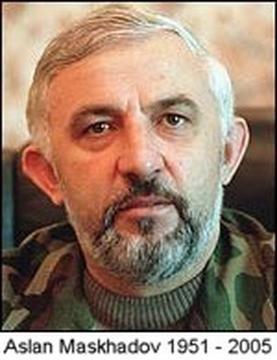 Aslan Maskhadov Killed //Nikolai Patrushev claims responsibility// Special Operation Aslan Maskhadov, the president of Ichkeria, was killed yesterday in Chechnya. It was learned that he was in hiding in Tolstoy-Yurt (Grozny Rural District), one of the most peaceful villages in the republic. The Regional Antiterrorist Headquarters explained the death of the Ichkerian leader, who had recently come out with peace initiatives, as the result of an attempt by his followers to seize the district center. After Maskhadov's death, the next leader of the Chechen fighters will probably be Shamil Basaev or Doku Umarov, who are well known for their implacability towards Russia. Grounds for Murder "A large detachment of federal forces arrived in the village at dawn in armored vehicles and blocked several streets leading to the center," Kommersant was told at the Tolstoy-Yurt administration. Local residents who happened to be outside at the time were ordered to return home immediately and not leave before receiving special instructions. They even deployed administration employees and local police officers. Frightened residents began phoning to Grozny; this was the first time in recent years that such a thing had happened in Tolstoy-Yurt, which is considered the most peaceful village in Chechnya. "Neither the government nor the republic's Interior Ministry told us anything, citing military orders," the residents said. At midday, Ilya Shabalkin, an official spokesman for the Regional Antiterrorist Headquarters, announced that soldiers and FSB forces had stopped a sortie of fighters who were planning to attack participants at a gathering in honor of March 8 being held yesterday in the local administration building. "We prevented this attack by barricading the fighters in their hideout two hours before the ceremonies," Shabalkin told Kommersant. "We arrested 12 members of illegal units; the operation was bloodless, and many of the fighters were half asleep." However, towards evening, it was learned that reports of the averted seizure of the district center by Chechen fighters were only to prepare public opinion for the most important event in the republic since the start of the second Chechen campaign – the murder of President of Ichkeria Aslan Maskhadov. "They couldn't kill Maskhadov just like that, after he announced a moratorium in February on military operations and observed it," a source in Chechnya's Interior Ministry told Kommersant. "That's why they reported that his followers were planning to disrupt the holiday. In actual fact, no one was planning to attack Tolstoy-Yurt. The fighters would have been stupid to do that, given that Maskhadov had been living there for the last while." His choice of Tolstoy-Yurt as a refuge was no accident; the birthplace of Ruslan Khasbulatov has always been considered a center of the anti-Dudaev and then the anti-Maskhadov opposition, so no one would think to look for Maskhadov there. But at the same time, after the start of the second Chechen war, many of Maskhadov's compatriots and relatives moved to Tolstoy-Yurt from Nozhai-Yurt District, where active military operations have been carried out in recent years. As Kommersant has already reported, two weeks ago, a large detachment of fighters, as many as 80 people, including Maskhadov and Akhmed Avdorkhanov, the chief of his bodyguard, were blockaded in the mountains on the border of Nozhai-Yurt District and Dagestan. However, the fighters split up into small groups, and taking advantage of the bad weather that prevented the use of aircraft, they broke through the surrounding forces. Death in the Basement As Kommersant has learned, the regional FSB and Interior Ministry found out from fighters captured during recent operations in Chechnya's Achkhoi-Martanov and Sunzhensk districts that Maskhadov was hiding in Tolstoy-Yurt. They were also members of the group of fighters who had been surrounded in the mountains but managed to break through. During interrogations, the prisoners said that Maskhadov and three of his bodyguards – Iliskhanov and the related Murdashevs – had also escaped encirclement and had hidden themselves in the house of a certain Yusupov, a distant relative of the Ichkerian president. Yesterday morning, after the entire district center had been blockaded by troops, special FSB and Interior Ministry forces advanced on the small one-story house at 1 Suvorov Street. "The special forces broke down the door and burst in," one of the participants in the operation recounted. "The owner of the house didn't offer any resistance, and they tied him up and took him outside. When asked where Maskhadov and his people were, he answered in the basement'. They couldn't return fire from the basement; you could easily throw grenades at them through the hatch. At first they tried to talk Maskhadov into giving himself up, but he refused to talk to us. Vakhid Murdashev [the former head of human resources in Maskhadov's administration] joined the negotiations for him." The negotiations lasted nearly an hour. However, the negotiators said there was no rapport among the people in the basement. "There was the impression that they first tried to agree among themselves," operation participants said. "Realizing the hopelessness of their situation, Maskhadov's bodyguards tried to persuade him to leave the basement. Especially since our side had guaranteed them their lives and a fair trial. We didn't hear Maskhadov's answer to that. All we heard was a heated exchange between him and his bodyguards. At the same time, Murdashev told us that the president of Ichkeria was refusing to give himself up." In the end, only Maskhadov's three guards came out and voluntarily laid down their weapons. Ramzan Kadyrov, the first deputy prime minister of Chechnya, said yesterday that before giving himself up, one of the bodyguards shot Maskhadov "as a result of careless handling of his weapon." In his turn, Ruslan Alkhanov, the head of Chechya's Interior Ministry, told Kommersant that the special forces threw grenades into the basement where the Ichkerian leader was found after the breakdown of negotiations. "It's symbolic that our president, Akhmat-hadji Kadyrov, died heroically on a men's holiday – Victory Day [May 9] – Alkhanov noted. "And this so-called president of Ichkeria died in a damp cellar on International Women's Day. What more can you say?" Residents of Tolstoy-Yurt, who heard several muffled explosions, confirm the version of death from a grenade. According to them, there was no shooting in the village. Admittedly, the condition of Maskhadov's body casts doubt on this assumption. When he was shown on Russian television yesterday, there were no signs of any wounds suggesting a grenade blast on the body. It was unclear yesterday whether Maskhadov's body will be turned over to relatives for burial. Ramzan Kadyrov said that he had no quarrel with the dead, and therefore was ready to hand over his body to relatives if they can be found. At the Regional Antiterrorist Headquarters, they said that since Maskhadov was accused of terrorism, according to the law on terrorism, his body would be buried in an unmarked grave on the grounds of some prison colony. In any case, this would not happen soon. Experts would first have to examine Maskhadov's body. They not only had to establish the cause of death, but also make an official identification, including fingerprinting, and if required, a genetic examination. Yesterday, Maskhadov was identified only by fighters from his circle and some of Kadyrov's followers who had once fought under his leadership. Russian President Vladimir Putin, to whom FSB director Nikolai Patrushev gave a report of the successful special operation, explicitly pointed to the necessity of double checking the information on Maskhadov's death. "Conduct an additional examination and identification, and report again," the president ordered Patrushev, noting that participants in the operation should be recommended for state awards. Umarov the Terrorist Will Replace Maskhadov the Negotiator It is still unknown who will replace Maskahdov as official leader of the separatists. We recall that after the start of military operations, the State Defense Committee headed by President Maskhadov became the main governing structure in Ichkeria. Under to the constitution of Ichkeria, in the event of his death, Vice-President Vakha Arsanov could have replaced him as committee chairman, but he was demoted in December 2001, and according to some reports, is now under arrest. The committee members must now elect their new leader. The only remaining rebel leaders active in Chechnya are Shamil Basaev and Doku Umarov. Basaev does not hold any official positions in the so-called government of Ichkeria; therefore, the committee leaders may turn to Umarov, who is minister of state security in the Ichkerian government. We note that, unlike Maskhadov, who had declared his pursuit of peaceful negotiations with Moscow, both field commanders are well known for their implacability and aggressiveness towards Russia. Therefore, in the event one of them comes to power, terror will only intensify. However, it cannot be ruled out that for the sake of preserving the possibility of political cooperation with the West, Akhmed Zakaev, now living in London, will be nominated for the position of leader of Ichkeria. Commenting on Maskhadov's death, Zakaev did not specify who would replace him; however, he did say that his successor must live in Chechnya. At the same time, Zakaev reminded everyone that the death of the first president of Ichkeria, Dzhokhar Dudaev, had no effect on the course of military operations. How They've Tried to Kill Aslan Maskhadov At the beginning of 1995, a nine-ton aircraft bomb landed on the roof of the presidential palace in Grozny, punched through it and hit Maskhadov's bunker, but did not explode. Maskhadov was only a few meters from the site but was unharmed. On April 9, 1996, Maskhadov was slightly injured as a result of a murder attempt in Kurchaloi District of Chechnya. A bomb placed under a platform where Maskhadov was supposed to give a speech exploded prematurely. On July 23, 1998, a pinpoint explosion of a bomb destroyed a jeep and a car escorting the president of Ichkeria. One bodyguard was killed, and six other people suffered burns and injuries. The president himself miraculously escaped injury after being thrown from the car along with a door. On March 21, 1999, a bomb exploded in the path of Maskhadov's motorcade. The president of Chechnya was saved by the armor of his jeep. On February 29, 2000, Gennady Troshev, the first deputy commander of the United Forces in the Northern Caucasus, said it was possible that Chechen war leaders Aslan Maskhadov, Khattab, and Shamil Basaev had been killed as a result of a special operation in the village of Shatoi. This information was later disproved. On May 22, 2000, some Russian media, with references to Main Intelligence Administration (GRU) special forces, reported that Maskhadov and his entire detachment had died in the mountains under a hail of Russian artillery. Official sources did not comment on this information. On June 6, 2000, Troshev announced that Maskhadov had been wounded on June 1 during a battle in southern Chechnya and that he had been seen with a bandaged head and chest. Georgy Shpak, the commander of the airborne troops, made a similar announcement in August 2000. On December 2000, the office of Sergey Yastrzhembsky, the Russian president's aide, distributed information that Maskhadov had been wounded on November 7 in the village of Alleroi. Maskhadov's driver and two of his bodyguards had been killed during a special operation, but the separatist leader managed to escape. On September 4, 2002, some media, with references to the special services, reported that "Aslan Maskhadov is more likely dead than alive". They cited statements of fighters captured in Kerigo gorge on July 27 as proof. At a briefing in Moscow on September 5, Viacheslav Tikhomirov, the commander-in-chief of the Interior Ministry's internal forces, did not rule out Maskhadov's death, but urged everyone not to jump to conclusions. In an interview with Novaya Gazeta on September 8, Maskhadov refuted information of his death. ---------------------------------------------------------------------- How Chechen Leaders Have Died Dzhokhar Dudaev, the first president of Ichkeria, was killed on the night of April 22, 1996, near the village of Gekhi-Chu 30 km from Grozny. FSB troops managed to pinpoint the location of a satellite telephone conversation between Dudaev and deputy Konstantin Borov. They sent up a fighter plane that launched a missile at Dudaev. The general died of his wounds. Participants in the operation were nominated for awards. On February 13, 2004, former president of Ichkeria Zelimkhan Yandarbiev was killed and his 12-year-old son Daud was wounded as a result of a car bomb explosion in Doha, the capital of Qatar. On the night of February 19, three Russian citizens were arrested on suspicion of involvement in the murder. One of them was the first secretary of the Russian Embassy in Qatar, Aleksandr Fetisov, who was later released. On June 30, a Doha court sentenced the other two – Anatoly Yablochkov and Vasily Pugachev – to life imprisonment. In accordance with a bilateral treaty, the prisoners returned to Russia in December to serve out their sentences. On May 9, 2004, a landmine exploded under the VIP stand of Grozny's Dinamo Stadium during a parade. Chechen President Akhmat Kadyrov, chairman of the republic's state committee Khusein Isaev, and five other people were killed and 80 people were wounded. Field commander Shamil Basaev was believed to have ordered the terrorist attack. Ten people suspected of organizing the crime were arrested in June 2004, but all of them were released within a month. Field commander Suleiman Ilmurzaev (Khairulla), the organizer of the terrorist attack, was killed on November 8, 2004, during a special operation in the village of Shamil-Yurt. Aslan Alievich Maskhadov Born on September 21, 1951 in the village of Shakai in Karaganda Region of the Kazakh SSR. In 1957, Maskhadov and his family returned to their native village of Zebir-Yurt in the Chechen-Ingush ASSR. In 1972, he graduated from the Tbilisi Higher Artillery School. He served in Ussuriisk (Far Eastern military district), and rose from the rank of platoon commander to chief of staff of the artillery division. In 1981, he graduated from Kalinin Artillery Academy in Leningrad and was assigned to the Southern Group of forces (Hungary), first as a division commander and then as commander of the 198th mobile artillery regiment. In 1986, he was transferred to the 107th motorized infantry division (Vilnius) of the Baltic military district as commander of the 379th mobile artillery division. In 1990, the division won first place in combat training in the district, and Maskhadov became head of an artillery division, secretary of the Party committee, and chairman of the officer's assembly. In 1992, he retired from the armed forces with the rank of colonel and was appointed head of civil defense in Chechnya. He then held the position of deputy chief of the Main Staff of the Armed Forces of the Chechen Republic. In 1993-1994, he took part in military operations against the anti-Dudaev opposition and became chief of the Main Staff. During the first Chechen war of 1994-1996, he planned and directed most military and diversionary operations of the Chechen separatists. In March 1995, the prosecutor's office instituted a criminal case against Maskhadov under three articles of the Criminal Code of the Russian Federation and put out a search warrant for him. In 1995 and 1996, he took part in peace negotiations with Russian authorities, and in August 1996 signed the Khasavyurt treaties with Aleksandr Lebedev. On October 17, 1996, he became prime minister of Chechnya's coalition government. On November 23, 1996, he signed an agreement on the principles of mutual relations between the federal center and the Chechen Republic with Russian prime minister Viktor Chernomyrdin. He was elected president of Chechnya on January 27, 1997, winning 59.3 percent of the vote. In February 1997, he simultaneously held the position of prime minister. In the spring of 1999, he introduced Sharia rule in Chechnya. In August 1999, he at first condemned the attacks on Dagestan by Shamil Basaev and Khattab, but later headed the armed resistance to the Russian authorities. In March 2000, he was put under federal investigation, and then international investigation in 2002. He was decorated with the order For Service to the Homeland in the Armed Forces of the USSR of the second and third degrees and Ichkeria's highest order Honor of the Nation. Author of the autobiographical book Honor Is Worth More Than Life. His widow Kusama is a teacher. He has a son Anzor and a daughter Fatima. by Musa Muradov, Sergey Mashkin Russian Article as of Mar. 09, 2005 Chechenpress Appeal from the family of Aslan Maskhadov to the leaders of the countries of the world community Gentlemen! The widow and the close relatives of the tragically killed President of the Chechen Republic of Ichkeria, Maskhadov, appeal to you. Our appeal is connected with the fact that the leadership of the Russian Federation, calling the President of the ChRI a "terrorist", are attempting to evade their responsibility for his murder. We wish to recall in connection with this that the observers from your countries confirmed that Aslan Maskhadov became the legitimate President of Chechnya by indisputably winning the free elections in the Chechen Republic of Ichkeria on 27 January, 1997. We have no doubt that you, the leaders of the democratic, civilized community, condemn the barbarous act of the murder of the legitimate President Maskhadov. Gentlemen! In connection with the tragedy, there is a monstrous situation, in which the Russian leadership, trampling on general human standards, behaves in a totally savage manner towards the body of President Maskhadov, killed by them. Under the pretext that the killed legitimate President Maskhadov allegedly was a "terrorist", the Russian leadership doesn't release the body for burial, thus adding additional pain to the pain of our loss. This is blasphemous and totally inexplicable under the conditions of today's civilized world! We urgently request of you to use your entire authority and possibilities in order to require from the Russian leadership the release of the body of Chechen President Aslan Maskhadov to his family and relatives. We assume that Russian President Putin will find it necessary to listen to your opinion and to the voice of reason. Thank you in advance - Kusama Maskhadova - widow of the President of the ChRI, A. Maskhadov Anzor Maskhadov - son of the President of the ChRI, A. Maskhadov Fatima Maskhadova - daughter of the President of the ChRI, A. Maskhadov 9 March 2005. Chechenpress, 10.03.05g. http://chechenpress.co.uk/news/2005/03/10/07.shtml [Translation by N.S.] Russians split on killing of Chechen By C.J. Chivers The New York Times Thursday, March 10, 2005 MOSCOW The killing of Aslan Maskhadov, the Chechen rebel leader and president of the republic's underground separatist government, touched off a polarized debate in Russia on Wednesday as to whether the death marked a step forward or back. On the surface, the killing marked a rare public success in Russia's Chechnya policy, in which capturing or killing prominent rebel leaders and terrorists has been a highly publicized goal. Politicians loyal to the Kremlin hailed the killing as a demoralizing loss to the separatists that would give Russia's security forces fresh momentum in the war. "The elimination of a terrorist of international standing only means that there will be much less evil now," said Boris Gryzlov, the speaker of the state Duma, Russia's lower house of Parliament, in remarks broadcast on national television. Human rights organizations, however, said Maskhadov's death meant the loss of both a willing negotiator and a moderating influence over the separatists, many of whom have turned to terrorism in recent years. Greater violence, they said, might now be in store. "Maskhadov wanted peace, and he wanted to do something about it," said Valentina Melnikova, head of the Union of Committees of Soldiers' Mothers, an antiwar group that counsels Russian soldiers and veterans. "Now that he is dead, the door is open for the Islamic radical leaders and movements." The separatists themselves spoke in similar terms, saying negotiations were now out of the question and calling for a jihad to avenge Maskhadov's death. Announcing a three-day period of mourning, they ordered rebel units to continue planned attacks in the spring and summer. "The invaders and puppets claim to be celebrating victory," said one of several postings on Web sites that the rebels often use. "A new period in the history of the Russian-Chechen military confrontation has started." The divergent predictions of the effects of Maskhadov's death reflected the longstanding split between the Kremlin and critics of the Chechen war. Russia's government describes the second war in Chechnya, which began in 1999, as a necessary part of multinational efforts against terrorist groups, and often calls the Muslim separatists an offshoot of Al Qaeda's international jihad. Outside the Kremlin's circle of influence, the war has been broadly condemned for the corruption and brutality of Russian forces and the Chechen proxies they support. Maskhadov, 53, who in 1997 was legitimately elected president of the so-called Chechen Republic of Ichkeria, the name that separatists have given the tiny republic in the Caucasus, was one of two of the most prominent rebel leaders. The other, Shamil Basayev, heads an Islamic terrorist group and has claimed responsibility for the worst acts of terrorism in post- Soviet Russia, including the seizure in 2002 of a Moscow theater, the downing of two passenger jets and the seizure of a public school in Beslan last autumn. Basayev's group also deploys suicide bombers, including women, not only in the Caucasus but also in Moscow. In recent years, Basayev became the Kremlin's more visible and vicious foe. But it was Maskhadov who presented his Russian adversaries with a more clear political challenge. A former Red Army colonel, he sometimes spoke against terrorism and made frequent overtures to the Kremlin to negotiate a political settlement to the war. He also quarreled with Basayev and said he would prosecute him. Moreover, he maintained a network of supporters in the West, which gave him a mark of legitimacy that none of the other rebel commanders or terrorists could match. Last month, his government in exile convened a meeting in London with the Union of Committees of Soldiers' Mothers to discuss a possible peace settlement. The meeting attracted the attention of European diplomats, some of whom attended. Russia boycotted the talks, but news reports indicated that it watched the results closely, including sending two government officers to monitor the news conference. Such public credibility has eluded most of the Chechen leadership. Maskhadov was trapped by Russian commandos on Tuesday in a bunker beneath a house in a Chechen village. Officials said that he was killed by a grenade. Because there is no clear alternative to Maskhadov, his loss, critics of the war said, could lead to a dangerous reorganization of the Chechen fighters. "There are a lot of moderates in the separatist movement who have no leader," said Tatyana Lokshina, a program director at the Moscow Helsinki Foundation who frequently travels to Chechnya. "Now they have a choice: either to quit or to join with Basayev. And I think most will join Basayev." The American Committee for Peace in Chechnya, an organization based in Washington that seeks a peaceful resolution to the war, also condemned the killing as the result of "a self-defeating policy of killing moderates." The criticism seemed likely to have little effect here, where the Kremlin has endured years of international disapproval for its conduct in the war. Russian officials took an almost unanimously upbeat position. "Maskhadov's death will reduce foreign support for the terrorist movement, Maskhadov's death will trigger disintegration processes," said Gennady Gudkov, a member of the Duma Security Committee, in televised remarks. "I think it was a serious blow." The special operation did attract one measured bit of criticism from supporters, who said that it was unfortunate that Maskhadov, who was surrounded, was not captured alive, as his interrogation might have been fruitful. The authorities said that investigators had seized two laptop computers and Maskhadov's personal archives and that these were being examined. Overwhelming majority of Chechens regret Maskhadov’s death By Timur Aliyev CHECHNYA – Our Prague Watchdog correspondent visited Chechnya where he asked nearly fifty people of various ages and professions what do they think about the death of Aslan Maskhadov and the further development of the situation in Chechnya. The overwhelming majority expressed regret at his death; of them most regretted the death of a Chechen and a man; some regretted that it was the President of the Chechen Republic of Ichkeria who had died; and two of them said he deserved it. Most people think that the situation will now deteriorate in Chechnya. Half of them strongly believe this as it will now be radicals who will lead the Chechen resistance. Others believe the federal forces will increase repression against the civilian population because of alleged collaboration with the guerrillas. Only few people think nothing will change, and a mere two believe the situation would improve. Ruslan, 35, a former guerrilla: “The Russians already killed one Ichkerian President – Dzhokhar Dudayev. In 1995 Russia thought this would end the war to its advantage. But the idea that killing Dudayev would divide the guerrillas did not work. This time there is again no guarantee as the war is not led by Dudayev and Maskhadov, but by men carrying weapons.” Shamil Tangiyev, Memorial human rights center, Grozny: “The murder of Maskhadov also kills our expression of free will in 1997 [presidential elections]. Whether he was weak or not, it was for us to decide. But now I finally understand that Russia does not want the Chechens or anyone else to lead normal lives.” Usman Kasayev, 39, independent journalist: “I think Maskhadov was a courageous man whom the people respected. Even in such difficult times he was able to live in a village with just two bodyguards. Yet the current leadership of our republic does not move one step without a dozen of bodyguards.” Abubakar Eldarkhanov, 35, a computer store owner: “I know that something will change. Either for the worse or for the better, but it will change.” Luisa Asayeva, 33, Russian language and literature teacher: “I basically feel pity for Maskhadov, as a person. When his body was shown on television I thought, 'What must it be like for his family to see him like that?' Maskhadov did not deserve this.” Kazbek Mazayev, 23, college student: “As long as Maskhadov was alive, hope remained that the war in Chechnya would have a peaceful outcome. Now it is obvious that it will continue to the end. Who or what will survive it, I do not know.” Timur Aliyev is Prague Watchdog's North Caucasus correspondent and editor-in-chief of the Chechen Society newspaper. Women of Beslan Take to Streets on Women's Day Created: 08.03.2005 13:12 MSK (GMT +3), MosNews Hundreds of protesters took part in an anti-government rally in the central square of Vladikavkaz in Russia's southern republic of North Ossetia on Tuesday, Ekho Moskvy radio station reported. The demonstration started late, because the Committee of Mothers of Beslan were stopped by the authorities on their way to Vladikavkaz. They were checked repeatedly and arrived about 20 minutes late. There were about 1000 people in the Square of Liberty in Vladikavkaz. First several mothers from the Committee took the stand, then there were representatives of other local organizations that support the Committee of Mothers. Although the Committee repeated that the demonstration is NOT political, many of the speakers were speaking out openly against Dzasokov, the Republic's President. Official name of the demonstration is "Mothers against Terror". Taking part in the action were representatives of Women of Beslan, an organization set up in the wake of the militants' attack on a school in the North Ossetian town of Beslan where over 1,000 people, mostly children, were held hostage on September 1-3 of 2004. Over 330 people were killed during the siege. Protesters carried placards, addressed to North Ossetia's President: "Dzasokhov, where is your conscience?" and "Terrorism in power is worse than al-Qaeda". No incidents were reported during the action. |